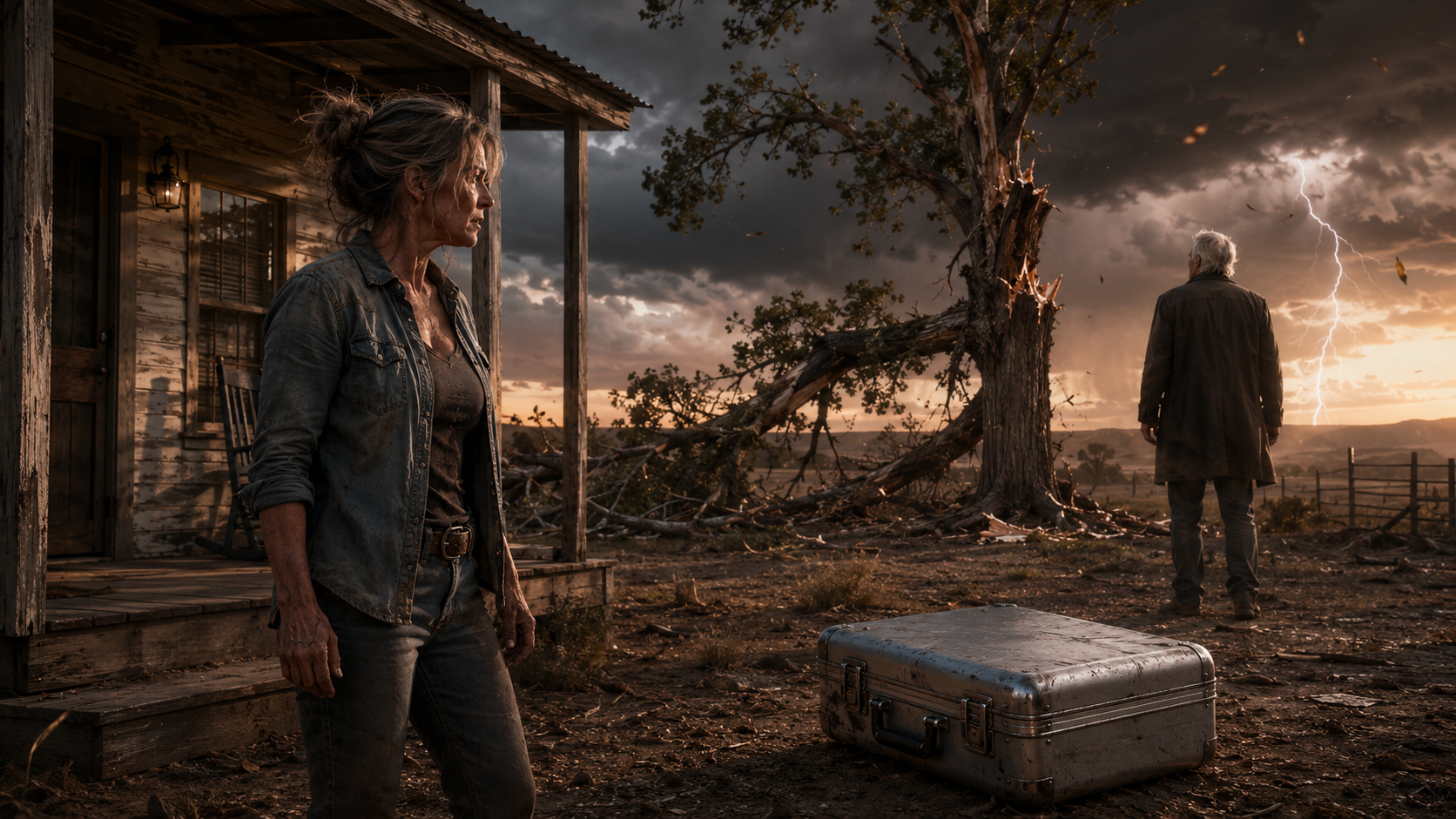
The Blackthorn Water Trust was activated with Leah as its scientific trustee. Families affected by the old creek diversion received shared control of the northern land and any future compensation obtained through the investigation.
Tomas Reed joined the trust’s board.
So did two other farmers who had once refused even to greet Mara in town.
Silas provided testimony and accepted that he might face charges for his role in the original concealment.
On the evening before his first formal interview with investigators, he visited the ranch.
Mara found him beside the fallen cottonwood.
“Are you frightened?” she asked.
“Yes.”
“Good.”
He gave her a tired smile.
“Daniel would have said the same thing.”
“Daniel said many things when he should have been listening.”
Silas nodded.
“He regretted that.”
“I know.”
“Do you forgive him?”
Mara looked at the ranch house, where Leah was preparing dinner with the windows open.
“I don’t think forgiveness is a gate you walk through once,” she said. “Some days it opens. Some days it doesn’t.”
Silas touched the split trunk.
“What will you do with the tree?”
“Leah wants to turn part of it into a table for the trust office.”
“And the rest?”
“Firewood.”
Silas laughed quietly.
“Daniel would hate that.”
“I know.”
That winter brought the heaviest rain the valley had seen in twelve years.
Water filled the creek but was redirected through a newly constructed safety channel while engineers studied the contaminated aquifer. The hills turned green. Wildflowers appeared beside roads where dust had ruled for years.
Leah remained at Blackthorn Ridge.
At first, she stayed in the guest room because neither woman knew how to discuss the possibility of anything permanent. Then she brought more clothes. Later, books appeared on the shelves and laboratory equipment filled the old storage building beside the barn.
One evening, Mara discovered Leah repainting her childhood bedroom.
“How long are you planning to stay?” Mara asked.
Leah continued rolling pale blue paint across the wall.
“Does that question have a correct answer?”
“No.”
“Then I don’t know.”
Mara nodded.
“There’s soup in the kitchen.”
“Is it the bean soup that could also repair fence posts?”
“It kept you alive for eighteen years.”
“Against all medical probability.”
Mara turned to leave.
“Mom?”
She looked back.
Leah set down the roller.
“I listened to the final part of Dad’s recording again.”
Mara waited.
“He said love without honesty becomes control.”
“Yes.”
“I think he wanted that message to be for both of us.”
Mara felt the old instinct to defend herself.
This time, she allowed it to pass.
“I think you’re right.”
Leah wiped paint from her fingers.
“I don’t want us to lose another six years.”
“Neither do I.”
They stood several feet apart.
Then Leah crossed the room and embraced her.
Mara held her daughter carefully at first, as if Leah might disappear.
When Leah did not pull away, Mara closed her eyes and held her tighter.
Outside, wind moved through the surviving half of the cottonwood.
By spring, new leaves appeared on its broken branches.
The tree would never regain its old shape. One side was scarred and open to the sky. People who saw it from the road assumed it was dying.
They were wrong.
Its roots remained deep.
The briefcase was eventually placed in the small Blackthorn Water Trust office. The maps and evidence had been removed, but Daniel’s recorder remained inside.
Mara kept the case unlocked.
Whenever visitors asked why, she gave them the same answer.
“Because secrets caused enough trouble here.”
Years later, people would tell different versions of the morning the truth was uncovered.
Some said lightning exposed the monitoring shaft.
Others credited Leah’s scientific work, Silas’s confession, or Daniel’s decision to preserve the evidence.
Mara believed all of them were partly right.
But she also knew the truth had not begun with the storm.
It had been waiting beneath their feet for more than twenty years—under the pasture, under the arguments, under every silence at the dinner table.
The storm had merely broken open the place where it was buried.
And sometimes, Mara thought as she watched Leah walk across the green field toward the trust office, broken things were not asking to be hidden or repaired.
Sometimes they were asking to become openings.
Places where light could finally enter.