When the recording ended, Leah stood and walked to the window.
Mara waited.
“He knew,” Leah said.
“Yes.”
“He knew I hated him.”
“Yes.”
“And he let me leave.”
“He thought he was protecting you.”
Leah turned sharply.
“Don’t defend him.”
“I’m not.”
“You always defended him.”
“I know.”
“You told me I was selfish. You said I cared more about strangers’ orchards than my own family.”
“I remember.”
“You said I had betrayed him.”
Mara looked down.
“I was wrong.”
Leah stared at her mother as if the words had been spoken in an unfamiliar language.
Mara forced herself to continue.
“I was angry because you questioned him, and I was afraid that if you were right, then my whole life with him would become something I didn’t understand.”
“So you chose not to understand.”
“Yes.”
The answer left no place for argument.
Leah faced the window again.
Outside, the first gray light touched the hills.
“What does the trust require?”
Mara opened the folder.
Leah read quickly. Her work as a hydrologist had taught her how to examine technical reports, property maps, and laboratory records. She moved from page to page, checking signatures and dates.
“These samples are old,” she said. “We’ll need fresh ones.”
“Can you take them?”
“If the monitoring shaft still exists.”
Mara unfolded the survey map.
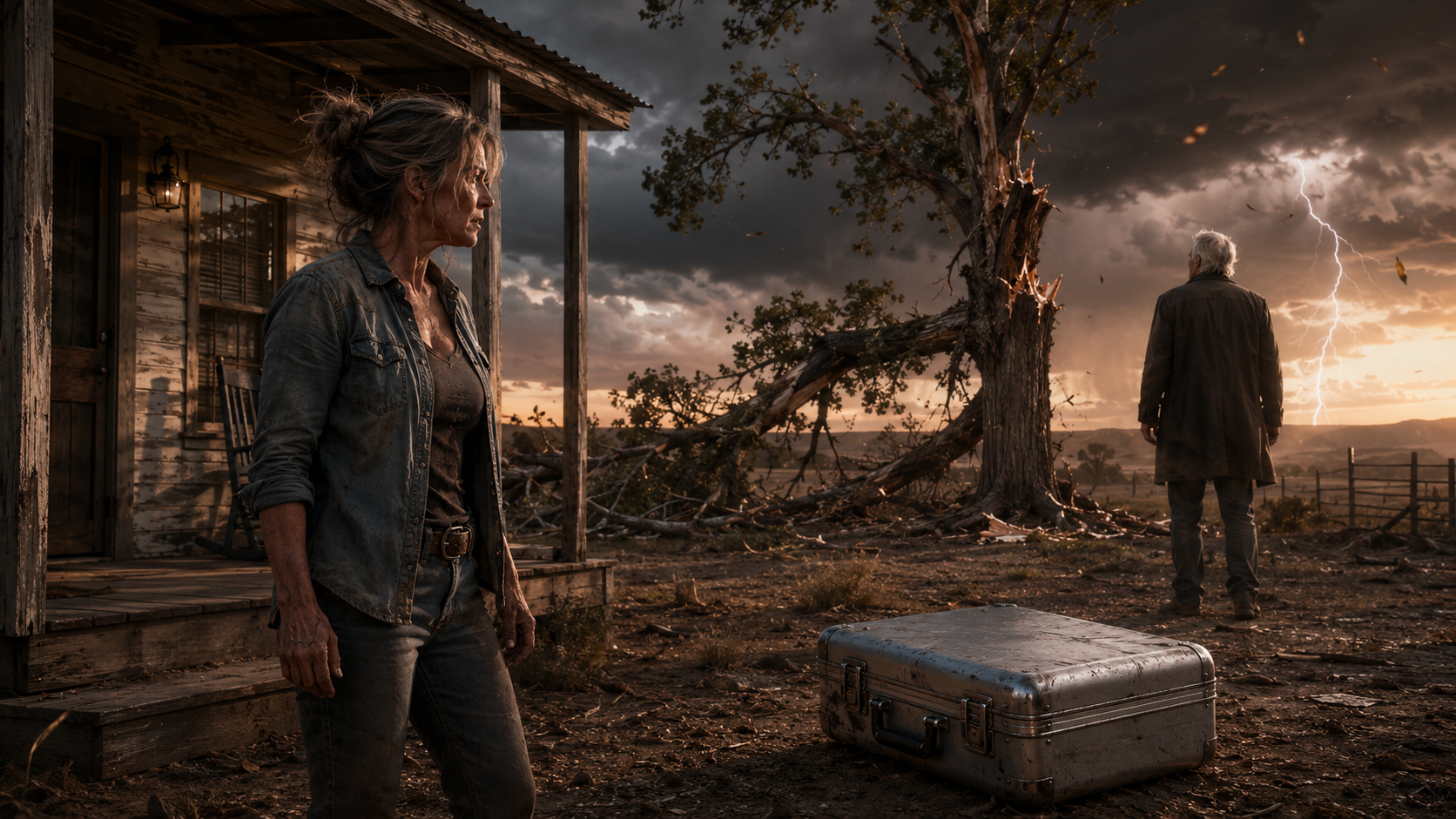
A red circle marked a location near the broken cottonwood.
Leah studied it.
“The shaft is beneath the root system.”
“Your father said the concrete cap may have cracked.”
“Then we need to find it before anyone contaminates the site or seals it again.”
Headlights swept across the kitchen wall.
A vehicle entered the yard.
Mara looked at the clock.
5:12 a.m.
A white SUV stopped beside Leah’s car.
Conrad Vale stepped out.
He was Vantage Earth Resources’ regional acquisition director. He always wore polished boots that had never done ranch work and shirts that remained clean no matter how much dust surrounded him.
A second man exited from the passenger side.
Leah looked at Mara.
“Were you expecting them?”
“Not until Thursday.”
Conrad knocked twice and entered without waiting.
“Mara, forgive the early visit. We heard about the storm damage and wanted to make sure you were—”
He saw the open briefcase.
His smile disappeared.
The second man closed the door behind them.
Conrad looked at Leah.
“You must be the daughter.”
“Leah Bell.”
“I’ve read some of your groundwater studies.”
“I’m surprised you admit that.”
Conrad glanced at the recorder and folder.
“Where did you get those materials?”
Mara stepped between him and the table.
“They belong to me.”
“They may contain proprietary Northstar records now legally owned by Vantage.”
“Then you recognize them.”
Conrad’s eyes narrowed.
“I recognize stolen documents.”
Leah picked up her phone.
“I’m contacting the state environmental office.”
The second man took one step toward her.
Mara reached behind the kitchen counter and placed Daniel’s old revolver on the table.
She did not point it.
She did not need to.
“Everyone stays where they are,” she said.
Conrad raised both hands.
“There’s no reason to behave dramatically.”
“You came into my house before sunrise with a man who hasn’t introduced himself.”
“My colleague is part of our legal security team.”
“Legal men usually carry briefcases,” Mara said. “Not shoulder holsters.”
The second man’s expression changed.
Leah moved closer to her mother.
Conrad sighed.
“Mara, that ranch is drowning in debt. We offered you a generous way out.”
“You offered to bury something beneath it.”
“You don’t understand the technical history.”
“My daughter does.”
Leah held up one of the maps.
“The original drilling path intersects a pressurized mineral formation. Your modern surveys show the same anomaly, but you classified the northern section as commercially irrelevant. You aren’t buying mineral rights. You’re buying liability.”
Conrad’s calmness began to fracture.
“Those are assumptions.”
“Then you won’t object to independent testing.”
“The site is unstable.”
“So you do know where it is.”
Conrad looked at Mara.
“Daniel made reckless allegations years ago. He damaged this valley, destroyed neighboring farms, and spent the rest of his life inventing excuses.”
Mara’s fingers rested beside the revolver.
“My husband made mistakes.”
“At least we agree on something.”
“But the greatest mistake he made was believing men like you could be defeated quietly.”
The sound of another engine approached.
This one belonged to the old dark pickup.
Silas Ward entered the yard, followed by two county vehicles and a television news van from Stanton.
Conrad moved to the window.
“What have you done?”
Mara looked at Leah.
Her daughter was smiling for the first time.