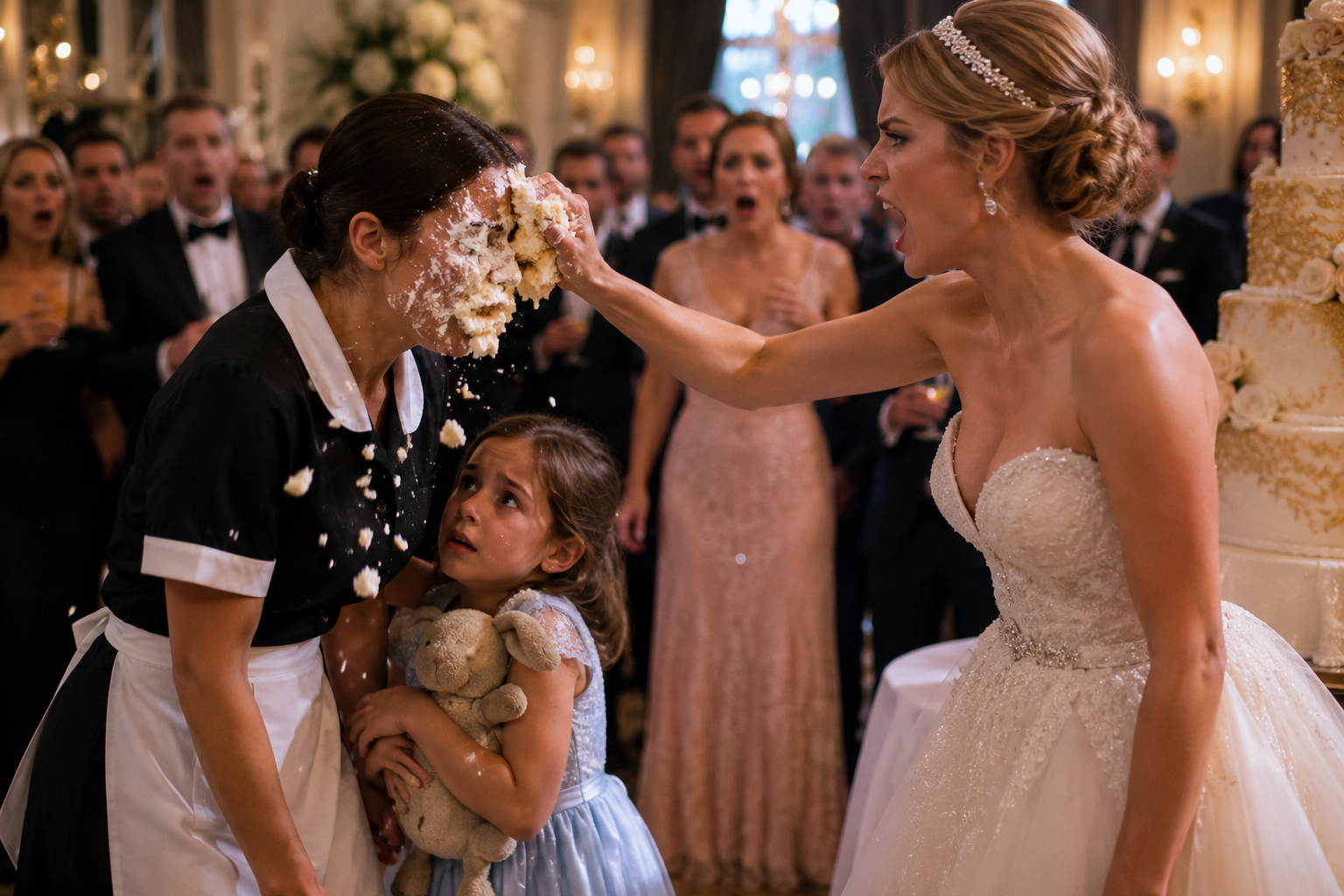
Elena Hart had spent the whole morning teaching herself how not to be seen.
At Ashbourne Manor, invisibility was a skill. It was folded into the towels, polished into the silver, hidden behind the tall vases of white lilies and the endless crystal glasses waiting beneath the ballroom lights. A good maid moved like a shadow. A good maid heard everything and repeated nothing. A good maid carried other people’s messes away before the important people noticed there had been a mess at all.
And on the day Julian Ashbourne married Vivienne Royce, Elena needed to be the best shadow in the house.
Her black uniform was freshly pressed, though the cuffs were beginning to fray. Her hair was pinned low at the back of her neck. Her shoes were clean but old, the soles softened by years of walking marble corridors before dawn. Beside her, half-hidden behind the service doorway, stood her five-year-old daughter, Rosie, wearing a pale blue dress Elena had bought secondhand and altered by hand the night before.
Rosie clutched a stuffed rabbit with one missing button eye.
His name was Sir Hopswell, and according to Rosie, he was “very brave, but allergic to mean people.”
“Is this where princesses get married?” Rosie whispered, staring through the narrow opening into the ballroom.
Elena almost smiled.
The room did look like something from a fairy tale. White roses climbed the columns. Gold light poured from the chandeliers. A string quartet played near the tall windows, and beyond the terrace the ocean flashed silver under the afternoon sun. Guests moved in silk, diamonds, tailored jackets, and careless laughter. Everything shimmered with money.
“Something like that,” Elena whispered back. “But remember, we stay near the kitchen. We don’t touch anything. We don’t bother anyone. And after the staff toast, we go straight home.”
Rosie nodded seriously. “I’m not bothering. Sir Hopswell is also not bothering.”
“I appreciate his cooperation.”
Elena had not planned to bring Rosie. She had begged the neighbor downstairs to watch her. Then the neighbor’s son woke with a fever, and Elena had been left with two choices: miss the most important workday of the year and risk losing her job, or bring her child quietly and pray nobody important cared enough to be cruel.
She should have known better.
Important people always had time to be cruel when the audience was large enough.
Julian Ashbourne had not minded children in the house. He had never minded much of anything that involved ordinary human inconvenience. He was not soft, exactly. A man did not build Ashbourne Medical Systems into a global empire by being soft. But he had a quiet decency that made the staff loyal to him in ways money alone could not buy.
He remembered birthdays. He knew which gardener had a bad knee. He had once found Rosie crying outside the kitchen because she had broken a glass ornament shaped like a star, and instead of scolding her, he had lifted her gently so she could touch the real crystal stars hanging from the winter tree.
“You see?” he had told her. “Some stars are only decorations. Some stars are meant to survive.”
After that, Rosie called him Mr. Star.
Elena called him Mr. Ashbourne in front of others and Julian only when the house was quiet and he found her late in the kitchen, both of them too tired to pretend titles mattered. She had worked for him for seven years. She had seen him after his mother died, standing in the library at two in the morning with his hands in his pockets, unable to touch a single one of her books. She had seen him forget meals, take calls in the rain, and give away money anonymously because public charity embarrassed him.
And she had seen him become engaged to Vivienne Royce.
Vivienne was beautiful in the kind of way that made people forgive her before she had done anything wrong. Her hair was the color of champagne. Her smile was practiced. Her voice was soft when men were listening and sharp when only women with paychecks were near enough to hear.
From the first week she arrived at Ashbourne Manor, Elena understood that Vivienne did not like her.
Not because Elena had done anything.
Because Elena knew where everything belonged.
Because Julian trusted her.
Because Rosie once ran into the entrance hall and Julian laughed.
Vivienne had seen that laugh.
After that, she stopped calling Elena by name unless there were witnesses.
“Girl,” she would say, though Elena was thirty-two.
“Help.”
“Clean this.”
“Don’t hover.”
“Elena,” Julian would correct her once, calmly.
Vivienne would smile. “Of course. Elena.”
But the smile never reached her eyes.
Now, on the wedding day, Elena hoped the size of the celebration would protect her. There were four hundred guests, photographers, caterers, musicians, florists, security officers, and three wedding planners speaking into headsets as if directing a military operation. One maid and one little girl should have been easy to ignore.