For almost an hour, they were.
Rosie sat on a wooden stool near the service corridor, swinging her feet and whispering observations to Sir Hopswell.
“That lady has a bird on her hat.”
“That man laughs like the coffee machine.”
“The cake is bigger than our fridge.”
Elena carried trays, cleared glasses, corrected a folded napkin at table fourteen, replaced a broken champagne flute before anyone stepped on the glass, and tried to keep Rosie within arm’s reach.
Then Vivienne saw them.
The bride stood beside the six-tier wedding cake, surrounded by bridesmaids in blush satin. Her gown was enormous, white lace falling around her like expensive snow. Diamonds glittered at her ears. Her mouth curved into a smile so polished it made Elena’s stomach tighten.
Vivienne crossed the ballroom slowly.
People noticed. Of course they noticed. Brides did not move unnoticed on their wedding day.
“Elena,” Vivienne said, loud enough for nearby guests to hear. “How sweet. You brought a guest.”
Elena’s fingers closed around Rosie’s shoulder.
“I apologize, Miss Royce,” she said quietly. “My sitter canceled this morning. Rosie has stayed in the service area. We won’t be in anyone’s way.”
Vivienne tilted her head.
“Oh, please. Don’t make it sound tragic.” Her smile widened. “This is a wedding. Everyone should feel included.”
A few guests turned toward them with soft, approving expressions. They thought they were watching generosity. A rich bride welcoming a poor child. A moment to repeat later over dessert.
Rosie looked up at Vivienne.
“You look like a princess,” she said.
Elena felt Vivienne’s hand tighten around her bouquet.
“Do I?” Vivienne asked.
Rosie nodded. “But Sir Hopswell says princesses should be nice.”
The bridesmaids laughed lightly.
Vivienne did not.
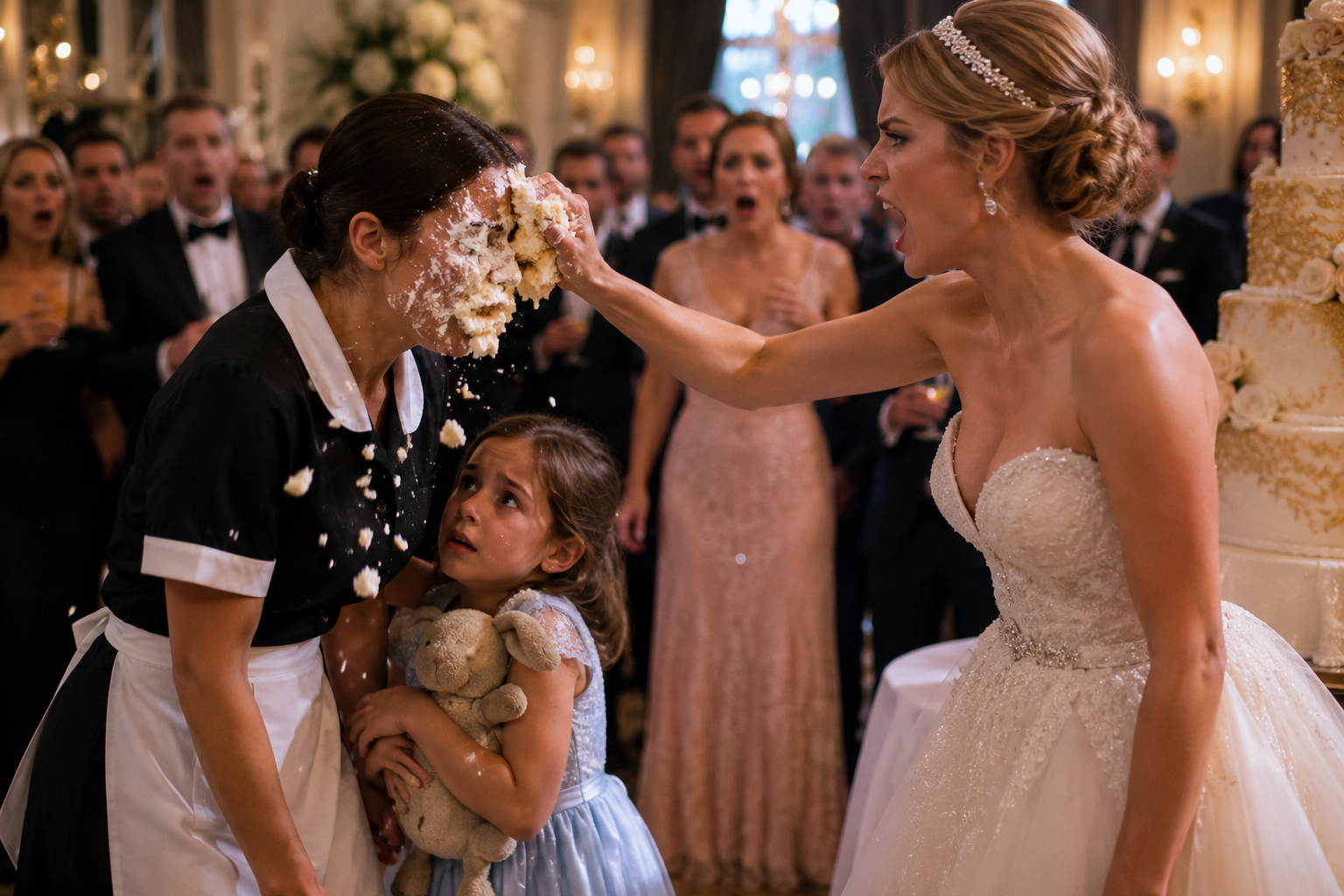
She looked at Elena, then at the crowd, then at the cake. On a silver plate near the table, a slice had already been cut for the ceremonial tasting. Thick vanilla sponge. White buttercream. A bright red ribbon of strawberry filling.
Vivienne lifted the slice.
Elena knew before it happened.
Some things announce themselves in the body before the world admits them. The angle of Vivienne’s wrist. The sweetness of her smile. The cruel brightness in her eyes.
“Then let me be nice,” Vivienne said. “Let me personally welcome you.”
“Elena,” Rosie whispered.
The cake hit Elena’s face with a wet, humiliating force.
For one second the entire ballroom stopped breathing.
Buttercream smeared across Elena’s cheek, nose, mouth, and hair. Strawberry filling slid down her uniform and dropped onto the polished marble. A broken piece of cake landed on Rosie’s blue shoe.
Nobody moved.
Then someone laughed.
It was a small sound at first, nervous and uncertain.
Then another person laughed.
Then the laughter spread.
Not everyone laughed. That mattered later. Elena remembered that not everyone laughed. Some guests looked away in shame. One older woman covered her mouth. A waiter near the wall went pale with anger.
But enough people laughed.
Enough to make the room feel colder than winter.
Vivienne leaned close, her perfume sharp and floral.
“There,” she murmured. “Now you’re part of the celebration.”
Elena did not cry.
She had learned years ago that tears could be dangerous when your rent depended on people pretending they had not hurt you. She reached blindly for a napkin. Her hand shook. She wiped frosting from her eyes first, not because she cared how she looked, but because she needed to see Rosie.
Rosie stood frozen, clutching Sir Hopswell so hard his little cloth neck bent sideways.
“Mama?” she whispered.
That broke something in Elena.
Not loudly. Not dramatically. Just a small crack inside, the kind that never quite closes.
Elena bent down, wiped the cake from Rosie’s shoe with the edge of the napkin, and took her daughter’s hand.
“We’re going home, sweetheart.”
Vivienne’s smile stayed in place for the crowd.
“Good idea,” she said softly. “This really isn’t your world.”
Elena looked at her then.
Not with rage.
Not with hatred.
Only with a tired sadness so deep that Vivienne, for the first time all day, looked away first.
Across the ballroom, Julian had not seen it.
He had been near the terrace doors, trapped between two investors, a senator, and an old family friend who kept clapping him on the back. He was smiling, nodding, accepting congratulations, trying not to count the minutes until the performance of the wedding became a private life.
When he finally turned, he saw Elena at the edge of the hallway.
Her face was mostly clean, but not fully. A streak of frosting remained near her ear. Her uniform was stained. Rosie was pressed against her leg, her little face frightened and pale.
Something in Julian’s chest tightened.
“Elena?”
She stopped.
He crossed the space quickly. “What happened?”
“Nothing, Mr. Ashbourne.”