“No.”
“And you?”
He looked up.
“Will you resent me for not being her?”
The fire cracked between them.
Finally he said, “No woman on earth could be Adelaide. I would not insult you by asking.”
Evelyn lowered her eyes.
That was the second kind thing he gave her.
A place not stolen from a dead woman.
On the third evening, Blackwell Range appeared beneath a vast red sky.
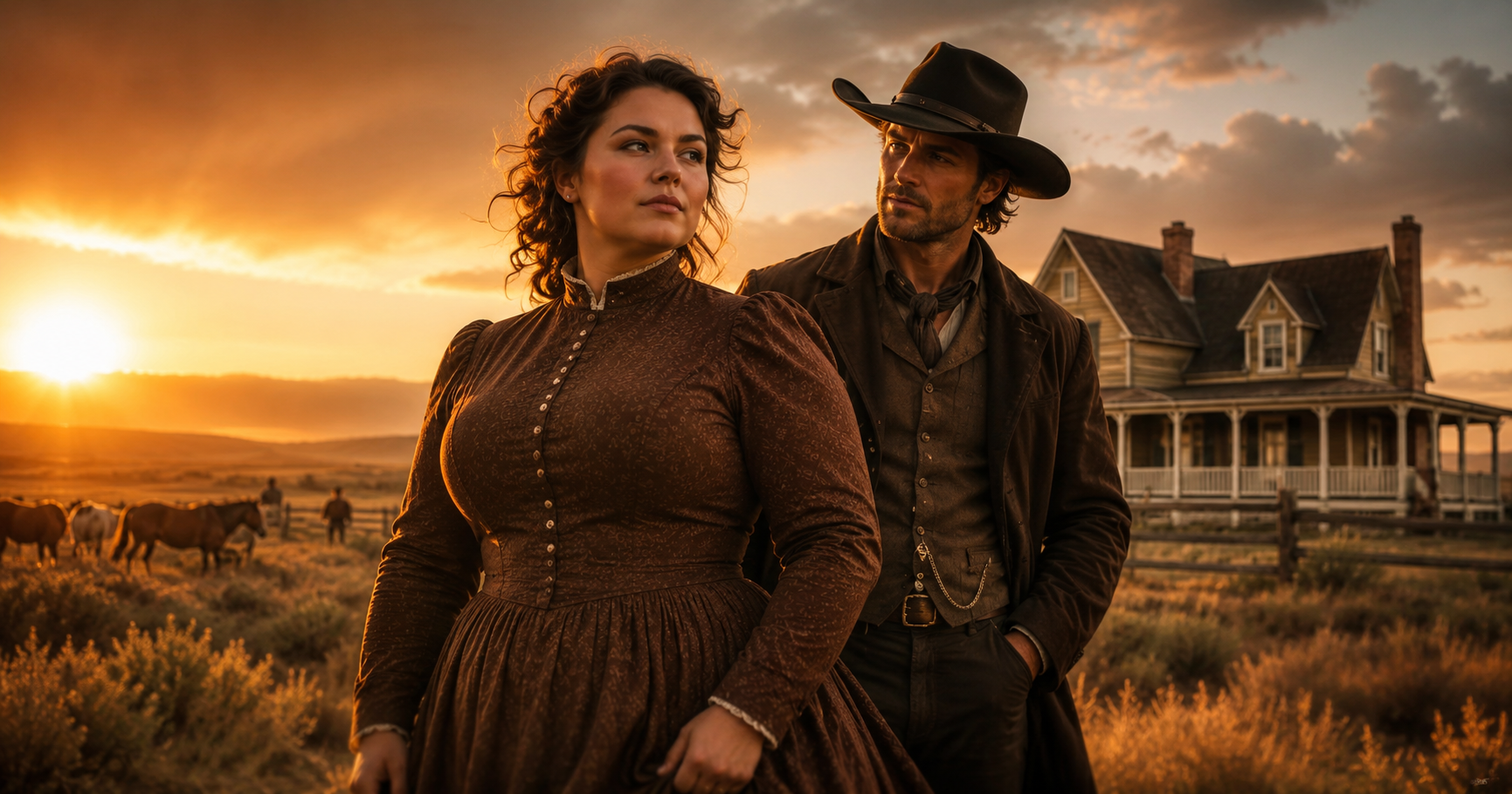
The house stood on a rise above the valley, square-shouldered and weathered, with a long porch, tall windows, barns beyond, and corrals full of restless horses. It was not elegant. It was alive. Smoke rose from the chimney. Dogs barked. Somewhere a gate slammed.
Before Rowan could help Evelyn down, the front door opened.
A thin girl with dark braids stepped onto the porch. Her chin was high, her eyes too old.
Behind her stood a small boy clutching a wooden horse.
“Tessa,” Rowan said. “Milo. This is Evelyn Hart.”
“March,” Evelyn corrected softly, then stopped.
No. Not anymore.
“This is Evelyn Blackwell,” Rowan said.
The girl’s face hardened. “She is not our mother.”
“No,” Evelyn said before Rowan could answer. “I am not.”
Tessa blinked, surprised by agreement.
Evelyn climbed down carefully, smoothing her skirt. “I have no wish to replace a woman I never knew. That would be foolish and rude. But I am hungry, tired, and very interested in knowing whether this house has a kitchen.”
Milo hid farther behind the door.
Tessa crossed her arms. “Of course it has a kitchen.”
“Then you are already better informed than I am. Will you show me?”
“I do not take orders from you.”
“That is fortunate,” Evelyn said. “I have not given one.”
Rowan’s mouth twitched.
Tessa stared at Evelyn, uncertain whether she had been challenged or respected.
At last the girl turned sharply. “This way.”
The kitchen told Evelyn more than any welcome could have.
Dishes stacked in the sink. Flour spilled near the pantry. A pot burned black at the bottom. Clean laundry folded on one chair, dirty laundry heaped under another. The room had not been ruined by laziness. It had been abandoned by joy.
Evelyn took off her gloves.
“Tessa, where is the flour kept?”
The girl hesitated. “Blue jar.”
“Salt?”
“Small tin by the stove.”
“Coffee?”
“Top shelf. Papa forgets and puts it with the beans.”
“I heard that,” Rowan said from the doorway.
“You were meant to,” Tessa replied.
Evelyn smiled before she could stop herself.
Milo watched from behind his wooden horse.
She crouched, slowly so as not to startle him. “Hello, Milo. I am told you are a man who keeps his words carefully. I respect careful men. I talk only when necessary myself, though your sister may doubt that after tonight.”
Milo did not answer.
But he did not run.
They ate fried potatoes, beans, and bread toasted hard over the stove. It was not a fine meal, but it was warm. Rowan looked at the table as though he had forgotten what it meant for four people to sit together under lamplight.
After supper, Evelyn washed dishes while Tessa dried them badly and with open resentment.
“You are doing that wrong,” Tessa said.
“Very likely.”
“Mama dried glasses first.”
“Then tomorrow you may teach me.”
The towel stilled in Tessa’s hands.
People who expected arguments were often disarmed by being believed.
That night, Evelyn stood alone in her new room. It had a narrow bed, a washstand, a hooked rug, and curtains faded by sun. Her trunk waited at the foot of the bed. On the dresser sat a small vase with one wildflower in it.
Rowan had not mentioned it.
That was the third kind thing he gave her.
Not a declaration. A quiet attempt.
The first weeks were brutal.
Evelyn rose before dawn and slept after midnight. She sorted the pantry, scrubbed floors, mended shirts, aired mattresses, cleaned ash from corners, organized invoices, and found unpaid bills tucked into a tobacco tin. She learned which hens bit, which pump handle stuck, which hired hand lied about feed, and which creditor had been charging Rowan twice for the same deliveries.
The ranch was rich in cattle and poor in attention.
Evelyn gave it attention.
She turned ledgers into columns, columns into truth, and truth into money saved. When she showed Rowan the first corrected account, he read it twice.
“You found all this?”
“I found what was there.”
“I have been cheated.”
“Yes.”
“For how long?”
“At least eight months.”
His face darkened.
Evelyn closed the ledger. “Anger is expensive if spent before planning.”
He looked at her.
“Then plan,” he said.
So she did.
By the end of the month, the dishonest supplier was gone, the pantry costs had dropped, and the ranch hands had learned that Mrs. Blackwell knew the difference between fair wages and padded invoices.
Respect came slowly.
Suspicion came faster.
The neighboring women arrived with pies and curiosity. They looked at Evelyn’s body, her dress, her ring, her face, and then at one another.