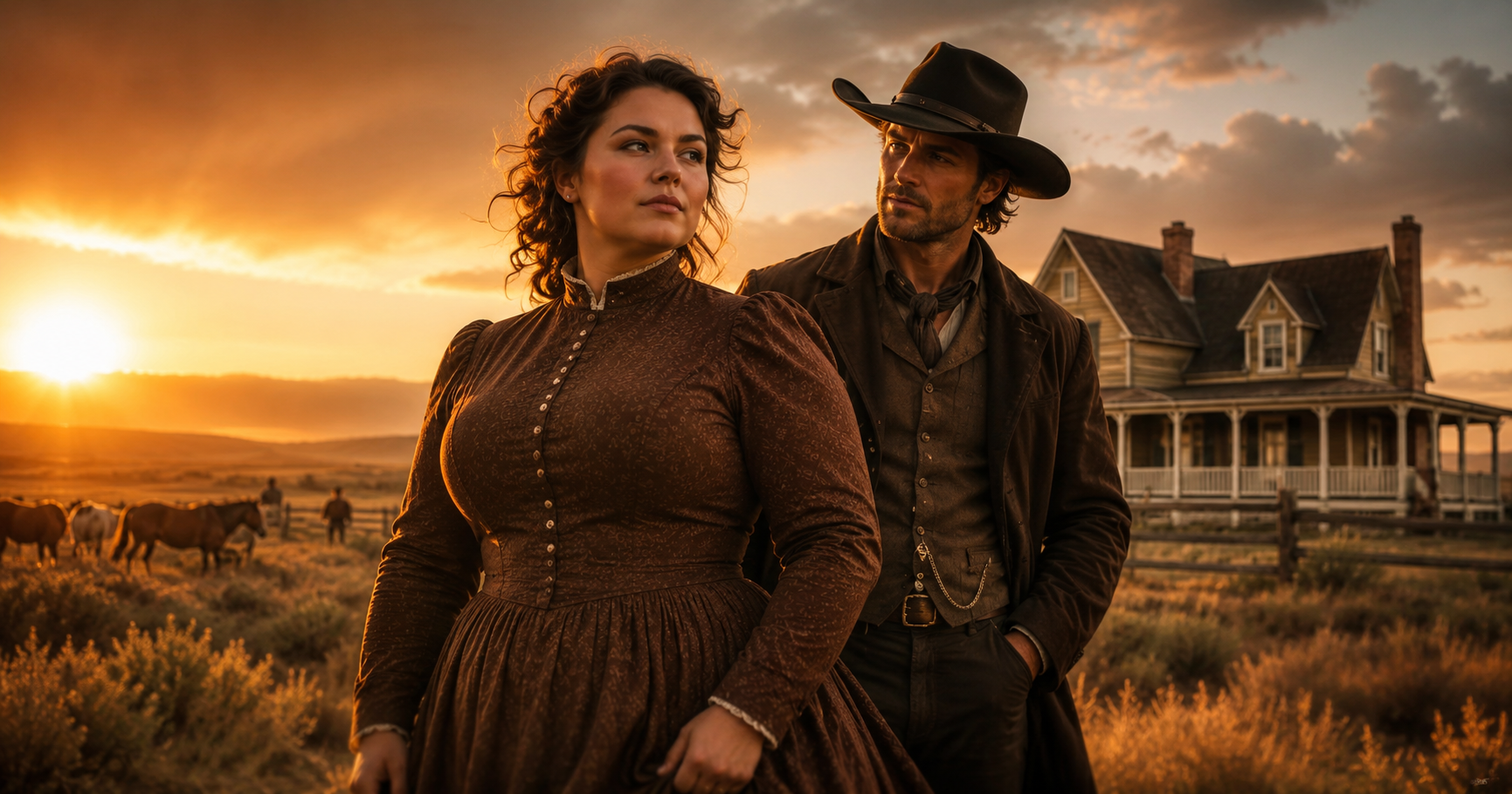
One of them, Mrs. Bellweather, smiled with sugar on her teeth. “It must be quite a change, dear, from town life to ranch life. So much movement. So many stairs.”
Evelyn placed the pie on the table. “Yes. Fortunately, I have legs.”
Tessa choked on a laugh.
Another woman said, “Mr. Blackwell has always been generous.”
“How lucky for him,” Evelyn replied, “that I have always been useful.”
After that, the visits became shorter.
Tessa began appearing in the kitchen without being asked. She corrected Evelyn’s recipes, then asked questions about books, then lingered after supper with a mending basket in her lap and grief she did not know how to put down.
“She smelled like lavender,” Tessa said one evening, so suddenly Evelyn nearly pricked her finger.
“Your mother?”
Tessa nodded.
“Would you like lavender in the linen chest?”
The girl’s face tightened. “Do not pretend you care.”
Evelyn set down the needle. “I am not pretending. But I am also not asking you to love me for it.”
Tessa looked at her with wet, furious eyes. “Everyone says I must be grateful.”
“That is a heavy thing to demand from a child.”
“I am not a child.”
“No,” Evelyn said gently. “You are a girl who had to stand up too soon.”
Tessa covered her face and cried without sound.
Evelyn did not touch her. Not at first. She simply sat nearby and threaded the needle again.
After a while, Tessa leaned against her shoulder.
Milo’s trust was quieter.
He followed Evelyn from room to room, carrying his wooden horse. She spoke to him as she worked, never demanding words. She told him why dough must rest, why socks should be darned before the holes widened, why angry dogs should not be stared down, why grief sometimes sat in the throat like a stone.
One morning, she found him in the barn beside a calf rejected by its mother.
The calf shivered in the straw.
Milo looked at Evelyn, eyes wide with fear.
“We will warm her,” Evelyn said.
Milo touched the calf’s wet nose.
“She is unwanted,” Evelyn said softly. “That does not mean she is worthless.”
Milo’s lips trembled.
Together they rubbed the calf with old towels. Evelyn fetched warm milk. Milo held the bottle with both hands. The calf drank greedily, bumping his fingers.
Milo smiled.
Not much. Just enough to change the world.
Three days later, while Evelyn kneaded bread, he climbed onto a stool beside her and whispered, “Her name is Button.”
Evelyn’s hands froze in the dough.
She did not turn too quickly. She did not cry out. She did not call the others.
She only said, “Button is a fine name.”
From the doorway, Rowan heard.
His face broke.
Not loudly. Not dramatically. His grief simply rose, filled his eyes, and made him look suddenly less like a cattle king and more like a father who had been praying in silence for months.
That night, he found Evelyn on the porch.
The stars were sharp above the black fields.
“He spoke,” Rowan said.
“Yes.”
“How did you know not to push?”
Evelyn wrapped her shawl tighter. “Because silence is sometimes the last room a wounded person owns.”
He stood beside her, not touching.
“I thought money could solve the worst of it,” he admitted. “A housekeeper. A tutor. New clothes. Better meals.”
“Money can mend many things.”
“But not that.”
“No.”
Wind moved across the grass.
Rowan said, “Your father was a fool.”
Evelyn laughed once, without humor. “Many people have been foolish about me.”
“I was not speaking of your appearance.”
“I know.”
“You deserved better.”
She looked out at the dark pasture. “Deserving and receiving are distant cousins.”
“Not always.”
She turned then.
Rowan was watching her with an expression she had not seen from a man before. Not hunger. Not pity. Not calculation.
Wonder, perhaps.
It frightened her more than cruelty.
“Do not look at me like that,” she said.
“How am I looking at you?”
“As if I am something rare.”
“You are.”
“No. I am practical. Stubborn. Too large for fashion and too plain for songs. I am good with accounts, children, bread, and emergencies. That is not rare. That is merely unnoticed.”
Rowan stepped closer, stopping before closeness became pressure. “Then the world has been criminally careless.”
Evelyn’s throat tightened.
The fourth kind thing he gave her was not a sentence.
It was patience.
Summer changed the ranch.
The garden returned first. Tessa showed Evelyn where Adelaide had planted tomatoes, beans, squash, and herbs. They worked side by side in soil warm from sun. Sometimes Tessa told stories. Sometimes she cried. Sometimes she laughed and then looked guilty for it.
“Laughing does not bury her deeper,” Evelyn told her.
Tessa wiped her nose on her sleeve. “It feels like betrayal.”
“It is proof she left warmth behind.”
Milo’s calf grew strong and ridiculous. Button followed him like a dog, and Milo began speaking in small pieces. One word became three. Three became sentences. Sentences became questions.