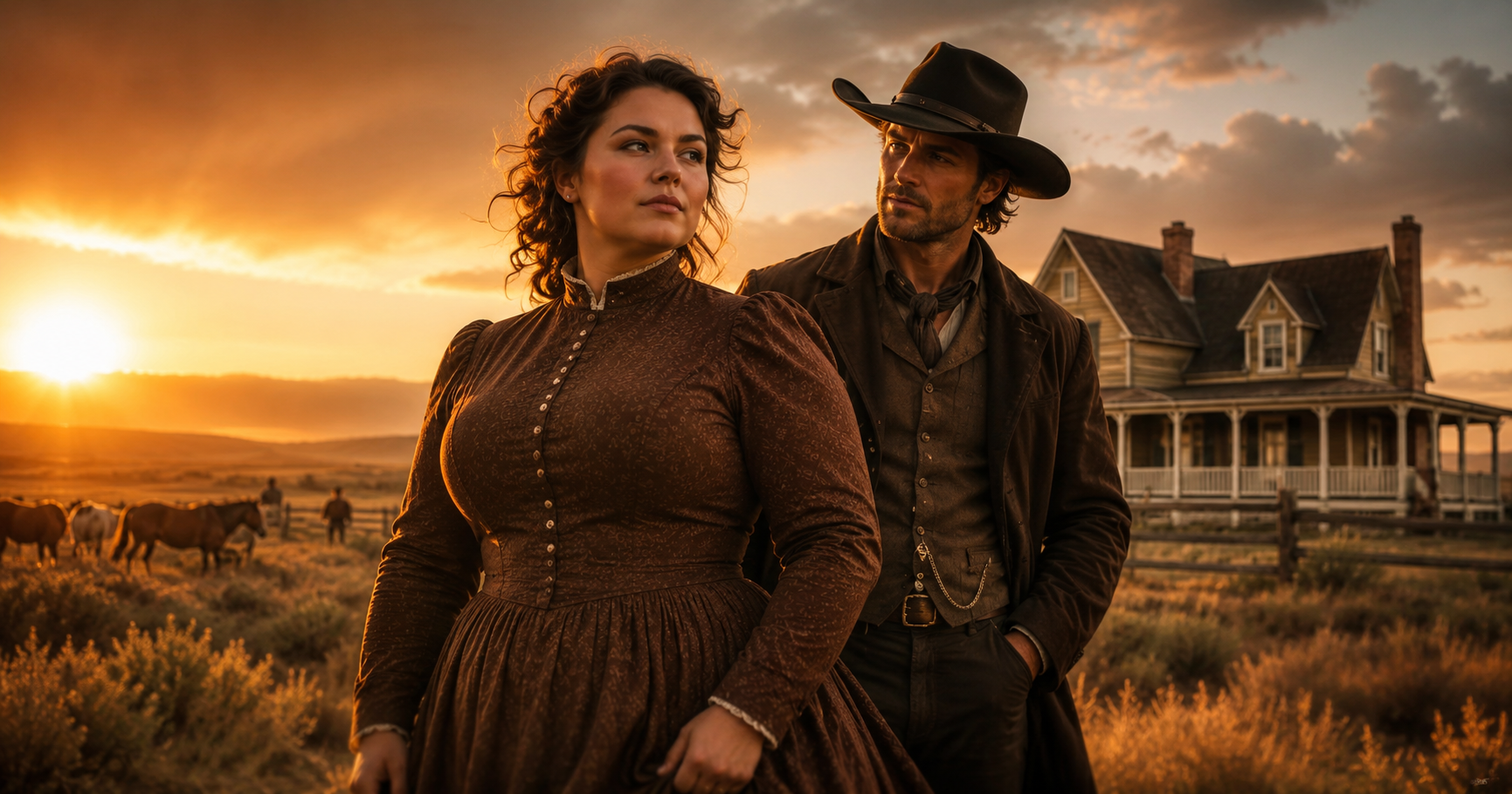
For years she had imagined grand speeches. She had imagined accusing him of every cruelty, every dinner where he watched her plate, every party where he introduced Marian as his daughter and Evelyn as “the older girl,” every time he said no man would want her unless hunger, debt, or desperation made him blind.
But freedom did not need a speech.
“No,” she said softly. “I will not.”
Outside, the morning was bright enough to hurt.
Rowan helped her into the carriage, then placed her trunk beside the driver’s bench himself. He did not touch her waist. He did not crowd her. He offered a hand and waited for her to decide whether to take it.
She did.
They rode in silence until the town road became open country.
At last Evelyn said, “How far is your ranch?”
“Three days if the weather holds.”
“You have children?”
“Two. A girl of ten and a boy of seven.”
“And they need a mother?”
His jaw tightened. “They need a house that does not feel like a grave.”
Evelyn turned to him. “That is not the same thing.”
“No,” Rowan said. “It is not.”
She studied his profile. He was not handsome in the polished way of city men. His face had been built by weather, loss, and command. There were lines at the corners of his eyes, a scar near his chin, and a stillness that warned the world not to come too close.
“What do you expect of me?” she asked.
“Honesty. Order. Help with the children if they allow it. Accounts if you are willing. The ranch books have been neglected since my wife died.”
“And as your wife?”
The question tasted of humiliation, but she made herself ask it.
Rowan looked at the reins. “Nothing you do not choose.”
She stared at him.
He continued, “This arrangement gives you a legal place in my household and gives my children a woman under the roof who is not passing through for wages. But your door is yours. Your body is yours. Your future is not something I purchased from Gideon March.”
Evelyn turned toward the window so he would not see her eyes fill.
“Men say many things on the road,” she whispered.
“I know.”
“And change them once the door is locked.”
“I know that too.”
“Then why should I believe you?”
Rowan guided the horses around a rut. “You should not believe me yet. Watch me.”
So she did.
That first night they stopped at a way station with peeling white paint and a stable that smelled of hay and rain. Rowan asked for two rooms. The keeper raised an eyebrow. Rowan stared until the man lowered it.
At supper, Evelyn noticed things.
Rowan thanked the girl who brought coffee. He paid the stable boy extra for rubbing down the horses. He did not drink whiskey though it was offered. When a drunk at the next table muttered something ugly about “fat brides and rich fools,” Rowan set down his fork and looked at him once.
The drunk found urgent business outside.
Evelyn slept badly in a clean bed, afraid that comfort was a trick.
On the second day, the road grew meaner. The carriage wheels jolted over stones. Wind worried dust into her hair. At noon, Rowan stopped near a creek and unpacked bread, cheese, apples, and cold ham.
Evelyn waited for him to comment on how much she ate.
He did not.
Instead he said, “There is more if you want it.”
She looked at him sharply.
He did not seem to understand what he had done.
That made it worse.
For years, meals had been battles. Her father counted biscuits. Her aunt sighed over butter. At parties, women watched her plate with soft smiles and sharp eyes. Evelyn had learned to eat before entering rooms, to refuse sweets she wanted, to hide hunger like a crime.
Rowan broke an apple with his knife and handed her half.
“You work hard?” he asked.
“I kept my father’s household.”
“That is not an answer.”
“It is the only one most people require.”
“I am not most people.”
“No,” Evelyn said. “Most people ask less and assume more.”
Something like amusement moved through his face. “And you?”
“I assume nothing. It saves disappointment.”
“That sounds lonely.”
“It is safer than hope.”
Rowan did not argue. She liked him better for that.
They camped the second night beneath cottonwoods, the sky bruised purple above the plains. Rowan built a fire, rolled his blanket on the far side of it, and gave Evelyn the covered wagon for privacy. Over beans and coffee, he told her about Blackwell Range.
There were cattle spread across three valleys, horses in the east pasture, two wells, one schoolhouse twelve miles away, and a house built too large for the silence that had entered it. His daughter, Tessa, read everything she could get her hands on and trusted almost no one. His son, Milo, had not spoken above a whisper since his mother’s burial.
“What was her name?” Evelyn asked.
“Adelaide.”
The name left his mouth carefully.
“She was loved,” Evelyn said.
Rowan stared into the fire. “Yes.”
“Then your children will not thank me for standing where she stood.”