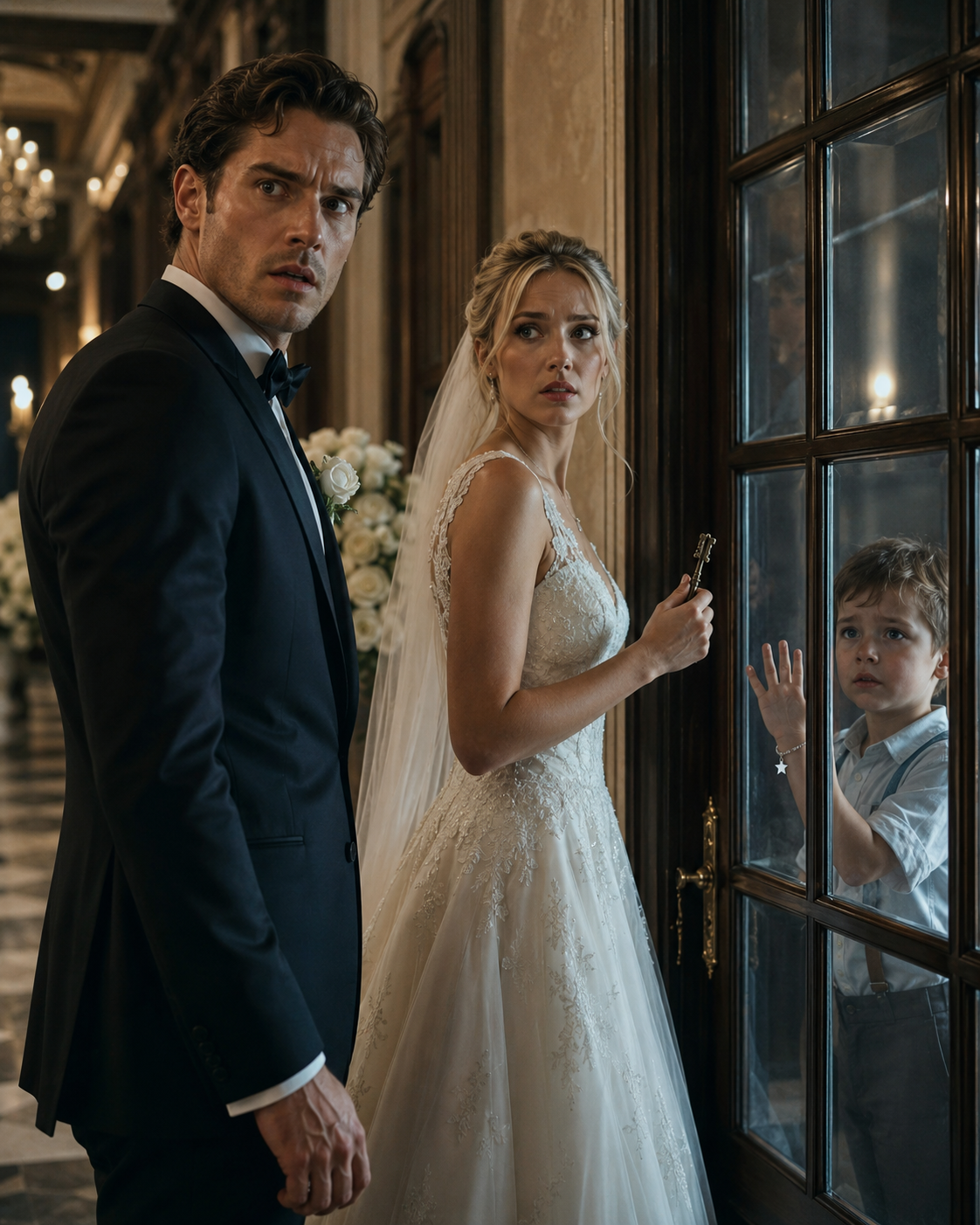
Instead, she looked away.
That was when I knew.
Mrs. Bell held Noah closer.
Celeste pressed a hand to her stomach as if the truth had struck her physically. “I was young,” she whispered. “I had nothing. No money. No family willing to help. You do not know what it is like to be trapped with a child and no future.”
“No future?” I repeated.
Her tears spilled now, but her voice grew stronger, almost angry. “Men like you always speak of morality because you can afford it. I made one terrible choice. One. I left him where someone would find him.”
Noah began to shake.
Mrs. Bell covered his ears, but not before he heard enough.
I stepped between them.
“Where did you leave him?”
Celeste’s gaze darted toward the watching guests. Toward my mother. Toward the open terrace where the wedding flowers moved in the breeze.
“Julian,” she said, “please.”
“Where?”
“At a convent gate,” she said. “In Seabrook. He was wrapped. He had food. I watched from the road until someone came.”
“And then you told everyone he died.”
Her jaw trembled.
“I had to.”
“No,” I said. “You chose to.”
For the first time, anger fully entered her face.
“You think I wanted to arrive here with a child from another life? You think your family would have welcomed me? Your mother inspected my bloodline like she was buying a horse. Your guests smile with knives behind their teeth. I did what I had to do to survive.”
My mother took a step forward. “Celeste…”
Celeste laughed, small and ugly. “Do not pretend shock, Lady Ashford. You would have rejected me the moment you knew.”
Perhaps she was right.
Perhaps my family, with all its polished manners and inherited cruelty, had helped build the world that made women like Celeste believe love was a door that only opened for the spotless.
But none of that changed the child in Mrs. Bell’s arms.
None of that changed the locked room.
None of that changed the fact that Celeste had seen her own son arrive at the house and chosen the key over the truth.
“How did he find you?” I asked.
Celeste wiped her face quickly, regaining fragments of herself. “I don’t know.”
Noah spoke before she could say more.
“I saw her picture,” he whispered.
Everyone turned.
He swallowed hard. “At the bakery. On a newspaper. The wedding picture. Aunt Mara said maybe it wasn’t her, but I knew. I remembered her song.”
Celeste closed her eyes.
“What song?” I asked softly.
Noah looked at her, waiting.
She did not answer.
He sang one broken line under his breath. A nursery tune. Simple. Tender. The kind of song a mother sings before she decides what kind of person she is going to become.
The sound destroyed the last of the wedding.
My mother began to cry quietly. One of the guests turned away. Mrs. Bell bowed her head over the boy.
Celeste stood alone in the middle of the corridor, dressed like a bride and exposed like a criminal before judgment.
“I only needed today,” she said. “After the wedding, I would have handled it. I would have found a place for him. A school. A home. Money. Anything he needed.”
“He needed his mother,” I said.
Her voice sharpened. “And what would you have done, Julian? Married me anyway? Raised another man’s child while society laughed behind your back?”
I looked at Noah.
He had stopped crying. That was worse. His eyes were too tired for a child’s face.
“Yes,” I said.
Celeste stared at me.
“If you had told me the truth,” I continued, “if you had brought him to me and said, ‘This is my son, and I was afraid,’ I would have had a choice. Maybe I would have failed. Maybe my family would have failed. But I would have known what was real.”
I removed the white rose from my lapel.
It had been pinned there that morning by Celeste herself. She had smiled as she adjusted it, telling me white meant loyalty.
I placed it on the table beside her crushed bouquet.
“I cannot marry a woman who locks a child away so the flowers will still look beautiful.”
The words moved through the corridor like cold air.
Celeste reached for my sleeve. “Julian, no. Please. You love me.”
“I loved someone who did not exist.”
Her hand dropped.
Outside, a gust of wind scattered rose petals across the terrace. The quartet did not begin again. No one moved toward the chapel. The entire estate seemed suspended between ceremony and ruin.
My mother approached Noah slowly.
“May I?” she asked Mrs. Bell.
Noah looked uncertain.
Mrs. Bell nodded only after he did.
My mother knelt, silk dress brushing the floor. I had never seen her kneel for anyone. Not servants. Not children. Not grief.
“I am sorry,” she said to him. “This house should have protected you the moment you came through its gates.”
Noah looked at me. “Am I in trouble?”
The question nearly broke me.
“No,” I said. “You are not in trouble.”
Celeste made a strangled sound. “You are all acting as if I am a monster.”