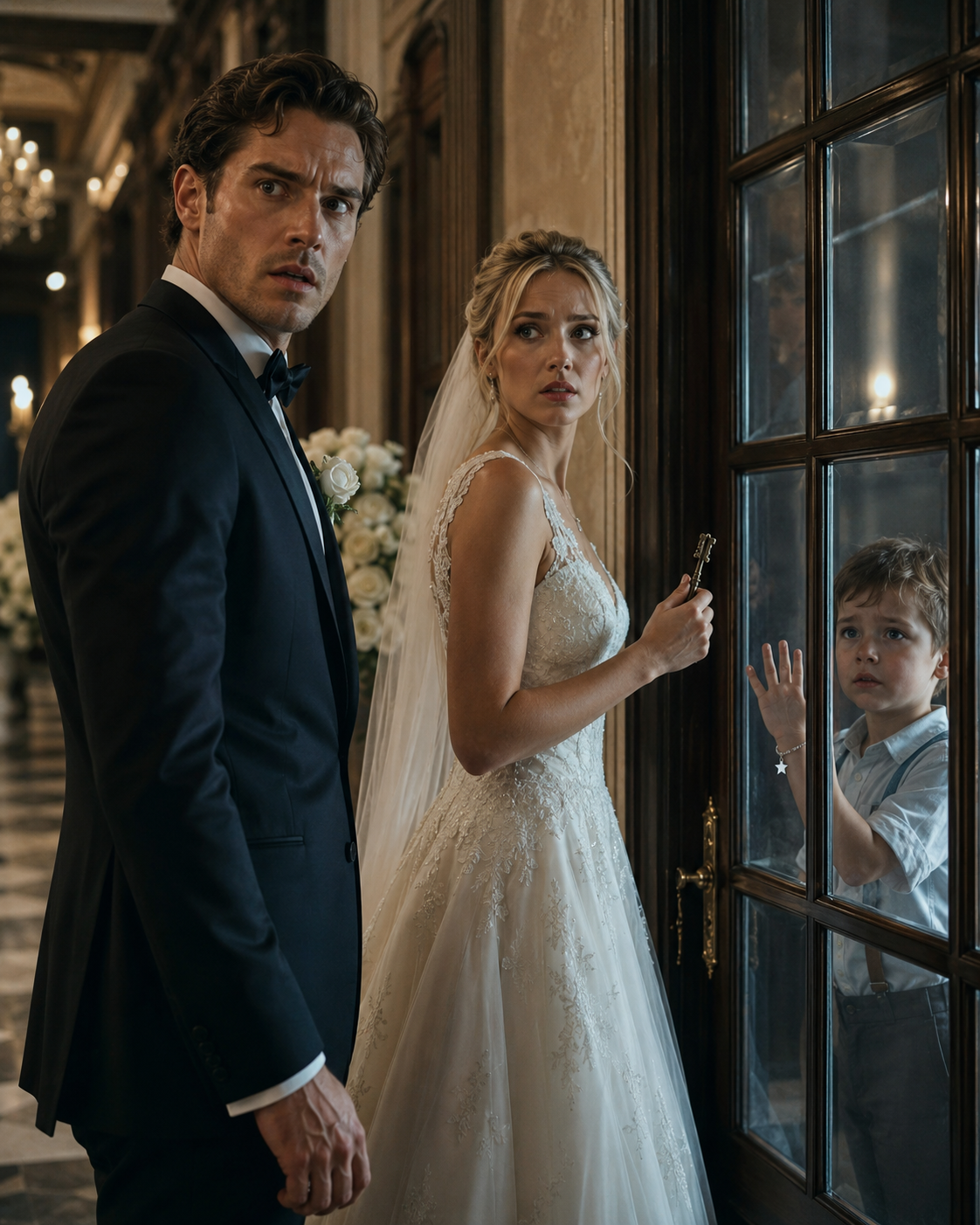
No one answered.
That silence was the only honest verdict she received.
The police were called quietly, though I did not let them storm through the house like theatre. Mrs. Bell took Noah to the morning room, where she gave him warm milk, a blanket, and a plate of biscuits he barely touched. My mother dismissed the guests herself.
There was no announcement.
No explanation.
Just the slow collapse of a day that had cost more money than most people saw in a decade.
By evening, the roses had begun to wilt.
Celeste sat in the library with two officers, her veil removed, her hair falling loose around her face. She no longer looked angelic. She looked young, frightened, and furious at the world for refusing to admire her suffering.
I watched from the doorway as she gave her statement.
She said she panicked.
She said she never meant harm.
She said she intended to explain after the wedding.
Perhaps some of that was true.
But truth, I learned that day, is not a medicine that works after the poison has been swallowed.
Later, when the house was quiet, I found Noah standing by the conservatory windows. The same glass that had trapped him now reflected his small figure back at him.
He touched the bracelet on his wrist.
“Will she come back?” he asked.
I knew he meant Celeste.
I sat beside him on the window bench.
“I don’t know.”
“Does she hate me?”
“No,” I said, though I was not sure I had the right to answer. “I think she hated the truth. Sometimes people hurt the truth and pretend they are only protecting themselves.”
He considered this with the grave seriousness of a child who had already learned too much.
“Are you angry?”
“Yes.”
“At me?”
“Never.”
He leaned his head against the window, looking out at the garden where chairs still faced an altar that would not be used.
“I wanted her to remember me,” he whispered.
I looked at the silver star on his wrist.
“She did,” I said. “That was what frightened her.”
He turned toward me.
“And you?”
“What about me?”
“Will you remember me?”
There are moments in life when a person becomes responsible not because blood demands it, not because law records it, but because the world reveals a wound in front of him and waits to see whether he will look away.
I had looked away from many things in my life.
Not this time.
“Yes,” I said. “I will remember you.”
For the first time that day, Noah’s fingers loosened around the bracelet.
Outside, servants began removing the wedding flowers. One by one, the white roses disappeared from the walls, from the chairs, from the archway where I had been meant to promise forever to a lie.
By morning, Whitmere Hall no longer looked like a wedding house.
It looked like a house after a storm.
But in the breakfast room, Noah sat wrapped in Mrs. Bell’s shawl, eating toast with both hands. My mother spoke gently to a solicitor by the fireplace. The police had found records. A convent. A foster file. A woman named Mara who had raised him when no one else came.
The story Celeste had buried was no longer buried.
It had a name.
Noah.
And when sunlight touched the silver star on his wrist, I understood something I should have known long before the wedding.
Some secrets do not stay hidden because they are weak.
They stay hidden because the people who know them are small, powerless, and waiting for one brave door to open.
That day, the door opened.
Not for the bride.
Not for the guests.
Not for the family name.
For the boy behind the glass.