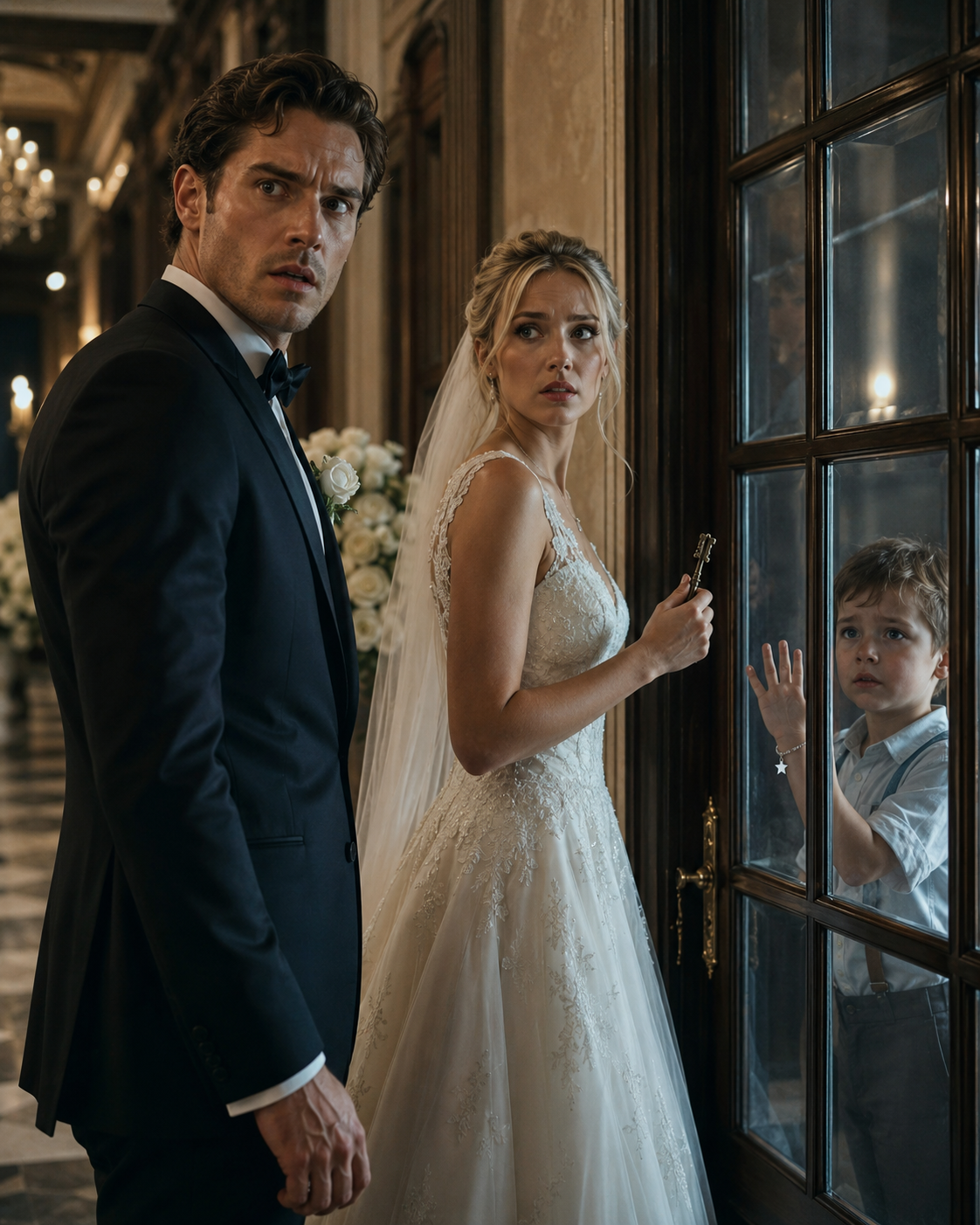
“Sweetheart,” she said through the glass, her voice dripping with the kind of sweetness adults use when they want children to doubt themselves, “you’re confused. You were lost. I helped you.”
The boy backed away from the door, trembling.
I stepped toward Celeste and held out my hand.
“The key.”
Her fingers closed around it.
“Julian, please don’t make a scene.”
“A scene?” I repeated.
Outside, beyond the corridor, I could hear the distant murmur of guests noticing that something had changed. Footsteps approached and stopped. Someone whispered my name.
Celeste moved closer to me. Her perfume was jasmine and orange blossom, the same scent she had worn the night she told me about the tragedy of her past.
A lost child.
A storm.
A grief she had carried alone.
I remembered holding her while she cried. I remembered thinking no one could fake that kind of pain.
Now there was a child behind a locked door, and the woman I loved was holding the key like a secret she could still force back into silence.
“Julian,” she whispered, “listen to me carefully. This boy is dangerous to us. Not physically, of course, but to everything we’ve built. He came here shouting nonsense. If the guests hear him, if the press hears him—”
“The key,” I said again.
Her mask cracked.
Just for a second.
It was enough.
Mrs. Bell stepped forward. “Miss Marlowe, please.”
Celeste turned on her. “You will stay out of this.”
The housekeeper flinched, but she did not move away.
The boy began crying harder. Not loudly now. Quietly. Exhausted. The kind of crying that sounds older than the child making it.
I took one step closer to Celeste.
She looked at my face and understood something. Whatever power she thought she had over me had reached its end.
With stiff fingers, she placed the key in my palm.
I unlocked the door.
The boy did not run out at first. He stood frozen, staring up at me as if freedom itself might be another trick.
“It’s all right,” I said, lowering myself to one knee. “No one is going to lock you in again.”
His lips trembled.
Mrs. Bell entered the room slowly and wrapped her shawl around his shoulders. The moment she touched him, he collapsed against her, gripping her sleeve with both hands.
Celeste let out a small, controlled breath.
“You see?” she said. “He is fine. He is frightened, yes, but children exaggerate. We can settle this quietly after the ceremony.”
I turned toward her.
“There will be no ceremony until I know who he is.”
Her face went still.
The boy lifted his head from Mrs. Bell’s shoulder.
“My name is Noah,” he whispered.
Something in Celeste’s expression changed.
Not surprise.
Recognition.
Mrs. Bell looked at me. “Sir…”
But I was no longer looking at Celeste’s face.
I was looking at the boy’s wrist.
Around it was a bracelet made from dark braided cord, old and frayed, tied carefully despite years of wear. Hanging from it was a tiny silver charm shaped like a star.
My breath left my body.
The corridor blurred at the edges.
I knew that bracelet.
Not because I had ever held it.
Because Celeste had described it to me so many times that it had become part of the sad mythology of her life.
“My son wore it,” she had told me one night in the library, rain tapping against the windows. “A little silver star. My grandmother gave it to him. After the accident, they never found it.”
The accident.
That was what she called it.
She said her first child had vanished during a storm on the coast. She said she had searched for him until her shoes filled with blood. She said the sea had taken him. She said grief had made her afraid to love again until me.
I had believed every word.
Now the lost child stood in my corridor with that same bracelet on his wrist.
“Noah,” I said carefully, “where did you get that?”
He curled his hand against his chest.
“My auntie tied it back on when it came loose,” he whispered. “She said my mother put it on me when I was a baby.”
Celeste made a sound like a glass cracking.
Not loud.
But final.
The corridor filled with silence. Guests had gathered at the far end now, a careful distance away. Faces hovered beyond the archway. My mother stood among them, one hand at her throat.
I looked at Celeste.
Her lips parted.
“No,” she said.
Just that.
No explanation. No denial formed with confidence. Only one small word falling uselessly into the space between us.
I stood slowly.
“Is he your son?”
Her eyes filled with tears so fast that, once, I would have mistaken them for innocence.
“Julian, you have to understand.”
“Is he your son?”
She looked at Noah.
The boy stared back at her with a terrible, hopeful fear.
For a moment, I thought she might go to him. I thought some buried part of her would break free from the jewels, the lace, the lies, and she would kneel before him. I thought she might say his name as a mother should.