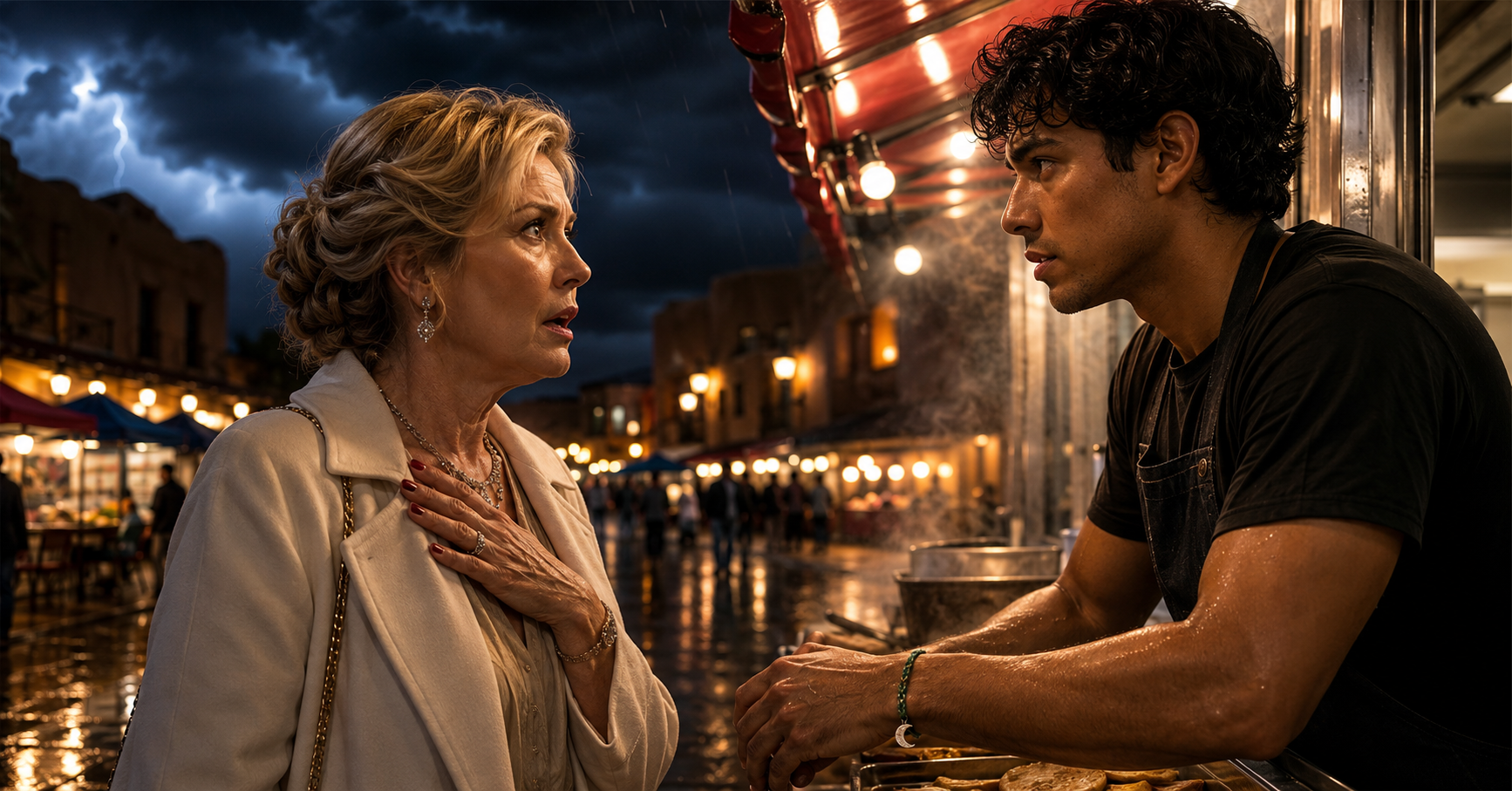
Elias looked wounded.
“You told me the box contained insurance documents.”
“It contains those too.”
“You lied.”
“I kept a promise.”
Teresa handed him a small brass key.
The box was hidden beneath the passenger seat of the food truck.
After the last customers had been served, Elias closed the service window. Teresa switched off the lights and left them alone inside.
The truck smelled of lime, grilled onions, coffee, and rain beginning to fall on hot pavement.
Elias placed a dented metal case on the preparation table.
The key turned with difficulty.
Inside were old newspaper clippings, several photographs, a child’s red wooden airplane, and a portable cassette recorder wrapped in a dish towel.
Claire touched the airplane with one finger.
Graham had made it in his workshop.
One wing still carried the blue line Jamie had drawn with a marker.
Elias watched her face.
“You recognize that too?”
Claire nodded.
“He slept with it beside his pillow.”
Elias sat down heavily.
Teresa had written instructions on a piece of paper and placed them inside the recorder. Elias pressed the play button.
Static filled the truck.
Then a woman began to speak.
Her voice was tired but steady.
“My name is Marisol Navarro. I am recording this because memory can be frightened into silence, but a recording cannot.”
Elias lowered his head.
Claire remained motionless.
Marisol described the wildfire clinic, the lost child, and the man who had claimed to be his uncle. She remembered his expensive watch, a burn on his left hand, and the black vehicle waiting outside.
After he returned the child, Marisol found a business card beneath the back seat.
It belonged to Reid Whitmore.
Claire’s brother-in-law.
Graham’s older brother.
The man who had stood beside Claire during every search conference.
The man who had helped organize the memorial service after the authorities declared Jamie presumed dead.
The recording continued.
Marisol had called the number on the card. Reid answered. When she mentioned the child, he offered her money. When she refused, he recited her home address and the name of her undocumented younger sister.
Marisol had taken Elias and left the state that same night.
“I believed the boy’s family was dangerous,” she said on the tape. “Years later, I learned that a woman named Claire Whitmore was still searching for her missing son. By then, I was ashamed and afraid. I told myself that taking Elias from the only life he remembered would harm him. Perhaps that was true. Perhaps it was only the excuse of a coward. I loved him. I also failed him. Both things can be true.”
The tape clicked.
Rain hammered the roof of the truck.
Elias covered his face with both hands.
Claire wanted to touch his shoulder, but she did not.
The young man sitting before her might be her son. He was also a stranger whose entire life had just been split open.
After several minutes, he looked up.
“Why would your husband’s brother take me?”
Claire stared at the red airplane.
“Graham discovered that Reid had been stealing from the company. He planned to remove him from the board and report him. The night before Jamie disappeared, Reid asked Graham to meet privately. Graham refused.”
“What happened to your husband?”
“He died seven years later.”
“How?”
“His heart failed.”
Elias looked toward the rain-blurred window.
“Or broke.”
Claire had no answer.
They contacted the police before leaving the truck.
Investigators collected the cassette, the photographs, the airplane, and the original newspaper clippings. Claire gave a formal statement. Elias agreed to provide a DNA sample only after Teresa convinced him that learning the truth would not erase Marisol.
The results arrived the next afternoon.
Claire sat in a private room at the hospital with her attorney. Elias entered alone and remained beside the door.
The geneticist placed the report on the table.
The probability of a biological parent-child relationship was greater than 99.99 percent.
Claire read the number three times.
Then she looked at Elias.
“My son,” she whispered.
He flinched.
Claire immediately regretted saying it.
Elias pulled out a chair but did not sit.
“A laboratory can tell me where my life started,” he said. “It cannot return twenty-four years.”
“I know.”
“It cannot make me remember you.”
“I know.”
“It doesn’t give you permission to arrive and decide who I am.”
“I know that too.”
His eyes filled with tears.
“Then what happens now?”
Claire rose slowly.
“Now you choose.”
“What does that mean?”
“You choose what name you use. You choose whether you speak to me. You choose whether I am part of your life tomorrow, next year, or never.”
“You would accept never?”
“No,” Claire said honestly. “It would destroy me. But I would accept that the decision belongs to you.”