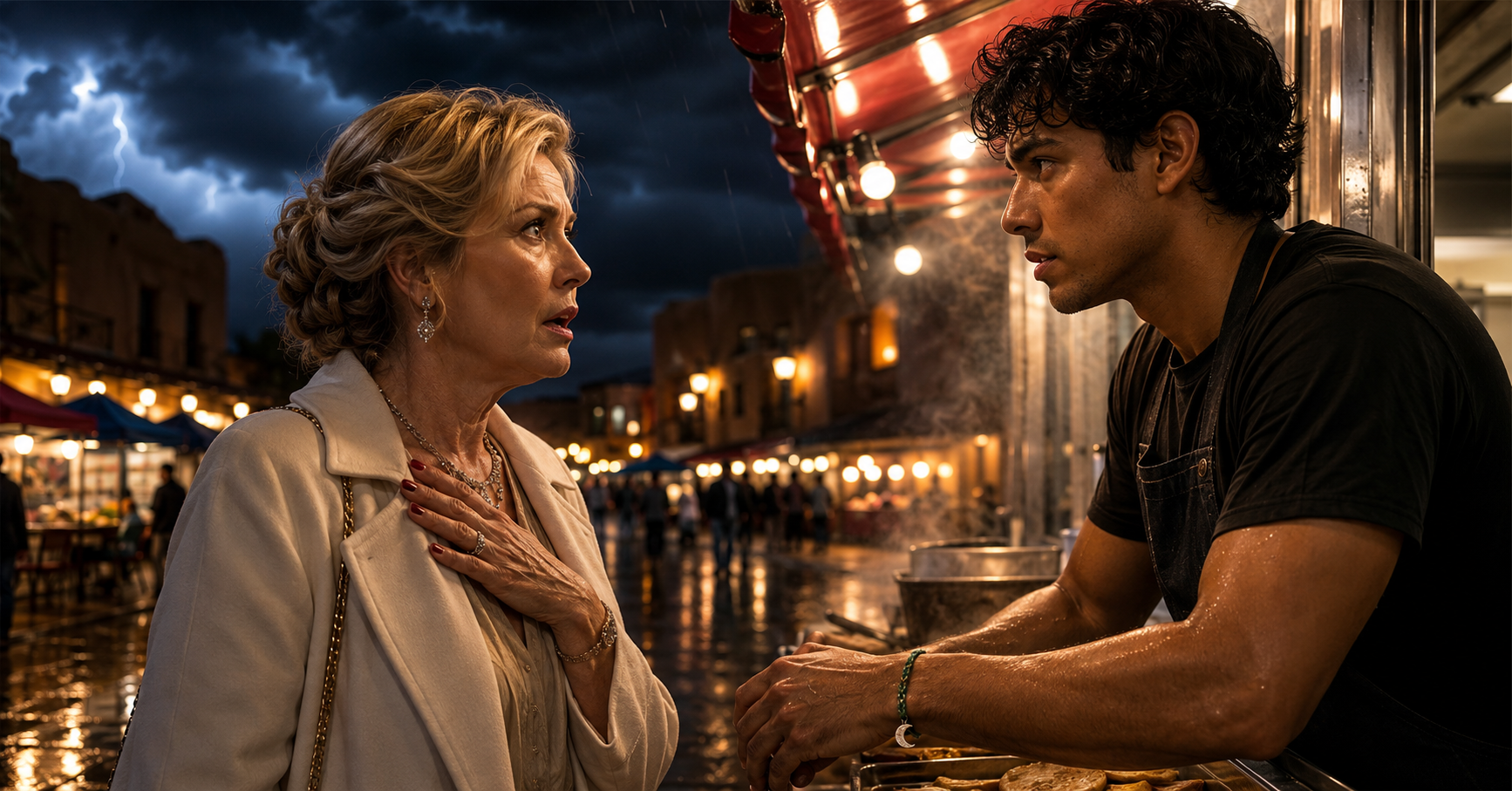
Elias finally sat down.
“My name is Elias.”
“Then Elias is your name.”
“Marisol is my mother.”
“Yes.”
“You are not replacing her.”
“I wouldn’t try.”
He wiped his face with the heel of his hand.
“What was my name?”
“James Graham Whitmore.”
“Jamie?”
“When you were little.”
He repeated it experimentally.
“Jamie.”
Claire waited.
After a long silence, Elias asked, “Did I really sleep with that wooden airplane?”
“Every night.”
“Was I afraid of storms?”
“You loved thunder. You thought clouds were moving furniture.”
A small, unwilling smile appeared on his face.
“I still like storms.”
Claire laughed, but the sound became a sob.
Elias looked at her for several seconds.
Then he moved the empty chair beside him away from the table.
He did not embrace her.
He simply made space.
Claire sat beside her son and told him everything she could remember.
The investigation into Reid Whitmore lasted eleven months.
Financial records, archived telephone logs, and testimony from a retired deputy supported Marisol’s account. Reid had arranged the abduction to force Graham to surrender control of the company. The wildfire disrupted his plan. His hired driver panicked, and Jamie was abandoned at the emergency clinic.
Reid had later used money and influence to alter records, destroy evidence, and persuade the family that the child had probably died in the fire.
He had believed time would bury the truth.
He had not expected a nurse to keep a business card.
He had not expected a frightened child to protect an old bracelet.
And he had never imagined that twenty-four years later, Claire would walk past a taco truck at precisely the moment Elias was humming his father’s song.
Elias did not become James again.
He added the name to his own, becoming Elias James Navarro. He kept Marisol’s surname and refused Claire’s offer of a mansion, a company position, or a large public celebration.
Instead, he asked her to visit Marisol’s grave.
They went on a cold morning in November.
Claire placed white roses beside the headstone.
“Thank you for saving him,” she said. “And thank you for loving him when I couldn’t reach him.”
Elias stood beside her, his green bracelet wrapped around his wrist.
For the first time, he took Claire’s hand.
The taco truck remained in the Santa Fe plaza.
Elias expanded the business slowly, using a small investment that he insisted on repaying. He hired teenagers leaving foster care and taught them to cook, manage money, and apply for culinary programs.
Claire visited every Thursday.
At first, she arrived in a black car and wore clothes too formal for folding chairs. Eventually, she began coming alone. She learned to chop onions, ruined several batches of salsa, and discovered that Elias became quiet when worried, just as Graham had.
They did not recover the missing years.
They built new ones.
On the first anniversary of their meeting, Elias removed the silver crescent from its worn cord and placed it on a stronger chain. He handed the old green braid to Claire.
“You should keep part of it,” he said.
Claire closed her fingers around the faded thread.
“Are you sure?”
“It did what it was supposed to do.”
“What was that?”
Elias glanced at the crowded plaza, the glowing truck, and the woman who had spent half her life searching for him.
“It found the way home.”
Claire understood then that home was not the mansion she had preserved, the photographs she had guarded, or the bedroom she had refused to change.
Home was not something money could rebuild or a DNA report could command.
Home was a door that had to be opened from both sides.
And at last, slowly, they were opening it together.