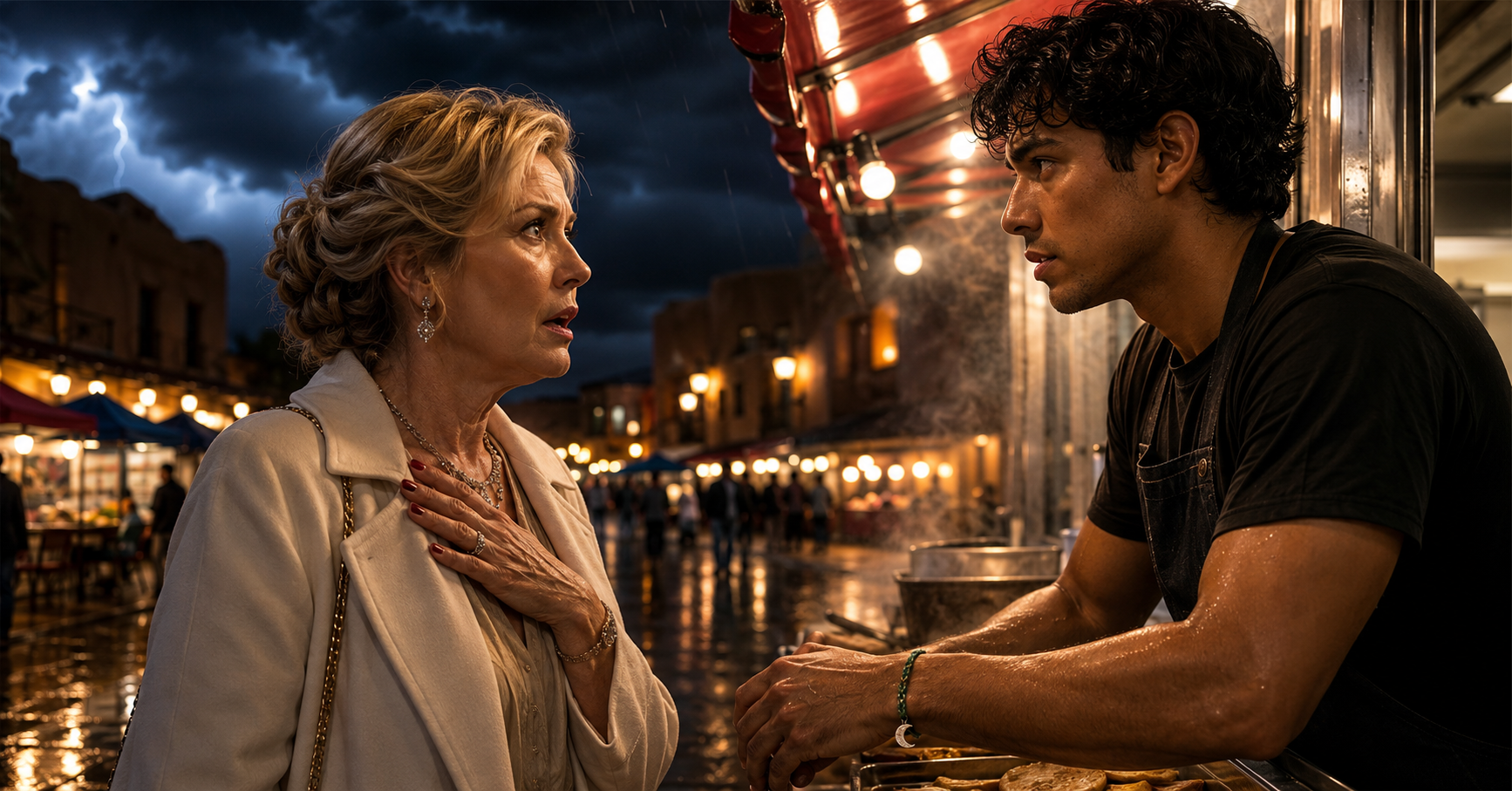
Elias raised his eyes.
“That has nothing to do with me.”
“He was four years old.”
“So?”
“You are the age he would be now.”
“There are millions of men my age.”
“He had that bracelet.”
Elias fastened it around his wrist again.
“My mother gave it to me.”
“Your biological mother?”
“My mother,” he repeated firmly.
Claire understood the warning in his voice.
“Is she alive?”
“No.”
“I’m sorry.”
“Don’t be. You didn’t know her.”
Claire looked at the photograph between them.
“Did she ever tell you where she found the bracelet?”
Elias’s jaw tightened.
“There was nothing to find. It was on my wrist when she met me.”
The words struck Claire harder than she expected.
“When did she meet you?”
He looked toward the customers.
“Not here.”
Elias turned off one side of the grill and called to a middle-aged woman working inside the truck.
“Aunt Teresa, can you take over?”
The woman looked from him to Claire.
“Everything all right?”
“I don’t know yet.”
Elias stepped through the rear door and pointed toward a quiet passage between two adobe buildings.
“Five minutes,” he told Claire. “Then you leave.”
They walked away from the market. Music echoed across the plaza, but the narrow passage was almost empty.
Elias leaned against the wall and folded his arms.
“My mother’s name was Marisol Navarro,” he said. “She worked as a night nurse at a temporary clinic during the wildfire. Hundreds of people came through without identification. Some were burned. Some were lost. Some were children.”
Claire remembered the clinic.
She had searched it herself.
Police officers had led her past rows of folding beds while smoke covered the sun. She had shown Jamie’s picture to every nurse, volunteer, firefighter, and frightened family she could find.
No one had recognized him.
“Marisol told me she found me asleep beneath a table in a church hall,” Elias continued. “I had a fever, a cut on my head, and that bracelet. I couldn’t tell anyone my last name.”
“What name did you give them?”
“I don’t remember.”
“What did she say?”
Elias looked away.
“She said I called myself Jay.”
Claire pressed a hand to her mouth.
Jamie had been unable to pronounce his own name clearly. When asked, he said Jay.
“Why didn’t she contact the police?”
“She did.”
Claire lowered her hand.
“What happened?”
“She reported me to a deputy. A man arrived the following morning and claimed he was my uncle. He had documents, family photographs, everything necessary to convince them.”
“What man?”
“I don’t know. My mother never learned his real name.”
“Did he take you?”
Elias nodded.
“For several hours.”
Claire felt cold despite the heat trapped between the buildings.
“Then how did you return to Marisol?”
“The man brought me back after midnight. I was unconscious. He told her that I had become sick in his car and that he couldn’t take me across the state line. He gave her an envelope full of cash and ordered her to forget she had seen him.”
Claire shook her head.
“That makes no sense.”
“My mother thought so too. She tried to report him. But when she returned to the sheriff’s station, the record of her first report was gone. The deputy told her no missing child matched my description.”
“I filed reports in every county.”
“I’m telling you what she told me.”
“Why did she keep you?”
“She was afraid whoever had taken me would come back.”
“And she never searched for your family?”
“She searched for years.”
His voice rose.
“She contacted newspapers. She wrote to hospitals. She visited police stations. She kept photographs of missing children in boxes beneath her bed. She wasn’t hiding me.”
“I didn’t say she was.”
“You were thinking it.”
Claire closed her eyes.
He was right.
For one terrible moment, she had resented a dead woman for possessing the years that had been stolen from her.
“I’m sorry,” she said. “That was unfair.”
Elias studied her, surprised by the apology.
“She raised me,” he said more quietly. “She worked double shifts. She taught me to cook because we couldn’t afford restaurants. When I was twelve, she sold her wedding ring so I could have surgery on my ear. Whatever happened before her, she was my mother.”
“I understand.”
“No, you don’t.”
Claire looked directly at him.
“No. I suppose I don’t.”
The anger in his face softened, although it did not disappear.
Before either of them could speak again, Aunt Teresa appeared at the entrance of the passage.
“Elias,” she called. “You need to show her the box.”
He turned sharply.
“You were listening?”
“I have ears.”
“This isn’t your decision.”
“Your mother made it my decision.”
Teresa wiped her hands on her apron.
“Marisol left something for him,” she told Claire. “She said it should remain sealed unless someone recognized the bracelet without being told what was engraved on it.”