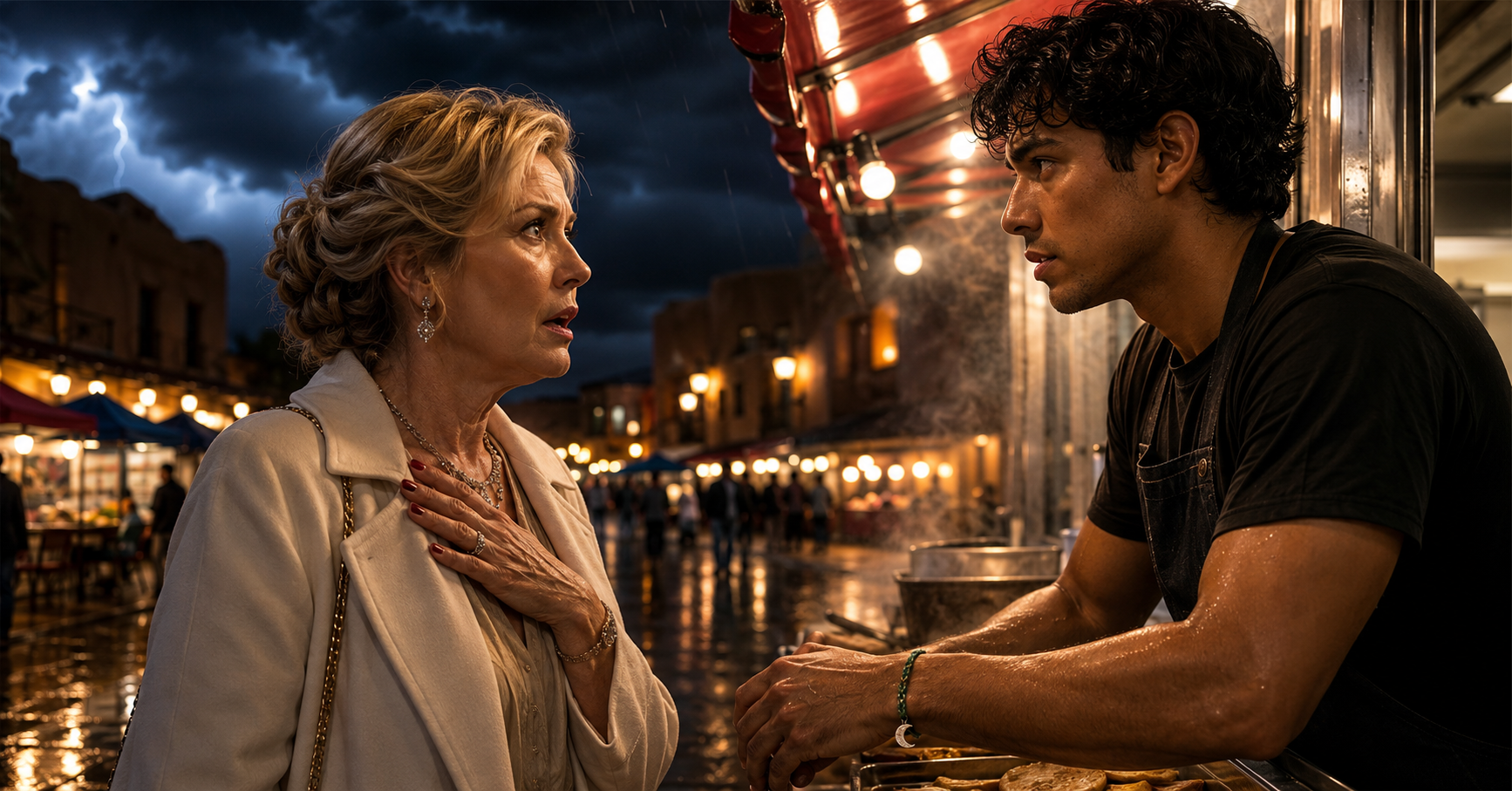
Claire Whitmore had spent twenty-four years avoiding crowded places.
Crowds contained too many small hands slipping away from larger ones, too many children calling for their mothers, too many strangers vanishing around corners before she could see their faces.
She preferred private dining rooms, silent elevators, cars with darkened windows, and offices where every visitor had an appointment. Control had become more than a habit. It was the wall she had built around a wound that refused to close.
That evening, however, control abandoned her.
Claire had traveled to Santa Fe to attend the final meeting concerning the sale of Whitmore Medical Systems, the company she and her late husband had built from a rented warehouse. The negotiations had lasted six exhausting hours. By the time she left the attorneys’ office, the summer sky had turned violet, and the streets were filling with music, smoke, and visitors arriving for the night market.
Her driver called to say that a delivery truck was blocking the hotel entrance. He would need fifteen minutes to reach her.
Claire decided to walk.
She was passing a row of food stalls when the smell of roasted peppers and warm corn stopped her near the edge of the plaza.
A faded blue truck stood beneath a string of bare lightbulbs. Steam rolled from its open window. A handwritten menu was taped beside the counter, and a young man worked over the grill with the quick, practiced movements of someone who had repeated the same routine thousands of times.
He was tall and lean, perhaps twenty-eight. His dark hair fell across his forehead whenever he bent over the grill. He wore a gray shirt with the sleeves pushed above his elbows, exposing a pale scar near his right wrist.
Claire might have continued walking if he had not begun to hum.
It was only a melody—five soft notes beneath the noise of the market.
But Claire knew them.
Her husband, Graham, had written that melody for their son when the boy was a baby. It had never been recorded or performed. Graham used to hum it while carrying Jamie through the house at night.
Claire stopped so abruptly that the couple behind her nearly collided with her.
The young man glanced up.
“Sorry,” he said. “Are you in line?”
Claire could not answer.
Something moved at his wrist as he reached for a stack of paper trays.
A braided green bracelet.
At its center hung a small silver crescent, darkened by age. One tip of the crescent was chipped, leaving a mark shaped like a tiny star.
Claire’s knees weakened.
She had bought the silver charm from a street artist in Lisbon when Jamie was two. Graham had woven the cord himself and engraved a message on the back.
For J.W.—find your way home.
Jamie had been wearing it on the afternoon he disappeared.
“Ma’am?”
The young man had stopped cooking.
Claire stepped closer to the truck.
“Where did you get that bracelet?”
His expression changed immediately. The friendliness vanished, replaced by caution.
“This?”
He covered it with his opposite hand.
“Yes.”
“I’ve always had it.”
“That isn’t possible.”
He frowned. “I don’t know what you want me to say.”
Claire heard the sharpness in her own voice and forced herself to breathe.
“What is your name?”
“Elias.”
“Your full name.”
A few people in line began looking at them.
The young man placed the metal spatula beside the grill.
“Elias Navarro. Why?”
Claire stared at the bracelet.
“May I see the back of the charm?”
“No.”
“Please.”
“I said no.”
“I know that bracelet.”
He gave a humorless laugh.
“A lot of people have bracelets.”
“Not like that one.”
Claire reached toward her handbag, and Elias immediately stepped back.
“I’m not asking for money,” he said.
“I wasn’t offering you money.”
“Then what are you doing?”
Claire removed her wallet and opened a hidden compartment. Inside was a photograph protected by cracked plastic.
She had carried it for more than two decades.
In the picture, a four-year-old boy sat on Graham’s shoulders, holding a red wooden airplane above his head. A green bracelet circled his wrist.
Claire placed the photograph on the counter.
Elias looked at it, but his face remained guarded.
“That could be anyone.”
“Turn over the charm,” Claire said. “There should be an engraving.”
He hesitated.
The conversations around them seemed to grow distant. Even the sizzling grill became a faint, unreal sound.
Finally, Elias unfastened the bracelet.
His fingers moved carefully, as if the old cord might break.
He turned the crescent over.
Time had worn the silver smooth, but several letters were still visible.
FIND YOUR WAY HOME.
Elias stared at the words.
Claire gripped the counter to remain standing.
“My son’s name was James Whitmore,” she said. “We called him Jamie. He disappeared during the Coyote Ridge wildfire twenty-four years ago.”
Elias raised his eyes.
“That has nothing to do with me.”
“He was four years old.”
“So?”
“You are the age he would be now.”
“There are millions of men my age.”
“He had that bracelet.”
Elias fastened it around his wrist again.
“My mother gave it to me.”
“Your biological mother?”
“My mother,” he repeated firmly.
Claire understood the warning in his voice.
“Is she alive?”
“No.”
“I’m sorry.”
“Don’t be. You didn’t know her.”
Claire looked at the photograph between them.
“Did she ever tell you where she found the bracelet?”
Elias’s jaw tightened.
“There was nothing to find. It was on my wrist when she met me.”
The words struck Claire harder than she expected.
“When did she meet you?”
He looked toward the customers.
“Not here.”
Elias turned off one side of the grill and called to a middle-aged woman working inside the truck.
“Aunt Teresa, can you take over?”
The woman looked from him to Claire.
“Everything all right?”
“I don’t know yet.”
Elias stepped through the rear door and pointed toward a quiet passage between two adobe buildings.
“Five minutes,” he told Claire. “Then you leave.”
They walked away from the market. Music echoed across the plaza, but the narrow passage was almost empty.
Elias leaned against the wall and folded his arms.
“My mother’s name was Marisol Navarro,” he said. “She worked as a night nurse at a temporary clinic during the wildfire. Hundreds of people came through without identification. Some were burned. Some were lost. Some were children.”
Claire remembered the clinic.
She had searched it herself.
Police officers had led her past rows of folding beds while smoke covered the sun. She had shown Jamie’s picture to every nurse, volunteer, firefighter, and frightened family she could find.
No one had recognized him.
“Marisol told me she found me asleep beneath a table in a church hall,” Elias continued. “I had a fever, a cut on my head, and that bracelet. I couldn’t tell anyone my last name.”
“What name did you give them?”
“I don’t remember.”
“What did she say?”
Elias looked away.
“She said I called myself Jay.”
Claire pressed a hand to her mouth.
Jamie had been unable to pronounce his own name clearly. When asked, he said Jay.
“Why didn’t she contact the police?”
“She did.”
Claire lowered her hand.
“What happened?”
“She reported me to a deputy. A man arrived the following morning and claimed he was my uncle. He had documents, family photographs, everything necessary to convince them.”
“What man?”
“I don’t know. My mother never learned his real name.”
“Did he take you?”
Elias nodded.
“For several hours.”
Claire felt cold despite the heat trapped between the buildings.
“Then how did you return to Marisol?”
“The man brought me back after midnight. I was unconscious. He told her that I had become sick in his car and that he couldn’t take me across the state line. He gave her an envelope full of cash and ordered her to forget she had seen him.”
Claire shook her head.
“That makes no sense.”
“My mother thought so too. She tried to report him. But when she returned to the sheriff’s station, the record of her first report was gone. The deputy told her no missing child matched my description.”
“I filed reports in every county.”
“I’m telling you what she told me.”
“Why did she keep you?”
“She was afraid whoever had taken me would come back.”
“And she never searched for your family?”
“She searched for years.”
His voice rose.
“She contacted newspapers. She wrote to hospitals. She visited police stations. She kept photographs of missing children in boxes beneath her bed. She wasn’t hiding me.”
“I didn’t say she was.”
“You were thinking it.”
Claire closed her eyes.
He was right.
For one terrible moment, she had resented a dead woman for possessing the years that had been stolen from her.
“I’m sorry,” she said. “That was unfair.”
Elias studied her, surprised by the apology.
“She raised me,” he said more quietly. “She worked double shifts. She taught me to cook because we couldn’t afford restaurants. When I was twelve, she sold her wedding ring so I could have surgery on my ear. Whatever happened before her, she was my mother.”
“I understand.”
“No, you don’t.”
Claire looked directly at him.
“No. I suppose I don’t.”
The anger in his face softened, although it did not disappear.
Before either of them could speak again, Aunt Teresa appeared at the entrance of the passage.
“Elias,” she called. “You need to show her the box.”
He turned sharply.
“You were listening?”
“I have ears.”
“This isn’t your decision.”
“Your mother made it my decision.”
Teresa wiped her hands on her apron.
“Marisol left something for him,” she told Claire. “She said it should remain sealed unless someone recognized the bracelet without being told what was engraved on it.”
Elias looked wounded.
“You told me the box contained insurance documents.”
“It contains those too.”
“You lied.”
“I kept a promise.”
Teresa handed him a small brass key.
The box was hidden beneath the passenger seat of the food truck.
After the last customers had been served, Elias closed the service window. Teresa switched off the lights and left them alone inside.
The truck smelled of lime, grilled onions, coffee, and rain beginning to fall on hot pavement.
Elias placed a dented metal case on the preparation table.
The key turned with difficulty.
Inside were old newspaper clippings, several photographs, a child’s red wooden airplane, and a portable cassette recorder wrapped in a dish towel.
Claire touched the airplane with one finger.
Graham had made it in his workshop.
One wing still carried the blue line Jamie had drawn with a marker.
Elias watched her face.
“You recognize that too?”
Claire nodded.
“He slept with it beside his pillow.”
Elias sat down heavily.
Teresa had written instructions on a piece of paper and placed them inside the recorder. Elias pressed the play button.
Static filled the truck.
Then a woman began to speak.
Her voice was tired but steady.
“My name is Marisol Navarro. I am recording this because memory can be frightened into silence, but a recording cannot.”
Elias lowered his head.
Claire remained motionless.
Marisol described the wildfire clinic, the lost child, and the man who had claimed to be his uncle. She remembered his expensive watch, a burn on his left hand, and the black vehicle waiting outside.
After he returned the child, Marisol found a business card beneath the back seat.
It belonged to Reid Whitmore.
Claire’s brother-in-law.
Graham’s older brother.
The man who had stood beside Claire during every search conference.
The man who had helped organize the memorial service after the authorities declared Jamie presumed dead.
The recording continued.
Marisol had called the number on the card. Reid answered. When she mentioned the child, he offered her money. When she refused, he recited her home address and the name of her undocumented younger sister.
Marisol had taken Elias and left the state that same night.
“I believed the boy’s family was dangerous,” she said on the tape. “Years later, I learned that a woman named Claire Whitmore was still searching for her missing son. By then, I was ashamed and afraid. I told myself that taking Elias from the only life he remembered would harm him. Perhaps that was true. Perhaps it was only the excuse of a coward. I loved him. I also failed him. Both things can be true.”
The tape clicked.
Rain hammered the roof of the truck.
Elias covered his face with both hands.
Claire wanted to touch his shoulder, but she did not.
The young man sitting before her might be her son. He was also a stranger whose entire life had just been split open.
After several minutes, he looked up.
“Why would your husband’s brother take me?”
Claire stared at the red airplane.
“Graham discovered that Reid had been stealing from the company. He planned to remove him from the board and report him. The night before Jamie disappeared, Reid asked Graham to meet privately. Graham refused.”
“What happened to your husband?”
“He died seven years later.”
“How?”
“His heart failed.”
Elias looked toward the rain-blurred window.
“Or broke.”
Claire had no answer.
They contacted the police before leaving the truck.
Investigators collected the cassette, the photographs, the airplane, and the original newspaper clippings. Claire gave a formal statement. Elias agreed to provide a DNA sample only after Teresa convinced him that learning the truth would not erase Marisol.
The results arrived the next afternoon.
Claire sat in a private room at the hospital with her attorney. Elias entered alone and remained beside the door.
The geneticist placed the report on the table.
The probability of a biological parent-child relationship was greater than 99.99 percent.
Claire read the number three times.
Then she looked at Elias.
“My son,” she whispered.
He flinched.
Claire immediately regretted saying it.
Elias pulled out a chair but did not sit.
“A laboratory can tell me where my life started,” he said. “It cannot return twenty-four years.”
“I know.”
“It cannot make me remember you.”
“I know.”
“It doesn’t give you permission to arrive and decide who I am.”
“I know that too.”
His eyes filled with tears.
“Then what happens now?”
Claire rose slowly.
“Now you choose.”
“What does that mean?”
“You choose what name you use. You choose whether you speak to me. You choose whether I am part of your life tomorrow, next year, or never.”
“You would accept never?”
“No,” Claire said honestly. “It would destroy me. But I would accept that the decision belongs to you.”
Elias finally sat down.
“My name is Elias.”
“Then Elias is your name.”
“Marisol is my mother.”
“Yes.”
“You are not replacing her.”
“I wouldn’t try.”
He wiped his face with the heel of his hand.
“What was my name?”
“James Graham Whitmore.”
“Jamie?”
“When you were little.”
He repeated it experimentally.
“Jamie.”
Claire waited.
After a long silence, Elias asked, “Did I really sleep with that wooden airplane?”
“Every night.”
“Was I afraid of storms?”
“You loved thunder. You thought clouds were moving furniture.”
A small, unwilling smile appeared on his face.
“I still like storms.”
Claire laughed, but the sound became a sob.
Elias looked at her for several seconds.
Then he moved the empty chair beside him away from the table.
He did not embrace her.
He simply made space.
Claire sat beside her son and told him everything she could remember.
The investigation into Reid Whitmore lasted eleven months.
Financial records, archived telephone logs, and testimony from a retired deputy supported Marisol’s account. Reid had arranged the abduction to force Graham to surrender control of the company. The wildfire disrupted his plan. His hired driver panicked, and Jamie was abandoned at the emergency clinic.
Reid had later used money and influence to alter records, destroy evidence, and persuade the family that the child had probably died in the fire.
He had believed time would bury the truth.
He had not expected a nurse to keep a business card.
He had not expected a frightened child to protect an old bracelet.
And he had never imagined that twenty-four years later, Claire would walk past a taco truck at precisely the moment Elias was humming his father’s song.
Elias did not become James again.
He added the name to his own, becoming Elias James Navarro. He kept Marisol’s surname and refused Claire’s offer of a mansion, a company position, or a large public celebration.
Instead, he asked her to visit Marisol’s grave.
They went on a cold morning in November.
Claire placed white roses beside the headstone.
“Thank you for saving him,” she said. “And thank you for loving him when I couldn’t reach him.”
Elias stood beside her, his green bracelet wrapped around his wrist.
For the first time, he took Claire’s hand.
The taco truck remained in the Santa Fe plaza.
Elias expanded the business slowly, using a small investment that he insisted on repaying. He hired teenagers leaving foster care and taught them to cook, manage money, and apply for culinary programs.
Claire visited every Thursday.
At first, she arrived in a black car and wore clothes too formal for folding chairs. Eventually, she began coming alone. She learned to chop onions, ruined several batches of salsa, and discovered that Elias became quiet when worried, just as Graham had.
They did not recover the missing years.
They built new ones.
On the first anniversary of their meeting, Elias removed the silver crescent from its worn cord and placed it on a stronger chain. He handed the old green braid to Claire.
“You should keep part of it,” he said.
Claire closed her fingers around the faded thread.
“Are you sure?”
“It did what it was supposed to do.”
“What was that?”
Elias glanced at the crowded plaza, the glowing truck, and the woman who had spent half her life searching for him.
“It found the way home.”
Claire understood then that home was not the mansion she had preserved, the photographs she had guarded, or the bedroom she had refused to change.
Home was not something money could rebuild or a DNA report could command.
Home was a door that had to be opened from both sides.
And at last, slowly, they were opening it together.

