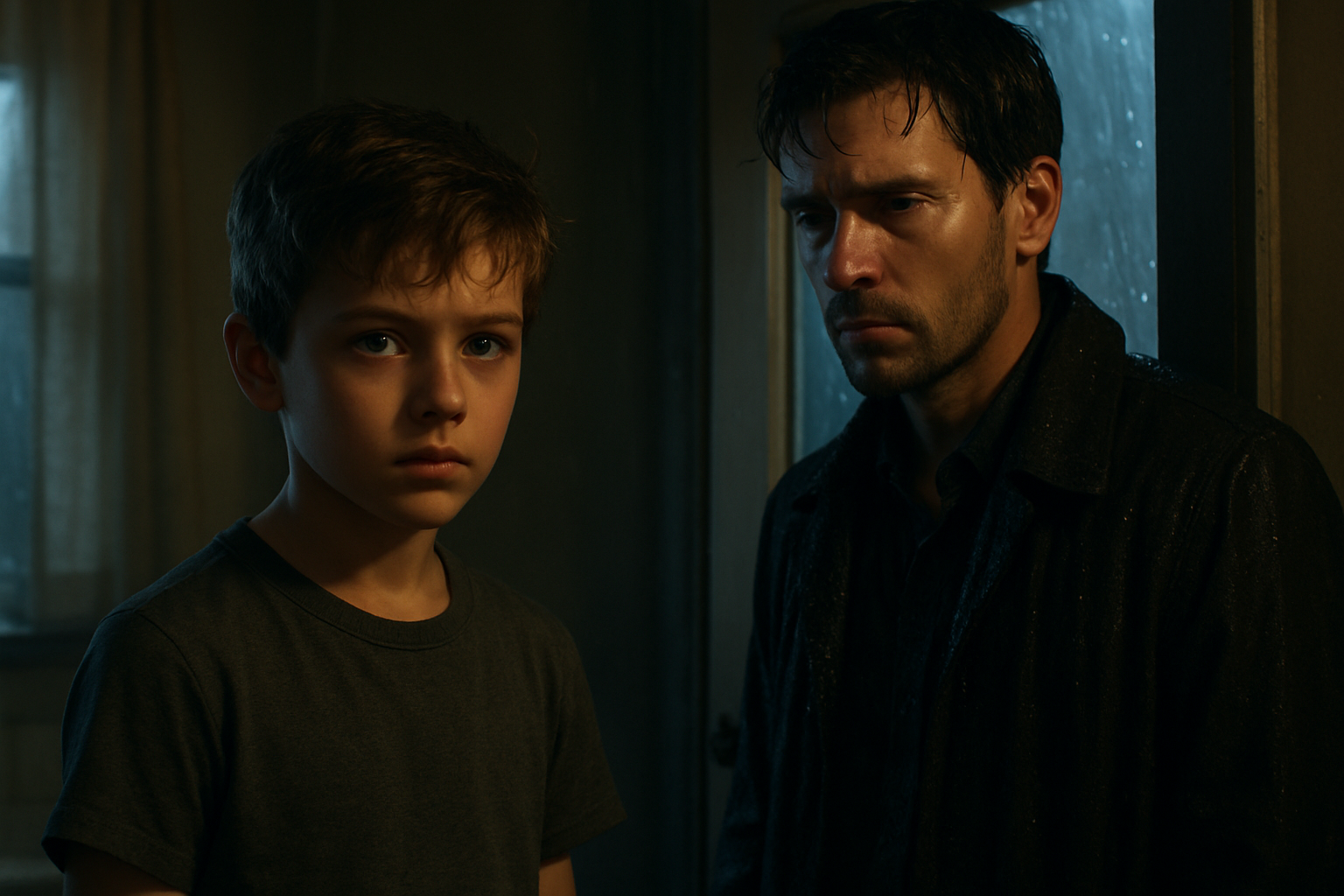
“Who was Aaron?”
For one second, nobody answered.
Then Tessa felt the old familiar panic rise—mother panic, sharp and immediate. The instinct to soften, redirect, lie gently enough that the lie could be called protection. She took one step toward him.
“Caleb, sweetheart, this isn’t—”
“He heard us,” Nolan said quietly.
Tessa turned on him. “I am aware.”
Nolan did not react to the bite in her voice. His face was wrecked, but something about him had gone very still. Not cold. Not distant. Present in a way that made Tessa more afraid, because she had no practice trusting his presence.
Caleb’s fingers tightened around the notebook.
“Who was he?” he asked again.
Tessa crouched in front of him. It was absurd—he was getting too tall for it, all elbows and angles, but some part of her still wanted to meet him the way she had when he was small and the world could be explained with bandaids and bedtime stories.
“Aaron was my brother,” she said. “Your uncle.”
Caleb’s eyebrows pulled together. “I have an uncle?”
“You had one.”
His expression changed, almost imperceptibly. Grief arrived in him as information first. That was his way. He took facts in, held them up to the light, and only later discovered they had edges.
“How did he die?”
Tessa’s throat tightened.
Nolan stood from the sofa. “Caleb—”
“No.” Caleb’s gaze snapped to him. Not angry. Worse. Clinical. “If this concerns why everyone is crying and why you look like someone removed all your bones, I’d like accurate information.”
Tessa almost laughed. It came out as a broken breath.
“He died in a car accident,” she said. “He had been drinking.”
Caleb processed this. “Before I was born?”
“Yes.”
“And Nolan was supposed to help him?”
The question sliced cleanly through the room.
Tessa could not answer. She did not know how to do it without handing her son a weapon he was too young to carry.
But Nolan did.
“Yes,” he said.
Caleb looked up at him.
Nolan’s voice remained quiet, but it did not shake. “Your mother called me because she was scared. I told her I would come. Then I didn’t. I chose work. It was a terrible choice. I can’t fix it.”
Tessa stared at him.
She had expected defense. Qualification. The reflexive language powerful men used to make failure sound weather-related. Circumstances. Demands. Pressure. A difficult season. He offered none of it. Just the fact, bare and ugly in his hands.
Caleb studied him for a long moment.
“That seems unforgivable,” he said.
Nolan’s face tightened, but he nodded. “It might be.”
Tessa shut her eyes briefly.
There were sentences a child should not have to say. There were truths that should never have to pass through an eight-year-old mouth. But Caleb had lived with absence his whole life. He had measured fatherhood by the empty chair at school concerts, by the blank space on forms, by the way other children said dad casually, as if it were not a word with gravity.
He had earned more truth than comfort.
Caleb turned to Tessa. “Why didn’t you tell me about Aaron?”
“Because it hurt,” she admitted. “And because I didn’t know how to explain him without explaining everything around him. Your grandmother doesn’t talk about him. I thought maybe when you were older…”
“I am often older than people assume,” Caleb said.
A tear slipped down Tessa’s cheek before she could stop it. “I know.”
His expression softened then, and for once he looked exactly his age. He set the notebook on the side table and stepped into her arms. Tessa wrapped herself around him, pressing her face into his hair. He smelled faintly of soap and pencil lead.
“I’m not upset that you didn’t tell me,” he murmured into her shoulder. “I’m upset that you were sad alone.”
The last piece of Tessa’s composure gave way.
She held him tighter, crying silently because she did not want to frighten him, because mothers were allowed tears only in controlled doses, because she had spent eight years turning herself into a wall and her son had just found the door in it.
Across the room, Nolan did not move.
When Caleb finally pulled back, he wiped one of Tessa’s tears with his sleeve, then looked at Nolan again.
“If you leave for six months,” he said, “that will be another data point.”
Nolan inhaled as if he had been struck.
“I know,” he said.
Caleb nodded once, accepting the answer without mercy or drama. Then he picked up his notebook.
“I’m going to bed. Not because I’m finished thinking, but because circadian rhythm disruption worsens emotional regulation.”
Tessa made a sound that was almost a laugh.
“Goodnight, Mom.”
“Goodnight, baby.”
He hesitated, then looked at Nolan. “Goodnight.”
The word was small. It was not forgiveness. It was not rejection. It was a light left on in a distant room.
Nolan’s eyes shone. “Goodnight, Caleb.”
When the bedroom door clicked shut, the silence returned, changed and heavier.
Tessa wiped her face with both hands. “He shouldn’t have heard that.”
“No,” Nolan said. “But maybe he should have heard the truth.”