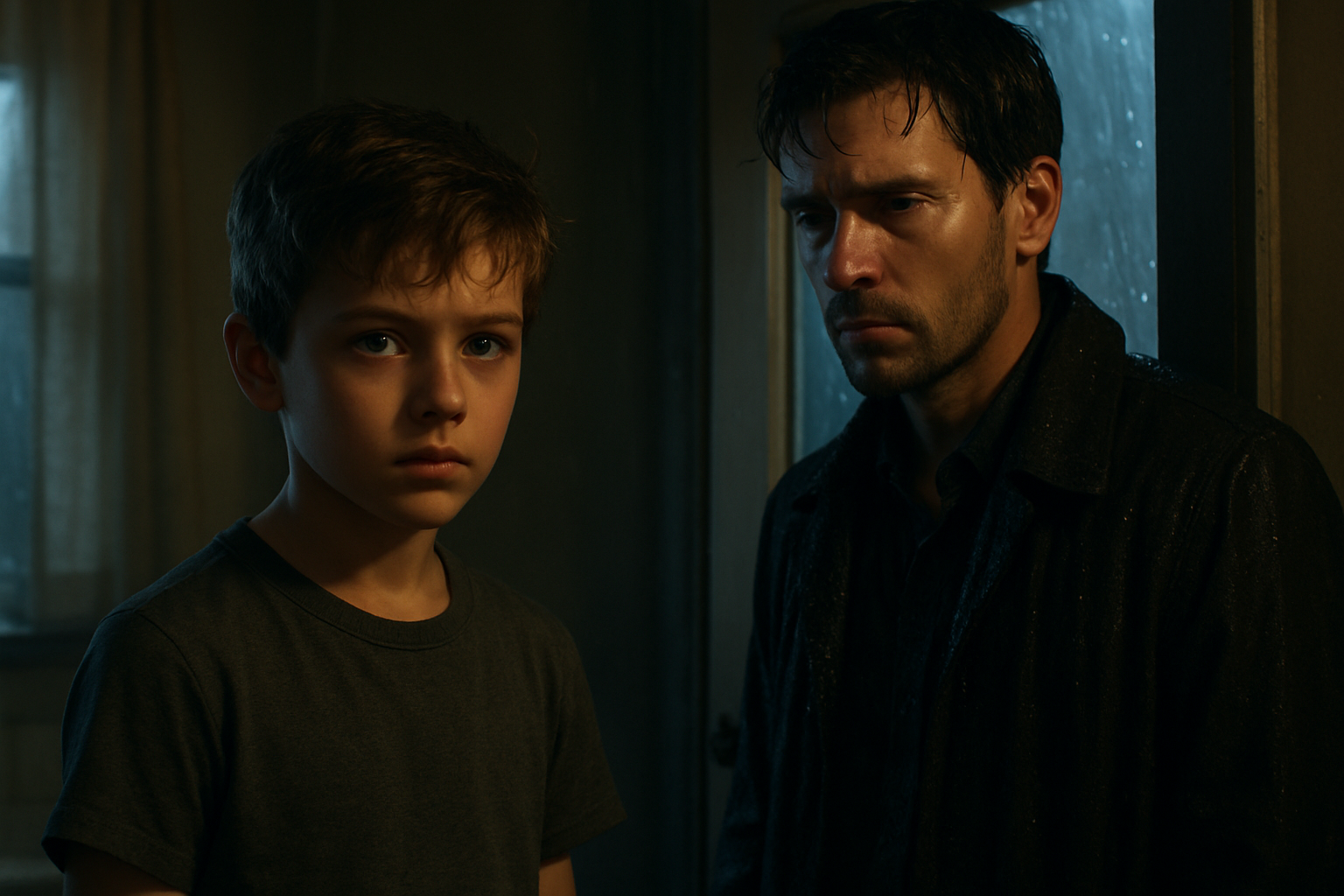
She looked at him, exhausted. “That’s easy to say when you’re not the one who has to put him back together every time the truth breaks something.”
“I know.”
“You keep saying that.”
“Because I am trying very hard not to say anything that makes this worse.”
That stopped her.
For a moment, she saw the effort in him. Not polished remorse. Not a boardroom performance. Effort. Real, clumsy, insufficient. The kind Caleb made when tightening the wrong telescope screw and trying again.
It made her angry all over again, because it was harder to hate him when he was learning.
Nolan looked toward the hallway. “I won’t go to London for six months.”
Tessa’s eyes sharpened. “Don’t make promises because you feel guilty.”
“I’m not.”
“You are soaked in guilt right now. You’d promise to buy the moon if Caleb looked disappointed enough.”
His mouth moved, almost a smile, but it didn’t make it. “The moon is not currently for sale.”
“Nolan.”
He sobered. “I won’t disappear. I don’t know what the company will cost me if I stay, but I know what leaving would cost him.”
“And you?”
His gaze returned to hers.
“What does staying cost you?” she asked.
“Maybe everything I thought I was.”
The answer should have satisfied her. It didn’t. Because the tragedy of Nolan Vale had never been that he felt nothing. It was that he felt too late.
“Your board won’t accept that,” she said.
“My board accepts what I can make profitable.”
“Fatherhood doesn’t usually report quarterly earnings.”
“No.” His eyes moved again toward Caleb’s room. “But absence has long-term liabilities.”
Despite herself, Tessa huffed a tired laugh. “You’re impossible.”
“I’ve been told.”
“By whom?”
“Nearly everyone.”
The fragile humor dissolved quickly, but it left a little oxygen behind.
Nolan reached for his coat from the chair. “I should go.”
Tessa’s heart lurched, foolish and immediate. She hated it. She hated that even now, some abandoned part of her heard those words and became twenty-three again, listening for footsteps that never came.
“Fine,” she said.
He noticed. Of course he noticed. Nolan had always been brilliant at reading rooms, even when he ignored what they told him.
“I mean for tonight,” he said carefully. “Not from this. Not from him.”
Tessa gave a small nod, unwilling to trust her voice.
At the door, he paused.
“I know apologies don’t repair anything,” he said. “But I am going to keep making them with actions until you tell me to stop.”
“And if I tell you to stop?”
He looked at her then, fully.
“Then I stop bothering you,” he said. “But I don’t stop being his father unless he asks me to.”
The words settled between them.
Tessa wanted to argue. She wanted to ask what right he had to sound noble now. She wanted to remind him that biology was not penance and presence was not redemption if it arrived like a storm and left debris behind.
Instead she said, “Goodnight, Nolan.”
Something in his face flickered.
“Goodnight, Tess.”
After he left, the apartment seemed enormous in its quiet.
Tessa stood in the entryway for a long time, staring at the locked door. Then she turned off the lamps one by one, moving through the rooms with the numb efficiency of a woman who had survived too many emotional emergencies to collapse properly after any one of them.
Caleb’s door was cracked open.
She pushed it gently.
He was awake, of course.
The telescope notebook lay open on his blanket. Instead of star charts, he had written Aaron Monroe at the top of a page, underlined once. Beneath it were three bullet points:
Mom’s brother.
Died before I was born.
Nolan failed to come.
Tessa’s breath caught at the bluntness of it.
Caleb looked up. “I know this may upset you, but I wrote the facts so my brain would stop looping.”
She sat on the edge of his bed. “It doesn’t upset me.”
“That is statistically unlikely.”
“It hurts,” she corrected. “That’s different.”
He considered that, then nodded.
“Was Aaron like you?” he asked.
Tessa smiled sadly. “A little. He was stubborn. Funny. He could make friends with anyone. He hated being told what to do, especially when the person telling him was right.”
“So, not like you at all,” Caleb said solemnly.
She laughed then, really laughed, and the sound startled them both.
“He loved old cars,” she said. “And crab cakes from a place your grandmother swore was going to poison us. He used to sing badly on purpose, except I later realized he just sang badly.”
Caleb listened with fierce concentration.
“Did he know about me?”
“No, baby. I didn’t know about you yet.”
“Oh.” His eyes lowered to the notebook. “That’s unfortunate.”
“Yes,” she whispered. “It is.”
He traced the spiral binding with one finger. “Do you think he would have liked me?”
Tessa touched his cheek. “He would have adored you.”
Caleb’s mouth pressed together in a way that told her he was trying not to show how much that mattered.
After a moment, he asked, “Do you still love Nolan?”
The question was so sudden, so precise, that Tessa could not prepare a mother-answer quickly enough.
She looked toward the rain-dark window.