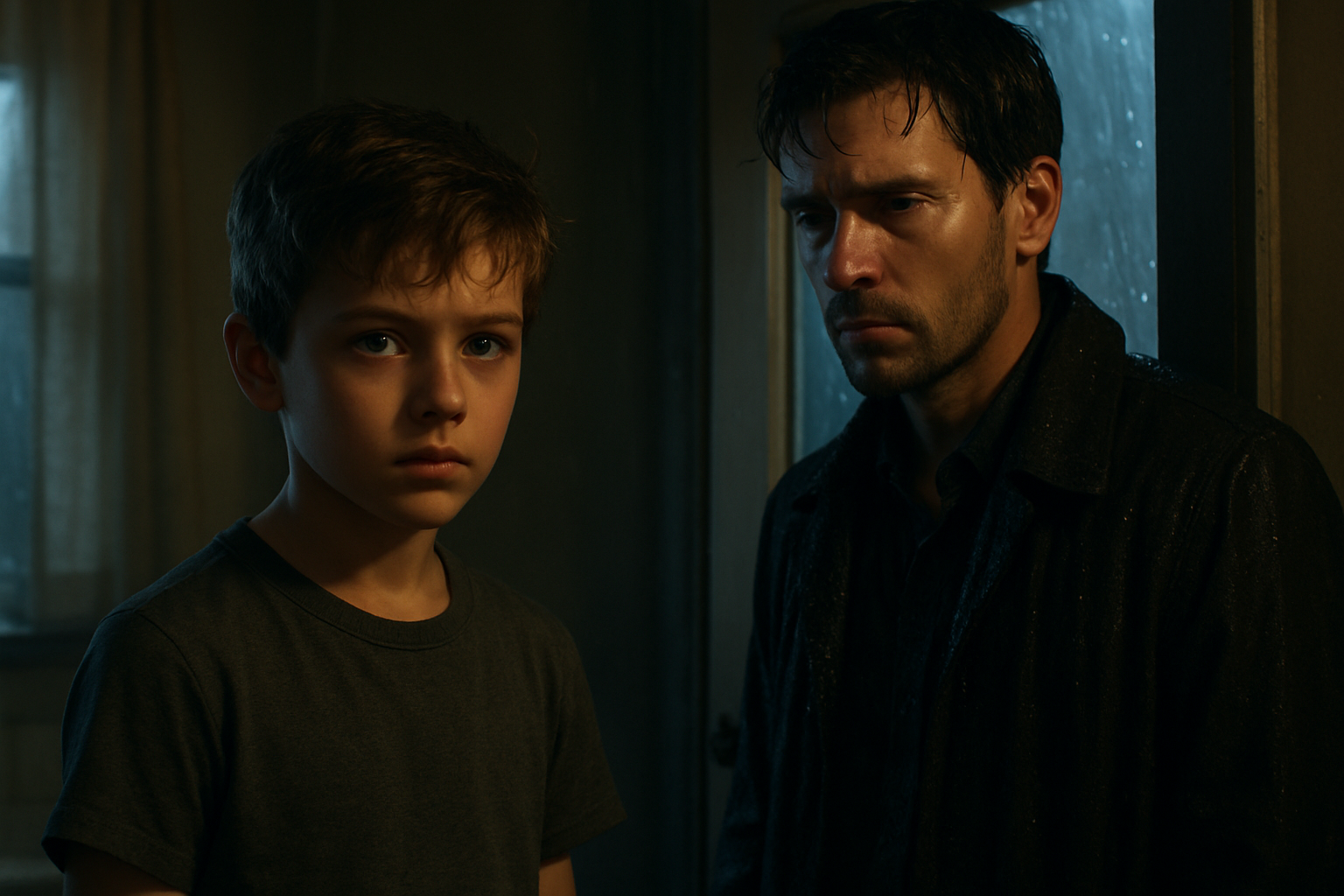
He tried with gifts next, because gifts were easy. Gifts could be researched, purchased, delivered. Gifts did not require the terrifying vulnerability of asking a child what he needed and waiting for an answer that might reveal Nolan had already failed him in ways no object could repair.
He bought Caleb a drone, a telescope, a chessboard carved from marble, and a limited-edition space exploration model that cost more than Tessa’s first car.
The boxes arrived stacked near the door like offerings to a small, skeptical king.
Caleb examined them with grave concern.
“You don’t have to buy me things,” he said.
“I wanted to.”
“Why?”
Nolan opened his mouth.
The true answer rose with such force it nearly knocked him backward.
Because I missed eight birthdays.
Because I don’t know your favorite color.
Because I don’t know what you looked like when your first tooth fell out.
Because I wasn’t there when you learned to walk, or talk, or read books meant for children twice your age.
Because every minute I stand near you, I discover another thing I lost.
Because guilt is eating me alive and I don’t know how to survive it without putting something in your hands.
But that was too large for a living room. Too heavy for an eight-year-old boy standing in socks beside a tower of expensive apologies.
So Nolan said, “I thought you’d like them.”
Caleb considered this.
“I already have a chessboard,” he said. “Marble pieces are inefficient because they chip.”
Nolan blinked. “Right.”
Caleb looked at the drone. “This has poor battery life.”
“Of course it does.”
“The model is inaccurate. The antenna proportions are wrong.”
“I’ll write a stern letter.”
Caleb gave him a patient look, as if humor were a language he understood but did not always respect.
Then he turned to the telescope.
His expression changed.
Not dramatically. Caleb did not seem built for dramatic displays. But something brightened behind his storm-gray eyes, quick and unmistakable.
“The telescope is acceptable,” he said.
“Acceptable,” Nolan repeated.
“The mirror alignment is manual.” Caleb ran his fingers reverently along the side of the box. “You’ll need help.”
“Tess—”
“Don’t.” She lifted a hand, not dramatically, not like someone in a movie stopping a confession, but like a woman too exhausted to survive one more impact. “Don’t say my name like that and make me responsible for comforting you.”
Nolan went silent.
The apartment hummed around them: the refrigerator clicking on, a taxi horn rising from the street below, rain tapping lightly against the windows as if the sky had decided to join the conversation with restraint.
Tessa folded her arms across her middle. Not because she was cold. Because if she did not hold herself together somehow, she was afraid grief would spill out of her in pieces.
“I’m not saying it was your fault,” she said after a moment, though some ruined part of her still wanted to. “Aaron made his choices. He got in the car. He was drunk. He was sick in ways none of us knew how to name yet. I know that. I have told myself that for nine years because the alternative was not survivable.”
Nolan looked down at his hands.
“But you were the person I trusted to show up,” she continued. “And you didn’t.”
His shoulders shifted, as if every word had weight and he was accepting it onto his back.
“I don’t remember the dinner,” he said hoarsely. “I remember Tokyo. I remember Caldwell. I remember thinking if I missed that meeting, everything I had built could collapse before it even became real. I remember…” He stopped, swallowed. “I remember convincing myself people would understand later.”
Tessa’s mouth twisted.
“They never do,” she said. “That’s the thing about later. It never arrives clean.”
Nolan closed his eyes.
“I should have come.”
“Yes.”
“I should have answered every call after.”
“Yes.”
“I should have known you wouldn’t disappear unless something terrible had happened.”
“Yes.”
He nodded once, each answer landing. “I am so sorry.”
Tessa looked at him, and for a moment the room dissolved into another room, another year: Nolan at nineteen, shoes scuffed, hair too long, sitting on the sagging porch steps outside her mother’s house while Aaron sprawled beside him, both of them laughing at something stupid and young and harmless. Back when ambition had seemed like a light inside Nolan, not a fire capable of burning everything within reach.
“I know,” she said again, softer this time. “That’s why I don’t know what to do with it.”
The floor creaked behind them.
Tessa turned so fast her breath caught.
Caleb stood in the hallway in his socks, his navy pajama sleeves rolled to his elbows, one hand wrapped around the little spiral notebook he used for telescope observations. His storm-gray eyes moved from Tessa to Nolan and back again. He had the pale, alert look of a child who had heard enough to know the adults had been keeping a door shut and had just found it open.
Tessa’s whole body went rigid. “Caleb.”
He did not flinch at her tone. He rarely did. Instead he looked at Nolan.