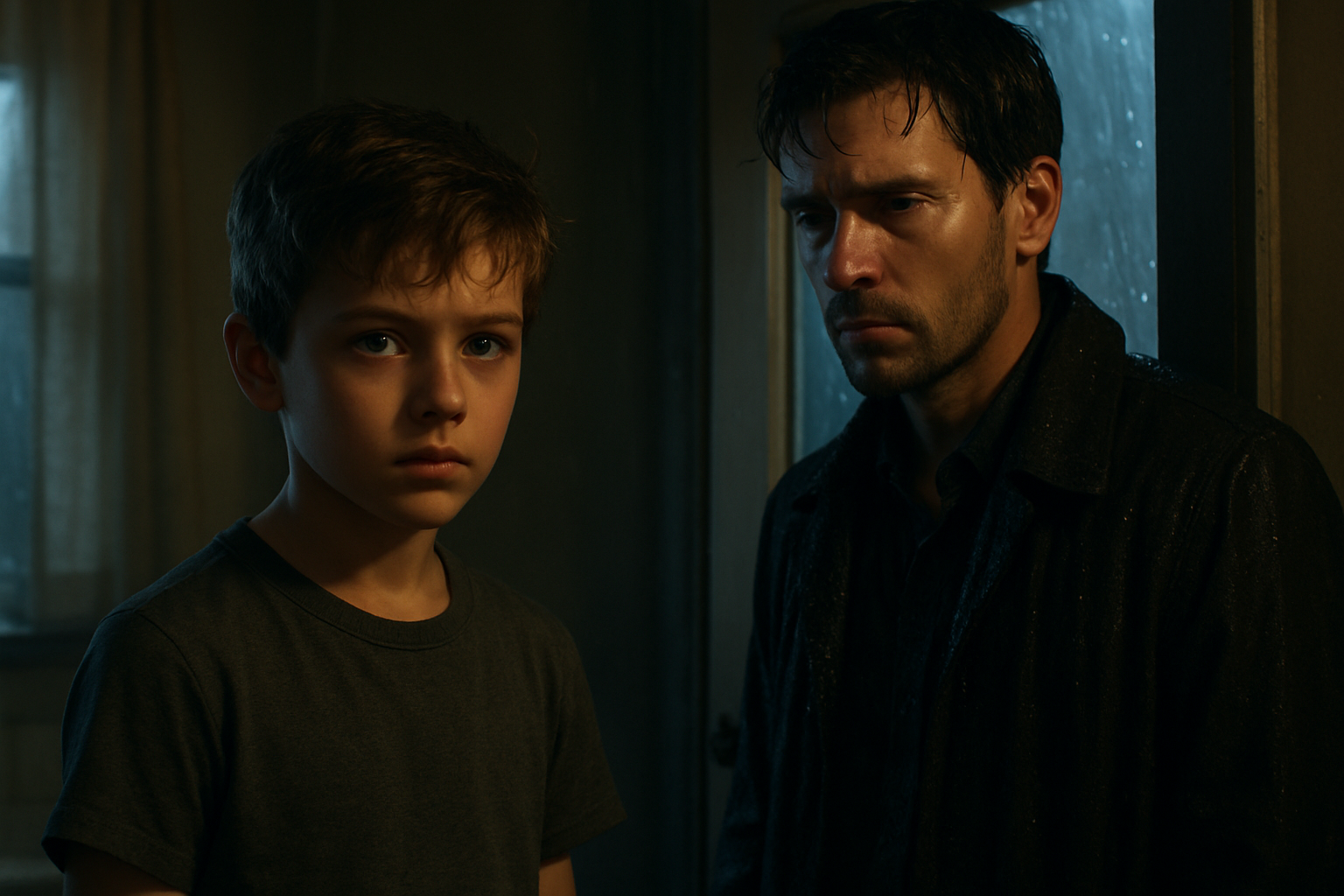
Nolan looked at the plaque for a long time. “I wish I had known him better.”
Tessa glanced at him.
There was grief in that sentence, but not the kind that asked to be comforted. It was simply true.
“You would’ve argued,” she said.
“About what?”
“Everything.”
Caleb nodded. “That tracks genetically.”
The dedication ceremony was short because Tessa refused to let it become a gala. Nolan spoke for less than two minutes, which several business magazines later described as “surprisingly restrained,” though Caleb called it “appropriate word economy.” Denise spoke next, voice shaking at first, then growing stronger as she told the crowd Aaron used to drag Tessa onto the roof when they were kids because he believed stars looked brighter if you were not supposed to be up there.
“He was wrong about many things,” Denise said, and laughter moved gently through the crowd. “But he was right that children need places to look beyond what hurts.”
Tessa stood with Caleb’s shoulder pressed against her side, Nolan just behind them, and felt the old ache open in her chest.
But this time, it did not swallow everything.
It made room.
Later, after the speeches ended and the crowd thinned, after the hot chocolate cooled and the younger children were carried downstairs sleepy and sugared, the clouds finally began to break.
“Typical,” Caleb muttered. “The sky waited until after peak attendance.”
“Very inconsiderate,” Nolan said.
“Don’t patronize the sky on my behalf.”
“Never.”
The largest telescope stood near the eastern edge of the rooftop, angled toward a gap in the clouds. Caleb approached it with the reverence of a priest and the impatience of a chief engineer. Nolan followed, careful to keep half a step back.
Tessa watched from a few feet away.
Her son adjusted the eyepiece, then glanced at Nolan’s hand.
“You’re turning it too hard,” Caleb said.
“I’m being gentle.”
“You’re being rich. Rich people think pressure solves mechanisms.”
Tessa laughed before she could stop herself.
Nolan looked over his shoulder at her, wounded. “You’re enjoying this.”
“Deeply.”
Caleb repositioned Nolan’s fingers. “Like this. Precision, not domination.”
“That feels like a broader critique.”
“It is.”
Nolan obeyed.
Caleb stepped back, satisfied. “Look now.”
Nolan bent to the eyepiece.
Above them, the clouds shifted in long silver seams. The moon appeared between them, bright and scarred, its surface marked by ancient collisions, cratered by impacts it had survived without ceasing to shine. It hung over Baltimore like a promise that damage and beauty were not opposites.
Nolan stayed bent over the telescope for a long moment.
Then he straightened and looked at Caleb.
“It’s beautiful,” he said.
Caleb’s face softened in a way he did not seem to notice. “I know.”
Then, after a pause, he added, “But I like hearing you say it.”
Nolan’s expression changed.
There were no cameras near enough to capture it. No audience close enough to misunderstand it. Just a father receiving a sentence that sounded small and was not small at all.
Tessa moved closer.
Caleb, who had once guarded every feeling like evidence in a trial, slipped his hand into hers without looking. His fingers were warm despite the cold air.
Then his other hand reached, hesitated for the smallest fraction of a second, and found Nolan’s.
Nolan closed his hand around Caleb’s carefully, as if the boy were both strong and breakable, which of course he was. Which all of them were.
For a while, the three of them stood under the clearing Baltimore sky. Their matching crescent birthmarks were hidden beneath sleeves and collars, but Tessa thought of them anyway—those small, strange marks that had become proof, wound, question, and answer. Hidden and visible at the same time. Like grief. Like love. Like family.
Their shadows touched on the rooftop floor.
Below them, the youth center hummed with voices. Somewhere downstairs, Denise was probably telling someone that Nolan still could not chop carrots properly. Somewhere beyond the skyline, the city carried on with all its sirens, secrets, laundromats, corner stores, churches, rowhouses, and roofs where children looked up because someone had finally given them a reason to.
Caleb tilted his face toward both of them.
“I have a hypothesis,” he said.
Tessa smiled. “Of course you do.”
Nolan gave Caleb his full attention. “Let’s hear it.”
Caleb looked at the moon first, as though borrowing courage from its battered brightness.
“That some families don’t start when people do everything right,” he said.
Tessa’s smile trembled.
Caleb glanced at Nolan, then at her. His storm-gray eyes held both of them now—not accusing, not pleading, simply measuring what had become true.
“Some start when people stop running from what they did wrong.”
Nolan swallowed. “That’s a strong hypothesis.”
“It has supporting evidence,” Caleb said.
Tessa squeezed his hand. “Then we’ll keep collecting more.”
Caleb nodded, satisfied with this approach. “Longitudinally.”
“Obviously,” Nolan said.
Tessa laughed softly.