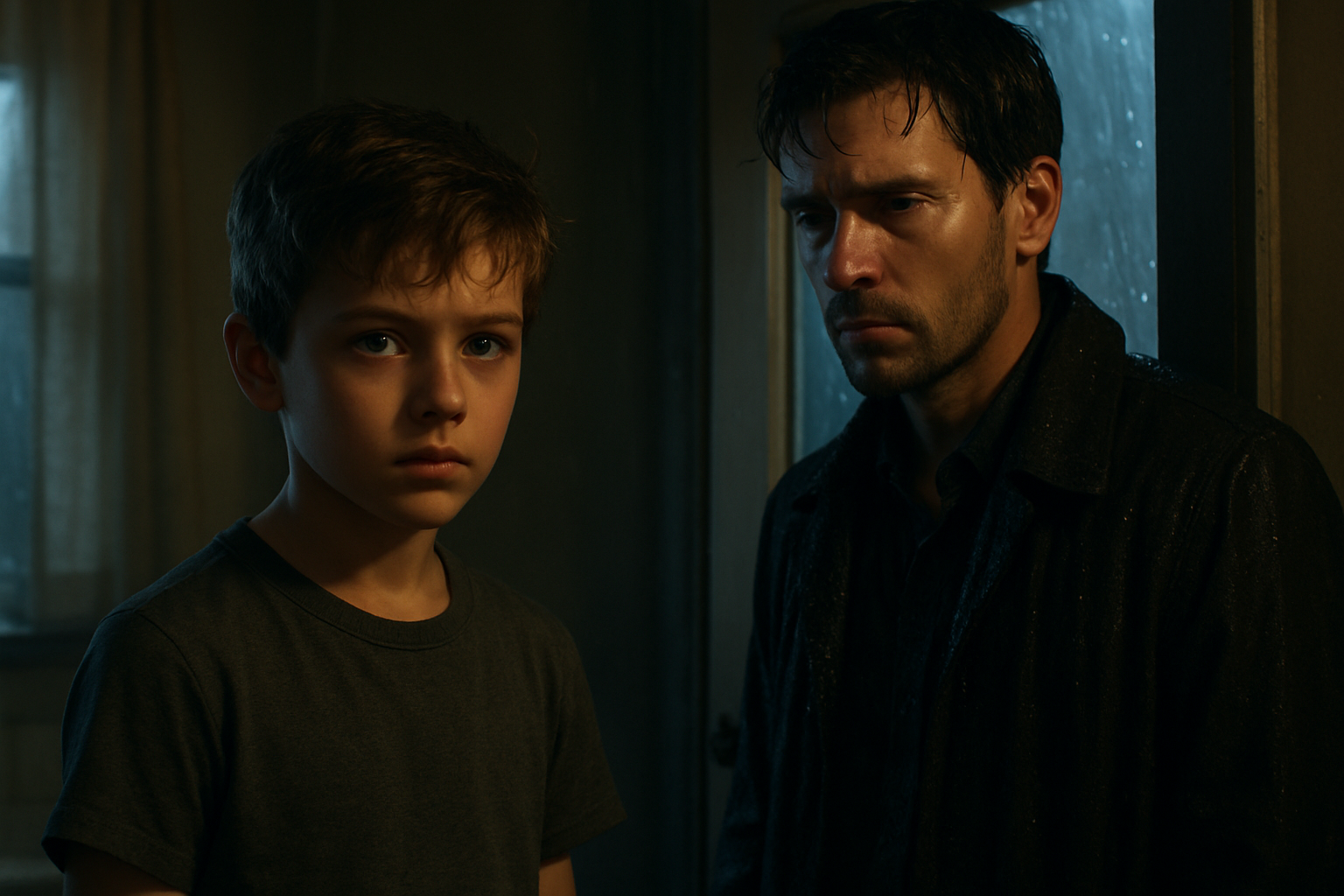
Nolan looked at her over their son’s head.
And this time, there was no airport between them. No investor dinner. No locked boardroom. No mother whispering ambition into his ear like scripture. No public image. No panic dressed as practicality. No past standing with a hand on his throat, deciding what he was allowed to say.
Only Tessa, with wind in her hair and moonlight on her face.
Only the woman who had loved him before he knew how to deserve it.
Only the woman who had survived him, defied him, protected their son from him, and still found a way to stand beside him when truth finally arrived.
“I love you,” Nolan said.
Not like a claim.
Not like a plea.
Like an offering placed gently into open hands.
Tessa’s eyes filled, but her smile held.
“I know,” she said.
Caleb sighed.
Both adults looked down.
“That was emotionally predictable,” he said.
Nolan laughed first. Then Tessa did, too, the sound catching and widening until it felt as if the rooftop itself had exhaled.
And somewhere in that laughter was Aaron—Aaron in Denise’s kitchen with a dish towel on his head, Aaron on the roof insisting the stars were brighter when you broke the rules, Aaron’s hand on Tessa’s shoulder in every memory where love and trouble had arrived together.
The past did not disappear.
It never would.
It stayed in the spaces between them: in missed birthdays, in photographs, in the grave Tessa still visited, in the old fear that sometimes returned without warning, in Nolan’s quiet moments of regret, in Caleb’s careful questions, in Denise’s eyes when she looked at the plaque.
But the past no longer stood at the door like a storm demanding to be let in.
They had opened that door once and nearly lost everything to what came through.
This time, they knew better.
They knew what to keep.
What to forgive.
What to name.
What to repair.
And what to never abandon again.
Above them, the clouds parted fully at last, and the moon shone down—scarred, luminous, whole.
THE END