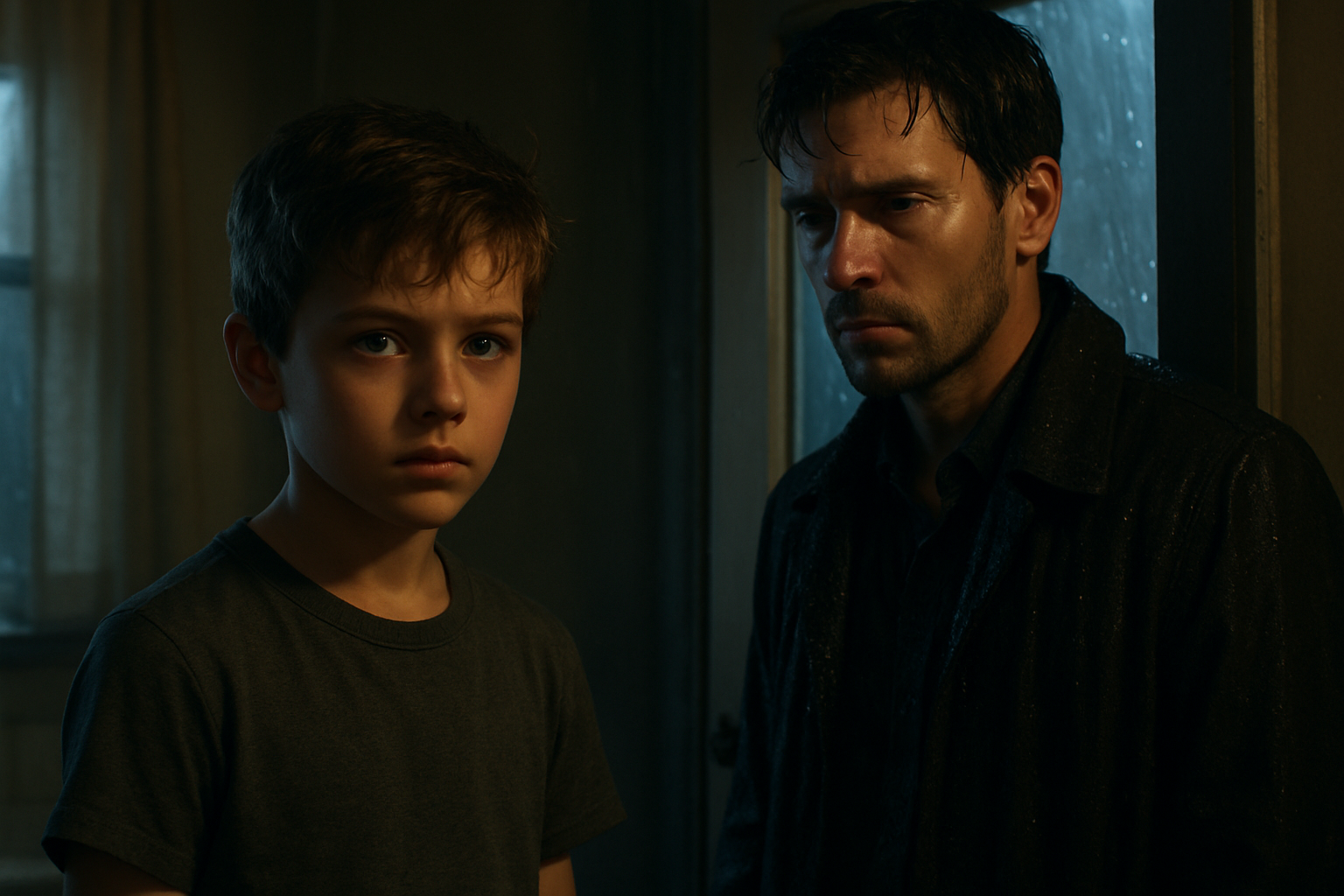
The first Sunday Nolan came to dinner after the storm, she handed him a knife and a pile of carrots.
“You can chop,” she said.
Nolan accepted the knife like it was a legal summons. “Of course.”
“Not like that,” Denise said five seconds later.
Tessa leaned against the counter, enjoying herself far too much.
Caleb observed from the table. “His hand position suggests he has never feared consequences from vegetables.”
“I have chopped vegetables,” Nolan protested.
Denise snorted. “Into what, stock options?”
By the end of the meal, Nolan had produced uneven carrots, accepted three corrections, and listened while Denise told a story about Aaron at seventeen trying to fix the kitchen sink and flooding two rooms because he refused to admit he had no idea what he was doing.
“He kept saying, ‘I’ve got it, Ma,’ while water shot sideways like a fountain,” Denise said, laughing through the memory. “Tessa was screaming, I was slipping all over the floor, and Aaron was wearing my good dish towel on his head like that was going to solve the plumbing.”
Tessa laughed until her eyes stung.
Nolan listened. Not with the guilt-heavy expression of a man trying to pay respect to the dead, but with attention. With gratitude. As if every ridiculous, ordinary detail of Aaron’s life was something worth preserving.
Later that night, as he helped dry dishes, Denise stood beside him in the warm kitchen light.
“I’m not giving you my blessing,” she said.
Nolan nodded. “I understand.”
“I don’t own Tessa’s life, and I don’t own Caleb’s heart. They’ll decide what place you get.”
“I know.”
Denise set another plate in the rack. “But I’ll tell you this. If you hurt that boy because you get tired, or scared, or because your family starts whispering in your ear again, I won’t need money or lawyers to ruin you.”
Nolan looked at her. “I believe you.”
“Good.”
A pause.
Then Denise added, “Your carrots were terrible.”
“Yes,” Nolan said. “I gathered.”
One year after the storm, the Aaron Monroe Community Observatory opened on the renovated rooftop above a youth center in East Baltimore.
It had taken eleven months, four zoning meetings, two contractor delays, one argument about accessibility that Tessa won so thoroughly the architect apologized to the entire room, and an anonymous donation Nolan tried to keep anonymous until Caleb discovered it through public filings and said, “Your stealth skills are disappointing.”
The youth center itself had once been a tired brick building with flickering hallway lights and a basketball court whose floor complained under every sneaker. Now it still had the old brick, because Tessa insisted the place should not be polished into something that forgot where it stood. But the windows were new. The roof was reinforced. The stairwells were bright. Downstairs, beside the tutoring rooms and art studio, there was a crisis counseling room staffed by people trained to answer the kinds of calls that changed lives.
Nolan had funded it.
Tessa had shaped it.
Caleb had named three of the telescopes after moons and one after a dog he did not own.
The opening night was cloudy.
Caleb stood on the rooftop with a clipboard tucked under one arm, staring at the sky with deep personal offense.
“This is statistically rude,” he announced.
Tessa adjusted his collar. “The clouds did not RSVP.”
“They knew.”
Nolan, standing nearby in a dark coat instead of a suit for once, looked upward. “Cloud cover may thin by nine.”
Caleb narrowed his eyes. “Did you check four weather models?”
“Six.”
“Acceptable.”
Despite the clouds, people came.
Families filled the stairwells. Children leaned over the rooftop railing and pointed at the skyline. Teenagers pretended not to care, then asked careful questions about the telescopes when they thought no one was watching. Counselors downstairs showed parents the new rooms. Volunteers passed out paper cups of hot chocolate. Someone’s toddler dropped a cookie into a potted plant and denied involvement with frosting on both hands.
Denise arrived wearing the blue coat Aaron had once bought her for Christmas after saving three months of part-time wages. She stood very still when she saw the small plaque near the main telescope.
AARON MONROE
Brother. Son. Friend.
For every child who looks up and deserves someone to answer.
No donor name beneath it.
No foundation logo.
No self-congratulatory inscription.
Tessa had made that clear from the beginning.
“If you make my brother’s memorial about your redemption,” she had told Nolan during planning, “I will remove the entire wall myself.”
Nolan had not argued.
Now he stood slightly behind Denise as she touched the plaque with two fingers. Her mouth trembled.
“He would’ve liked this,” she said.
Tessa’s throat tightened. “He would’ve pretended not to.”
Denise laughed softly, tears spilling anyway. “Then he would’ve tried to climb something he shouldn’t.”
Caleb came up beside them. “There are safety rails.”
“With Aaron,” Tessa said, “that would have been considered a suggestion.”