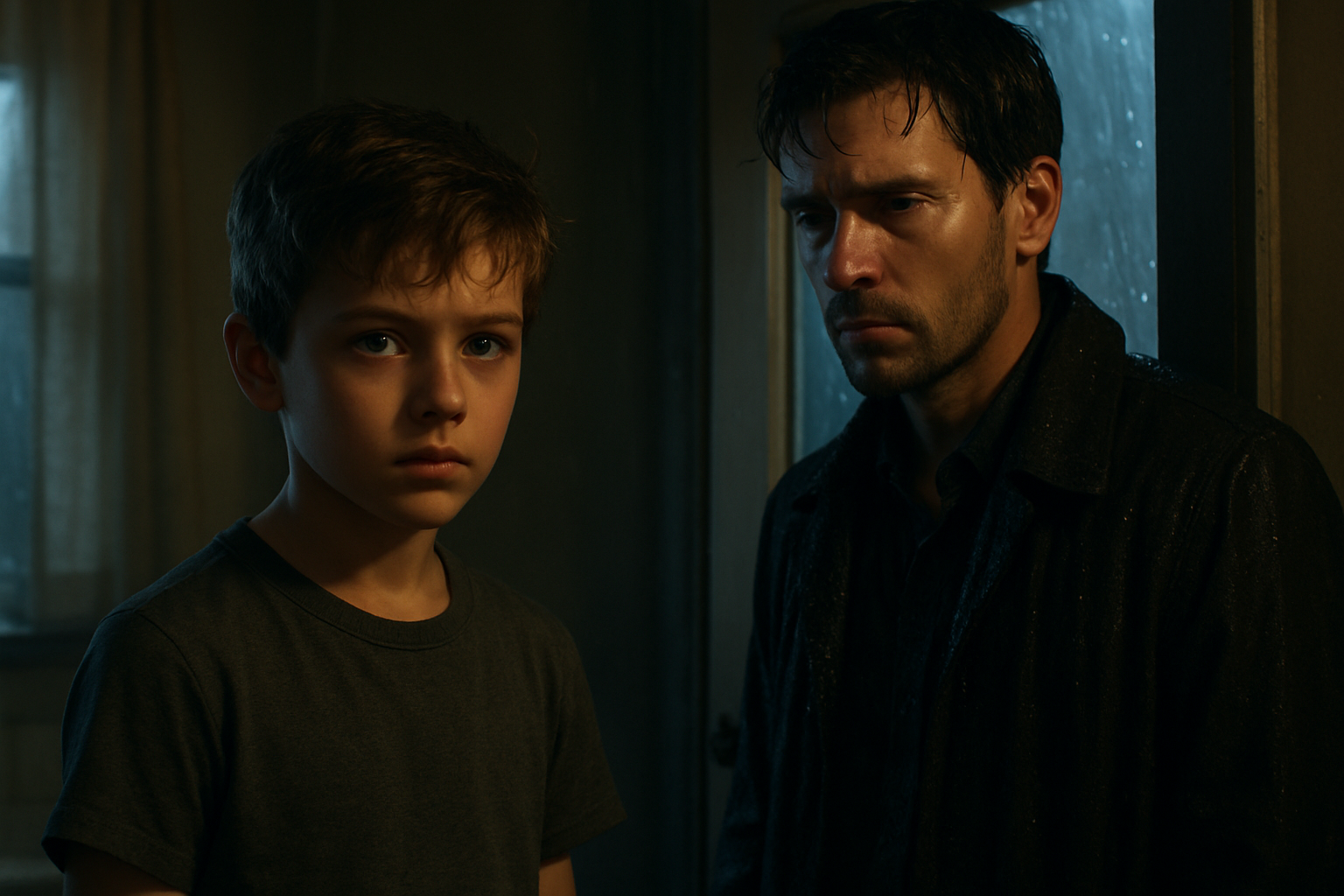
Nolan looked up at her. “What did she say?”
“Enough,” Tessa replied.
Caleb looked at him, searching. “Are you going to leave?”
The question landed harder than any accusation could have.
Nolan went still.
Then he sat fully on the floor in front of Caleb, ruining the line of his coat without noticing.
“No,” he said. “I am not going to leave because my mother is angry. I am not going to leave because the company is complicated. I am not going to leave because reporters get bored and mean. I am not going to leave because this is hard.”
Caleb’s mouth trembled.
Nolan leaned closer. “I left once because I was young and selfish and afraid, and because I let other people decide what I should protect. That is the worst mistake of my life. I can’t erase it. But I can promise you this: no one gets to make that choice for me again.”
Caleb stared at him for a long moment.
Then he slid off the couch and into Nolan’s arms.
Nolan held him like something inside him had finally been allowed to break open. Tessa watched them from the window, one hand pressed to her mouth, and felt the old house shift around them—not physically, not audibly, but in the secret architecture of memory.
For years, this room had held absence.
Now it held a father on the floor and a boy learning, inch by inch, that staying could be real.
Later, after Caleb slept, Nolan stood in Tessa’s kitchen with his tie loosened and fury banked low in his eyes.
“I’m going to deal with her,” he said.
Tessa poured tea because it gave her hands something to do. “Define deal.”
“I don’t know yet. Something legal enough that you won’t be mad.”
“An encouraging threshold.”
“She came here.” His voice nearly cracked. “She came to your home. To Caleb.”
“I know.”
“I should have anticipated it.”
“You can’t anticipate every cruel thing your mother does.”
“I can anticipate most of them. I was trained by the best.”
Tessa set the mug in front of him. “Nolan.”
He looked at her then, and the anger gave way to something more dangerous: guilt.
“I brought this to your door.”
“No,” she said. “You opened the door to us. There’s a difference.”
“She’ll keep pushing.”
“Then we push back.”
His gaze held hers. “Together?”
Tessa thought of the girl she had been, waiting alone by phones that did not ring. She thought of Vivienne’s envelope, of Caleb’s shaking hands, of Nolan on the floor promising not to disappear.
Together was no longer a fantasy.
It was a decision.
“Yes,” she said. “Together.”
The next morning, Nolan issued no public statement. He gave no interview, offered no dramatic denunciation for the networks to dissect over breakfast. Instead, he made three quiet calls.
By noon, Vivienne Vale had been removed from every advisory capacity connected to Vale Meridian’s family trusts.
By three, Nolan’s attorneys filed documents restricting her from contacting Caleb without parental consent.
By evening, a sealed packet of evidence concerning her obstruction nine years earlier was delivered to counsel overseeing the independent review.
Vivienne had built her life on access.
Nolan closed the doors one by one.
When she called him that night, he answered only because Tessa stood beside him and nodded.
Vivienne did not bother with darling.
“You have no idea what you’re doing,” she said.
Nolan looked at Tessa, then at the doorway where Caleb’s laughter drifted from the living room—he was video calling Aaron’s mother, explaining why Vivienne was “less strategically intelligent than advertised.”
“Yes,” Nolan said. “I do.”
“You would destroy your own mother?”
“No,” he replied. “I’m refusing to let my mother destroy my family.”
There was silence on the line.
Then Vivienne said, very softly, “That girl has made you weak.”
Nolan’s expression changed. Not with pain. With clarity.
“No,” he said. “She’s the reason I know what strength looks like.”
He ended the call.
Tessa expected relief.
Instead, she felt the air tighten, as if some unseen storm had shifted direction.
Because people like Vivienne did not simply lose.
They retreated, recalculated, and found sharper weapons.
Three days later, the first article appeared.
Not from a major paper at first. A gossip site. Then a financial blog. Then a morning segment with smiling hosts and cruel questions disguised as concern.
Was Nolan Vale’s sudden devotion sincere—or the result of emotional manipulation by his former teenage girlfriend?
Had Tessa Monroe hidden a billionaire’s son for years to leverage a payout?
Was Caleb truly Nolan’s child, despite the DNA test, or part of a larger campaign to destabilize Vale Meridian?
Worst of all, an old photograph of Aaron appeared online, taken from some forgotten social media account. The caption called him Tessa’s “troubled brother” and implied the foundation bearing his name was a sentimental cover for reputation laundering.
Tessa stared at the screen until the words blurred.
Then she closed the laptop before Caleb could see.
But Caleb was his father’s son and his mother’s too.
He saw everything eventually.