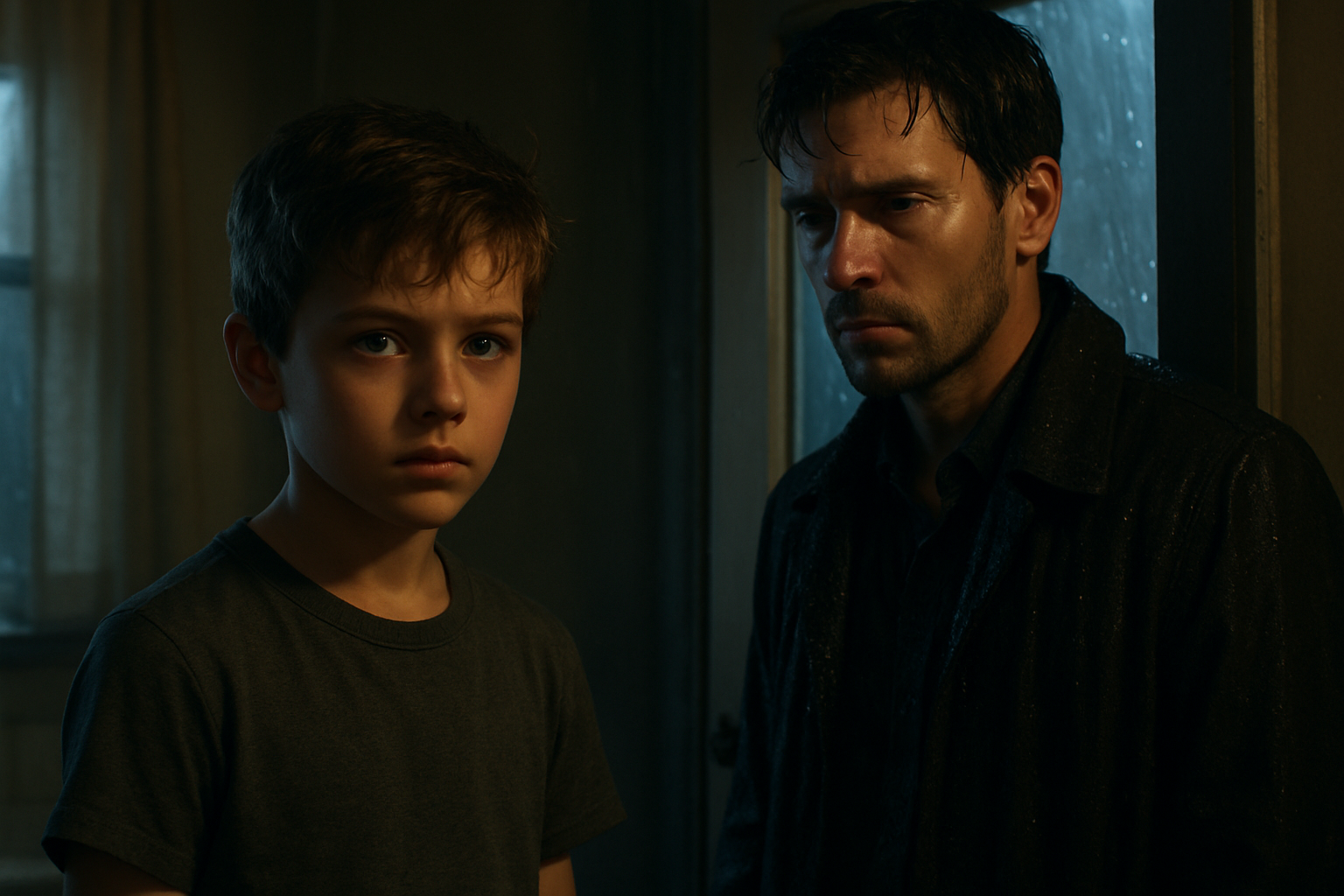
That Friday, Nolan arrived to find the house too quiet. Tessa stood in Caleb’s room holding his phone. Her face had gone bloodless.
“He left school after lunch,” she said. “He saw the articles. Some kids were talking.”
Nolan’s heart stopped.
“Where is he?”
Tessa held up the phone with a shaking hand. On the screen was a message from Caleb, sent eighteen minutes earlier.
I’m not evidence. I’m not a scandal. I’m going where Uncle Aaron used to take me when people were too loud.
Nolan looked at Tessa.
She was already moving.
Outside, the sky over Baltimore had turned the color of Caleb’s eyes, storm-gray and restless. Thunder rolled somewhere beyond the harbor, low and warning, as Nolan and Tessa ran for the car—not away from the past this time, but straight into it.
He smiled, but the expression faltered almost as soon as it appeared, as if even a small happiness had to pass through the bruised place between them before it could be trusted.
“I’m sorry for Aaron,” Nolan said.
The words came quietly, without the polish he used in boardrooms, without the careful rhythm of a man who had learned to make apologies sound like strategy. His hands were clasped loosely between his knees, his suit damp at the cuffs from the wet grass, his hair still unsettled by the wind that had torn through Baltimore an hour earlier.
“Not because I caused what happened in some simple, clean way,” he continued. “And not because guilt makes me noble. It doesn’t. Guilt is easy compared to consequences.”
Tessa did not look at him. She kept her eyes on the lawn, where rain clung to every blade like tiny, trembling witnesses.
Nolan swallowed.
“I’m sorry because you called me when you were afraid, and I let people convince me that my future mattered more than your emergency. I’m sorry because you learned not to trust me from evidence I provided. I’m sorry you raised Caleb alone because the version of me you knew was too dangerous to depend on.”
His voice broke there. Not dramatically. Not loudly. Just enough for Tessa to hear the fracture in it.
“And I’m grateful you protected him,” he said. “Even from me.”
The storm had moved east, leaving the sky bruised purple at the edges. Somewhere beyond the trees, a siren wailed and faded. The world, stubborn and indifferent, kept going.
Tessa stared at the wet grass until it blurred.
For years, forgiveness had felt like lowering a weapon while the enemy still stood armed. It had felt like inviting harm back in, like betraying the girl she had been, the sister who had buried Aaron, the mother who had learned to make one paycheck stretch across every fear. She had carried her anger like proof. Proof that Aaron mattered. Proof that what happened had not been small. Proof that Nolan’s absence had consequences.
But Nolan was not standing across from her anymore, guarded by money, status, and a family name sharp enough to cut. He was sitting beside her with mud on his shoes and grief in his mouth, unarmed at last, willing to be seen without the empire.
And Tessa was tired.
Not weak. Not defeated.
Tired of letting the worst day of her life decide every day after it.
“I forgive you,” she said.
Nolan’s breath caught as if the words had struck him in the chest.
Tessa finally turned her head. His face had gone still, stunned in a way she had never seen when he was younger. Back then, Nolan Vale had always looked like someone already halfway to winning. Now he looked like a man who had been handed something too fragile to hold carelessly.
“I don’t forgive you because you fixed it,” she said. “You can’t. Aaron is still gone. Those years are still gone. Caleb’s first steps, first words, first fever, first nightmare—you weren’t there. Forgiveness doesn’t erase that.”
“I know,” Nolan whispered.
“I forgive you because I’m tired of holding pain like it proves I loved Aaron properly.” Her voice trembled, but she did not stop. “I loved him. I miss him. I hate what happened. None of that requires me to keep hating you.”
Nolan bowed his head.
For a while, neither of them spoke. The quiet between them did not feel empty. It felt like a room after a fire had gone out—smoke-stained, damaged, but survivable.
Then Tessa nudged his shoulder with hers.
“Also,” she said, “Aaron would haunt me for being this dramatic.”
Nolan let out a breath that was almost a laugh. “He would haunt me first.”
“He probably already has. That explains your cooking.”
Nolan looked offended for half a second before the laugh broke free. A real laugh. Rusted from lack of use, but real.
Tessa laughed too, and then, without deciding to, she let herself lean against him.
Not all the way. Not like they were twenty-two again and the roof over Denise’s kitchen was the whole universe. Not like nothing had happened.
Just enough.
Enough to say they were no longer standing on opposite sides of the ruin.
Enough to say that rebuilding did not have to begin with certainty. It could begin with two people sitting in damp grass, telling the truth at last.