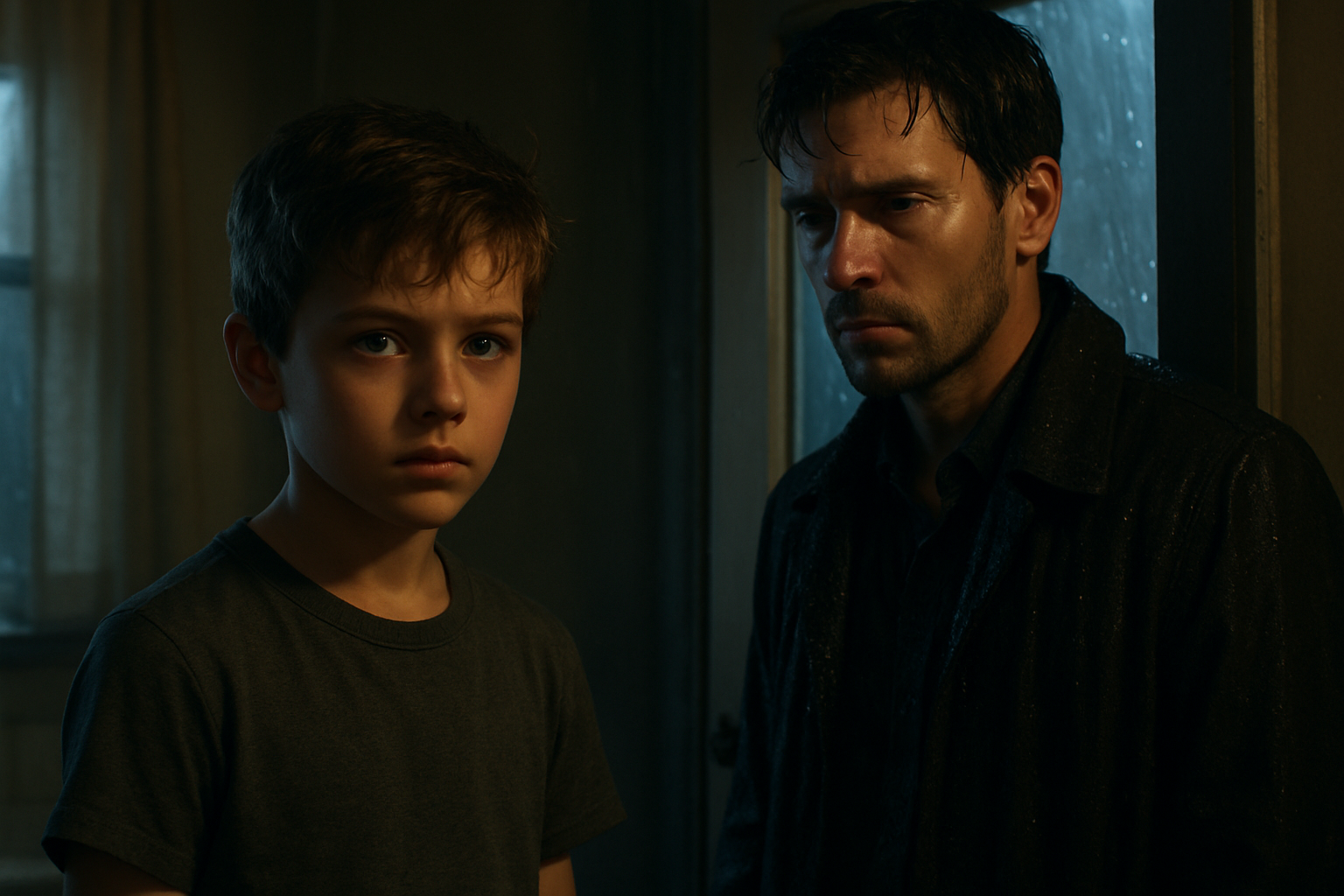
It was only her hand in his, warm and real on the back steps of a narrow house in South Baltimore, while the city breathed around them and the boy inside slept beneath glow-in-the-dark stars Nolan had helped stick to the ceiling in the wrong constellations until Caleb corrected him with severe disappointment.
It was enough for that night.
And for the first time in years, Tessa let enough be enough.
The next month unfolded with the strange tenderness of a life trying on a new shape.
Nolan did not move in. Tessa made that clear before he could even offer, and he accepted it with the solemnity of a man being briefed by a judge. He kept his place in Baltimore, not the glass penthouse he had once rented for visits, but a brick townhouse six blocks from hers with floors that creaked and windows that stuck in the rain. He claimed he liked it because it was “architecturally honest,” which made Caleb say, “It’s drafty,” and Tessa say, “He means it’s drafty.”
Still, Nolan filled it carefully. Not with museum furniture or the cold elegance of rooms designed to intimidate, but with mismatched mugs, Caleb’s spare telescope parts, a ridiculous number of blankets because Tessa complained once that rich people never owned enough blankets, and a secondhand kitchen table with burn marks on one side.
“Why did you buy a damaged table?” Caleb asked.
“Because your mother said new furniture makes her suspicious.”
Tessa, passing through with a basket of laundry, did not deny it.
They began Sunday dinners.
At first, the dinners were awkward. Caleb treated the whole ritual like a social experiment. He timed how long Nolan could go without checking his phone. He rated meals on flavor, texture, and “likelihood of future regret.” He asked difficult questions at random intervals, such as, “Did you always know you were emotionally repressed, or was it diagnosed later?”
Nolan took every question like penance and answered honestly.
“No, I did not always know.”
“Who told you?”
“Your mother. Repeatedly.”
“That sounds accurate.”
Tessa laughed more in those weeks than she had in years, and the laughter frightened her. It came too easily sometimes, rising before she could stop it, spilling into rooms that had learned to survive on function instead of joy. She would catch herself leaning against the counter while Nolan and Caleb argued about whether Pluto’s demotion was scientifically justified or morally offensive, and for one breath she would feel the impossible sweetness of a family gathered in lamplight.
Then guilt would follow.
Aaron should have been there.
Aaron would have loved watching Nolan fail to defend himself against a ten-year-old. He would have stolen food from the pan and declared himself the only person in the house with taste. He would have made some joke too sharp for Caleb and too funny for Tessa to properly scold.
Grief did not leave because happiness entered. It simply made room reluctantly, like an old wound learning weather.
Nolan noticed. He did not ask her to be happy faster.
One Sunday, after Caleb fell asleep on the sofa with a physics book open on his chest, Tessa found Nolan standing in the hallway before the framed photograph of Aaron she had hung beside the stairs. It was from the summer before everything broke: Aaron grinning at the camera, one arm slung around Tessa, a bruise on his cheekbone, sunlight in his hair, defiance and devotion written all over him.
“I used to be jealous of him,” Nolan said quietly.
Tessa stopped beside him.
“You should have been,” she said. “He was better-looking.”
A huff of laughter escaped him. “That too.”
She looked at the picture. “Why jealous?”
“Because he got to stay.”
Tessa felt the words settle between them.
Nolan’s jaw worked. “I used to tell myself he had no ambition. That he was trapped here because he didn’t know how to want more. But he knew exactly what mattered. He stayed because you needed him. Caleb needed him. That was the kind of man I should have been.”
Tessa swallowed.
“Aaron wasn’t perfect.”
“No,” Nolan said. “But he showed up.”
She nodded, unable to speak.
The Aaron Monroe Foundation opened its first crisis-response center in Baltimore before the winter fully arrived. Nolan insisted that Aaron’s mother approve the building plans and name the community rooms. She chose names that had nothing to do with donors or plaques: The Kitchen, The Porch, The Workshop, The Quiet Room. Places people could enter without feeling examined.
Tessa served on the advisory board only after Nolan agreed she could veto anything that smelled like rich guilt in polished shoes.
“You’re very aggressive in meetings,” he told her afterward, sounding almost proud.
“I learned from raising your son.”
“Our son,” he said, then paused.
Tessa looked at him.
He held her gaze, careful and steady. “If that’s all right.”
She thought of Caleb on the day he was born, red-faced and furious, gripping her finger as if he had arrived prepared to argue with the universe. She thought of every form where she had written father unknown with a pen that nearly tore the paper. She thought of Nolan holding Caleb’s telescope notebook as though entrusted with a relic.