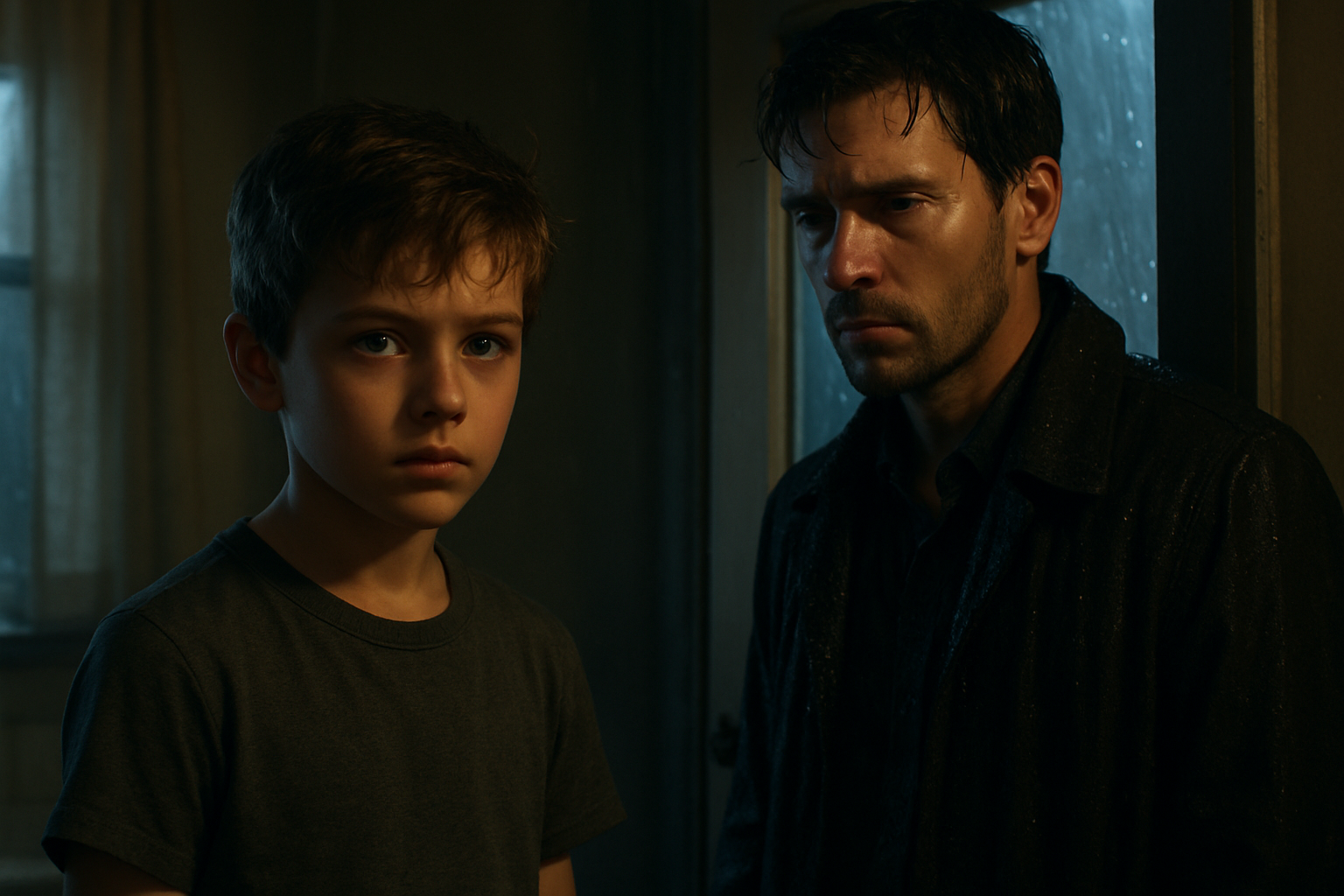
“Our son,” she said.
Nolan turned away under the pretense of looking for his keys, but she saw him wipe his face.
Caleb adjusted faster than either of them expected and slower than Nolan secretly hoped.
He still tested him. He still withheld certain pieces of himself, not cruelly, but with the caution of a child who had learned adults could vanish even when they loved you. He began calling Nolan Dad more often, though never in emotional moments where it might seem intentional. He used it when asking for cereal, when complaining about batteries, when announcing that the school’s science lab was an underfunded tragedy.
But when he was hurt or frightened, he still called for Tessa first.
Nolan never corrected that. He only came when called, and sometimes when he wasn’t.
The science fair became the next battlefield.
Caleb built a model predicting localized storm movement using pressure changes, humidity, and data from homemade sensors he had placed on the roof, in the backyard, and once, without permission, on the neighbor’s gutter. His project board was too detailed for the assigned space, his explanation too advanced for most of the judges, and his patience with their confusion dangerously limited.
Nolan crouched beside him before the judging began. “Remember what we talked about.”
“That adults dislike being corrected in public.”
“And?”
“That I should allow them to be wrong briefly before guiding them toward accuracy.”
“Gently.”
Caleb sighed. “Fine.”
Tessa adjusted his collar. “And no saying anyone’s question is ‘foundationally flawed.’”
“What if it is?”
“Use your face to hide that opinion.”
“I have your face,” Caleb said. “It hides nothing.”
Nolan laughed so hard he had to stand up and walk away.
Caleb won first place.
He pretended not to care until they reached the parking lot, where he clutched the ribbon against his chest and asked if they could call Aaron’s mother to tell her. Tessa’s heart folded in on itself, tender and aching.
They called her from the car. Nolan stood outside in the cold while Caleb spoke, giving him privacy, but Tessa watched through the windshield as Nolan looked up at the low gray clouds. There was pride in his face, and sorrow, and something like prayer.
That should have been the shape of things for a while—messy, fragile, improving.
But peace, Tessa had learned, often attracted people who believed it was theirs to disturb.
Vivienne Vale returned without warning at the end of February.
She did not call first. She did not request permission. She arrived at Tessa’s row house in a black car that looked too expensive for the narrow street, wearing winter white and diamonds at four in the afternoon, as if grief and snow had been tailored for her.
Tessa opened the door and stared.
Vivienne smiled the way women in her world smiled before drawing blood.
“Tessa,” she said. “We’ve never been properly introduced.”
“No,” Tessa replied. “You made sure of that.”
Vivienne’s smile thinned.
Behind Tessa, Caleb’s footsteps paused in the hallway.
Vivienne’s eyes shifted past her, and for the first time Tessa saw something crack in the woman’s polished face.
Caleb stood with one hand on the banister, storm-gray eyes narrowed, his dark hair falling into his face. He looked so much like Nolan at that age that even Vivienne, who had built a life out of denial, could not pretend otherwise.
“Well,” Vivienne murmured. “There you are.”
Caleb did not move. “Who are you?”
Tessa stepped backward until she stood between them.
“This is Vivienne,” she said. “Your father’s mother.”
Caleb’s expression changed by a fraction. Not warmth. Not curiosity. Calculation.
“You’re the one who deleted the voicemail,” he said.
Vivienne blinked.
Tessa almost laughed, but there was nothing funny in the way Caleb’s shoulders had gone rigid.
“I see Nolan has been generous with adult matters,” Vivienne said.
“I’m good at finding out things people don’t want me to know.”
“Yes,” Vivienne said, studying him. “I imagine you are.”
Tessa’s hand tightened on the door. “Why are you here?”
Vivienne looked back at her. “To prevent my son from ruining what remains of his life.”
“He’s not here.”
“I know. He’s at a foundation meeting with reporters he pretends not to enjoy.”
“He doesn’t pretend anything well,” Caleb said.
Vivienne’s gaze flickered to him again, and this time something almost human passed through it—recognition, perhaps, or hunger. The sudden understanding that blood had continued without her permission. That a grandson existed beyond the reach of her arrangements.
“You’re very like him,” she said.
Caleb’s chin lifted. “I’m very like my mother.”
Tessa felt the words strike somewhere deep.
Vivienne looked at Tessa as though reassessing the battlefield.
“I didn’t come to fight with a child,” she said.
“Then you should leave,” Tessa replied.
But Vivienne did not leave. She reached into her handbag and removed an envelope, cream-colored and heavy.
“I came to offer a solution.”
“No.”
“You haven’t heard it.”
“I heard your voice. That was enough.”