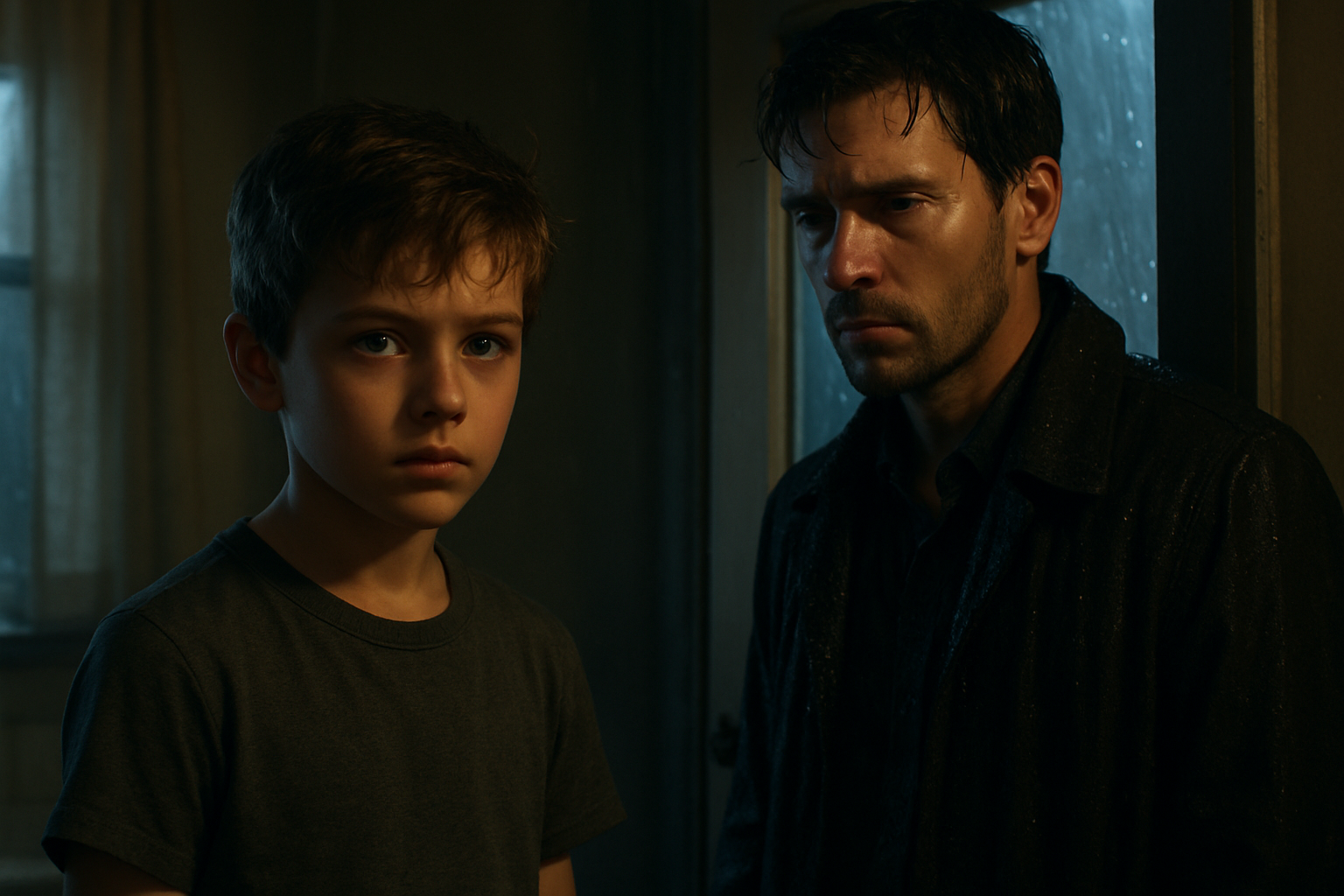
And that was its own violence.
Nolan stood so abruptly that his chair scraped backward across the floor.
June flinched.
“I’m sorry,” she whispered.
Nolan’s eyes were fixed on the paper in front of him, on his mother’s handwriting, on the record of every call that had never reached him.
When he spoke, his voice was low enough to frighten everyone in the room.
“No,” he said. “You’re not the one I’m going to speak to.”
Nolan exhaled like a man stepping onto thin ice.
“I love you,” he said.
Tessa went very still.
He lifted one hand before she could answer, not to stop her, but to keep himself from rushing. “Not as an argument. Not as a key I think should open a door. I’m not saying it because I think love makes up for absence, or because I expect you to say it back. I’m saying it because I should have said it when we were young and stupid and terrified, and I should have said it again every day after that. I loved you then. I love you now. And I know the love I have is not the same as the love you needed, because the love you needed showed up.”
The string lights hummed faintly above them. Somewhere beyond the fence, a dog barked. A car rolled past with music trembling through its windows.
Tessa looked down at her hands. They were older than the hands he remembered from hallways and rooftops, stronger too. Hands that had worked double shifts, signed school forms, carried grief, held Caleb through fevers, folded Aaron’s clothes after the funeral because their mother couldn’t stand to do it. Hands that had built a life out of what other people left behind.
“You practiced that four times?” she asked softly.
“Five if you count the version where I compared emotional accountability to corporate restructuring.”
She turned her head toward him. “Please tell me you deleted that one.”
“It was never written down. I still had some dignity.”
“No, you didn’t.”
“No,” he agreed. “I didn’t.”
That made her smile, but the smile trembled at the edges.
Nolan leaned forward, elbows on his knees. “I don’t want to take over your life. I don’t want to purchase a place in it. I don’t want to move Caleb into a mansion and call that parenting. I want to earn ordinary things. School mornings. Grocery lists. Sitting here while you tell me the porch light needs replacing and not secretly dispatching six contractors.”
“You already dispatched two.”
“One,” he corrected. “The second was an electrician I panicked and called after I looked at your fuse box.”
“My fuse box is fine.”
“Your fuse box is haunted.”
“It has character.”
“It sparked at me.”
“You were insulting it.”
His mouth curved, then faded into something more vulnerable. “I want to build something with you, Tessa. Slowly. On your terms. If all I ever get is a chair at Caleb’s science fair and a place on these steps when you’re willing to share them, I’ll be grateful. If there’s more someday, I’ll be grateful for that too.”
The old Tessa, the seventeen-year-old with tired eyes and a secret under her ribs, would have wanted to fall straight into him. She would have mistaken this moment for rescue. She would have believed that wanting something badly enough meant it could not hurt her.
But the woman on the steps had learned that love could be real and still insufficient. That regret could be sincere and still arrive late. That promises sounded different when a child’s heart was listening from the other room.
“I love you too,” she said.
Nolan’s eyes closed.
“Don’t look relieved yet,” she warned.
He opened them immediately. “I’m not. I’m cautiously devastated.”
“I love you,” she repeated, because she had denied herself the truth long enough and it had become another kind of prison. “But I don’t trust happiness when it shows up dressed like a miracle. I don’t know how to stop waiting for everything to collapse.”
“I know.”
“And I don’t know how to be with you without remembering every night I hated you.”
“I know that too.”
“No, you don’t.” Her voice caught, and she hated that it did. “You don’t know what it was like to watch Caleb stare at the door when he was little because some part of him thought fathers just appeared if children were good enough. You don’t know what it was like when Aaron would come home bleeding from whatever trouble he’d found and still sit at Caleb’s bedside reading space books in voices until he fell asleep. You don’t know how angry I am that my brother had to become a man before he got to finish being a boy.”
Nolan’s face crumpled, not dramatically, not for effect, but because the truth had landed where it belonged.
“No,” he said. “I don’t know. But I will listen to it for the rest of my life if you need to say it.”
Tessa stared at him through the blur in her eyes.
“That,” she whispered, “is a dangerous promise.”
“I’m done making safe ones.”
For a long moment, neither of them moved. Then Tessa reached over and took his hand.
It was not forgiveness. Not entirely.
It was not absolution.
It was not the ending anyone would have written for them at nineteen, when love still seemed like a thing that could outrun consequence.