“I don’t know what I feel,” she said.
Caleb sighed. “Adults say that when they know but dislike the implications.”
“Go to sleep.”
“That is not a rebuttal.”
“It is when spoken by your mother.”
He accepted this with mild disappointment and slid down under the covers. Tessa kissed his forehead.
At the door, he said, “Mom?”
“Yes?”
“If he stays, will you be unhappy?”
Tessa’s hand tightened on the doorknob.
“I might be,” she said honestly. “For a while.”
“And if he leaves?”
She could not answer immediately.
Caleb turned his face toward the wall. “That’s useful information.”
Tessa closed her eyes.
“Goodnight, Caleb.”
“Goodnight, Mom.”
In the hallway, she leaned against the wall until her knees felt steady again.
Across the city, Nolan did not go back to the hotel penthouse Maren had arranged for him. He walked.
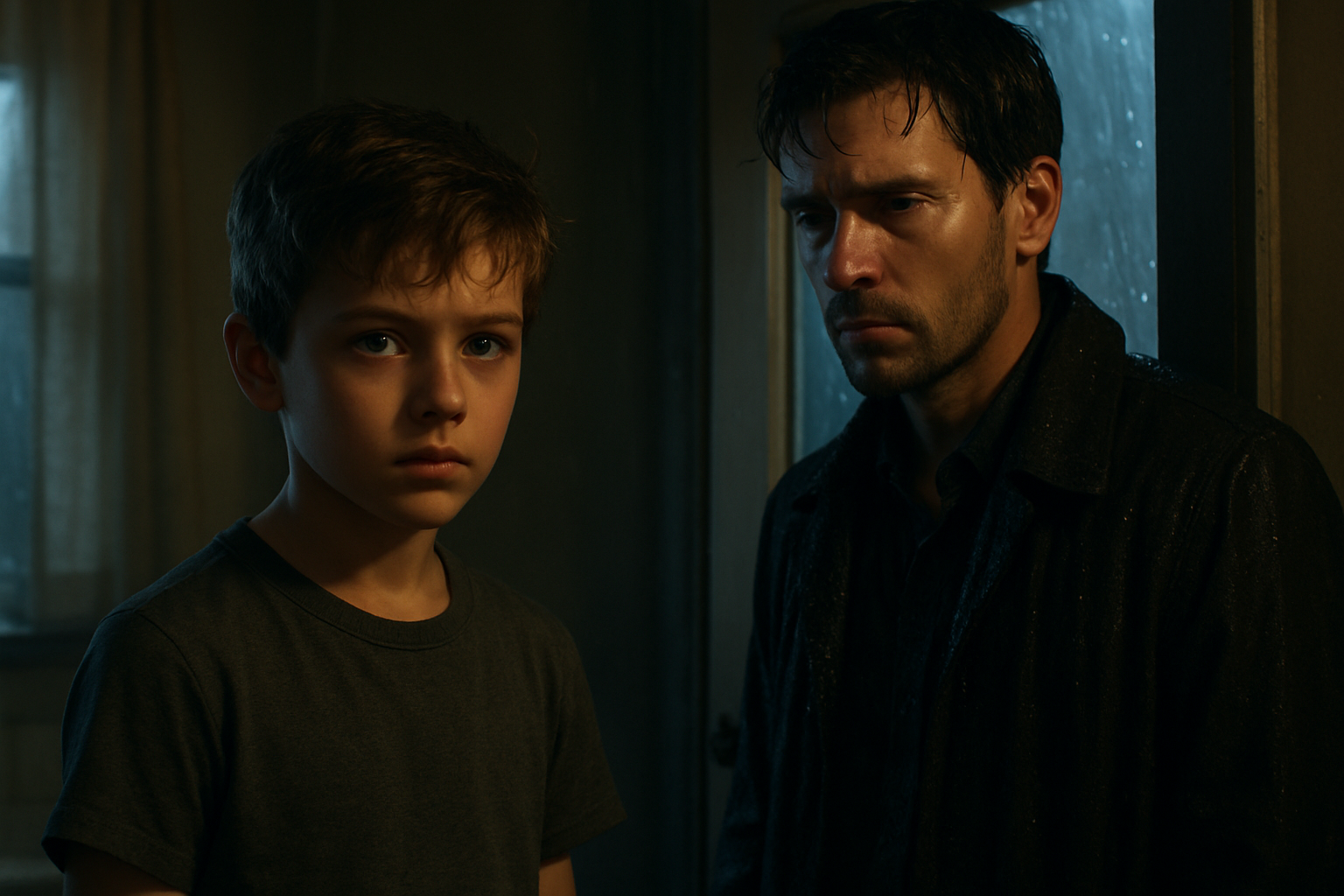
Security followed at a discreet distance, furious through their earpieces, but Nolan kept moving through the rain until his coat was soaked and his hair stuck to his forehead. Baltimore at night was not the city he had described to investors or avoided in interviews. It was brick and wet pavement, harbor lights smeared gold across black water, row houses with lives glowing behind curtains. It was the city where he had once been poor and hungry and certain he could outrun everything that humiliated him.
He had outrun nothing.
His phone buzzed fourteen times before he looked at it.
Maren.
Board liaison.
Maren again.
His chief legal officer.
Unknown London number.
Maren, again, with the message: If you are not dead, answer before I commit a felony.
Nolan stopped beneath an awning outside a closed bakery and called her.
“Where are you?” Maren demanded.
“Walking.”
“In weather? Like a Brontë character with equity?”
“I’m not going to London for six months.”
There was a pause.
Then Maren exhaled slowly. “I need you to define that sentence in a way that does not give me an aneurysm.”
“I’ll attend the board vote remotely. I’ll fly for forty-eight hours if absolutely necessary, and not until Caleb is ready for that. No acquisition tour. No comeback documentary following me through Europe like a trained parasite. No strategy that requires me to be an absentee father before I’ve even learned how to be a present one.”
“Nolan.”
“I know what it costs.”
“I genuinely don’t think you do.”
He stared out at the rain.
“Then tell me.”
Maren was quiet for a beat, and when she spoke again, the sharpness had thinned to something more human. “Caldwell’s people are using the scandal to argue you’re unstable. The board is split. Investors are skittish. If you don’t show dominance, they may force a leadership structure you cannot control. This isn’t just about your ego.”
“I know.”
“You built Vale Meridian from a laptop and spite.”
“I built it by leaving people.”
Maren said nothing.
Nolan closed his eyes. “I left Tessa. I left Aaron. I left whatever child she may have been carrying because I was too important to answer a phone. And then I turned that version of myself into a brand.”
“Nolan,” she said, softer now.
“I can’t keep saving the company by becoming the worst thing about it.”
Another pause.
Finally Maren said, “That is a beautiful sentence. It will test terribly with shareholders.”
Despite everything, he almost laughed.
“I need you to buy me time,” he said.
“I can buy time. I cannot buy trust.”
“No,” he said. “Apparently that has to be assembled incorrectly three times before anyone teaches you how to do it.”
“What?”
“Nothing.”
Maren sighed. “There’s one more thing.”
Nolan opened his eyes.
Her tone had changed. He recognized it immediately. Maren had three voices: surgical, irritated, and the one she used when standing between him and incoming fire.
“What?”
“The gala footage is everywhere.”
“I assumed.”
“Caleb’s comment about you being under emotional evaluation is trending.”
Nolan rubbed a hand over his face. “Of course it is.”
“He’s becoming… popular.”
The word made Nolan’s stomach turn.
“He is eight.”
“I know.”
“No interviews. No profiles. No school ambushes. No human-interest pieces.”
“I already threatened litigation against two outlets and made one producer cry. But that isn’t the problem.”
Nolan listened to the rain strike the awning.
“What is?”
Maren hesitated.
“That reporter from the gala wasn’t credentialed,” she said. “Someone got her in.”
“Who?”
“We’re tracing it.”
He went still.
“And she didn’t ask random questions. She knew exactly where Caleb would be standing. She knew security had rotated. She knew enough to get close.”
Nolan’s hand tightened around the phone.
“Caldwell?”
“Maybe. Or someone closer.”
The city noise seemed to recede.
Nolan thought of Caleb by the window, small in his blazer, facing a predator with perfect grammar and no shield but his own strange courage. He thought of Tessa’s eyes when she saw the recorder. The instant terror. The calculation. The knowledge that fame did not arrive like attention, but like weather—sudden, impersonal, impossible to reason with.
“Find out,” he said.
“I am.”
“Maren.”