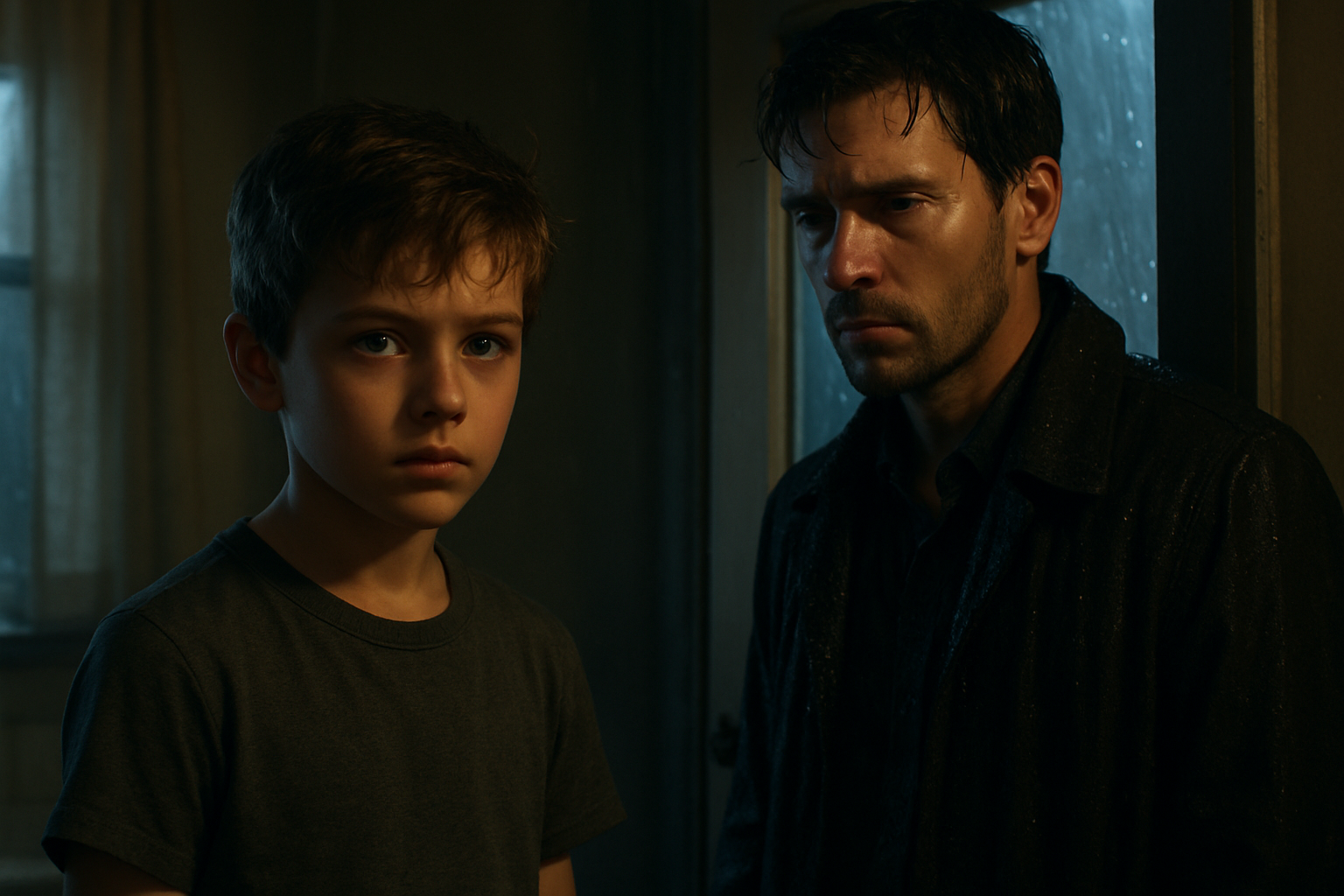
The Boy with the Storm-Gray Eyes

The Boy with the Storm-Gray Eyes

“Is he my son?”

The question did not fall gently. It cracked through Elara Quinn’s small kitchen like thunder, sharp enough to make the rain seem suddenly quiet against the windows.

Adrien Voss stood just inside the doorway, his black coat dripping water onto her worn linoleum floor, his hair darkened by the storm, his face stripped of every polished expression that had once made boardrooms bend and cameras adore him. He was no longer the untouchable billionaire whose name flashed across business magazines and skyline billboards. He was not the prodigy, the conqueror, the man who could buy silence, loyalty, time.

He was simply Adrien.

And he was staring at the little boy by the table.

At the boy’s eyes.

At the crescent-shaped birthmark circling the fragile bone of his wrist.

Elara held his gaze. She had always been able to lie to other people when survival required it. Small lies. Necessary lies. “I’m fine.” “We have enough.” “It doesn’t hurt anymore.”

But lies had never survived between her and Adrien. Not once. Not even when they were young and proud and terrified.

So she gave him the only answer she could.

“He is mine.”

It was cruel.

It was also true.

Adrien’s jaw tightened as if the words had struck him physically. Rainwater slipped from the hem of his coat and gathered in a dark, trembling puddle around his expensive shoes. The child, oblivious to the full weight of the moment, curled one hand around a chipped blue mug of cocoa and watched the stranger with solemn, storm-gray eyes.

Adrien’s eyes.

Elara’s heart clenched so violently she almost reached for the counter.

For the first time in all the years she had known him, Adrien Voss had no clever answer. No devastating half-smile. No sharp remark designed to hide the wound beneath. His entire empire seemed to collapse into that tiny birthmark, into that little wrist, into the silence between one breath and the next.

But Elara had told herself their story ended long before this storm.

Long before he appeared at her door unannounced.

Long before he saw the child.

Long before that terrible question.

It had begun in the city of Harrowmere, when Adrien was sixteen years old and furious at every locked door he had not yet learned how to purchase.

His mother, Celeste Voss, had dragged him there from Northwyck for what she called “a strategic development year,” which sounded elegant when spoken in her cool, commanding voice. In practice, it meant private athletic coaches before sunrise, advanced mathematics tutors after dinner, investor breakfasts on Saturdays, etiquette dinners with men who smiled too much, and a schedule so ruthless it seemed designed to carve all softness from a brilliant boy and leave only a weapon behind.

Adrien was supposed to become a professional tennis champion first.

Then a mathematical prodigy.

Then a technology founder.

Celeste changed his destiny whenever a richer room opened somewhere else.

She studied opportunity the way generals studied maps. She saw her son as talent, brand, legacy, leverage. He was handsome, unnervingly intelligent, and angry enough to confuse pressure with purpose. In certain circles, he was already becoming a rumor: the beautiful teenage genius with the impossible serve, the boy who built prediction software for athletes before he was old enough to sign his own contracts, the son investors watched with the bright-eyed hunger of men hoping to buy the future early.

Elara Quinn met him in eleventh-grade literature at Alderbrook Preparatory, a scholarship school where wealthy students arrived in casual clothes that cost more than her mother earned in a week.

Adrien sat behind her and tapped his pen through the entire discussion of The Golden House of Ash.

Tap. Tap. Tap.

The sound crawled under her skin.

After eleven minutes, Elara turned around without raising her voice.

“If your hands are that bored,” she said, “use them to take notes.”

Adrien blinked.

No one spoke to him that way.

Teachers excused him because brilliance made adults generous. Coaches praised him because winning made them look good. Girls watched him from across hallways and whispered behind notebooks. Boys either envied him or tried to attach themselves to his orbit. Even adults who should have known better treated him like a walking lottery ticket with a pulse.

Elara Quinn told him he was annoying, then turned back around as if dismissing a fly.

The next day, he borrowed her pen without asking.

The day after that, he followed her to the library and claimed the seat across from her as though fate had reserved it with his name engraved on a brass plaque.

“You always study like someone’s grading your breathing?” he asked.

Elara did not look up from her notes. “You always talk like silence owes you money?”

His mouth curved.

“You’re mean.”

“You’re loud.”

“I’m interesting.”

“You’re exhausting.”

That should have been the end of them.

Instead, somehow, it became the beginning.

Adrien began appearing at Elara’s house after school. At first, he had excuses. Calculus. A literature presentation. A group research project no one else in the group seemed aware of. Then the excuses grew thinner, flimsier, almost insulting in their lack of effort, until finally he stopped offering them at all.

He simply arrived.

The Quinn house was nothing like the glass-walled penthouses and leased town cars of Adrien’s life. It was narrow and warm and always slightly noisy. The front step cracked in the middle. The hallway smelled faintly of lemon soap and old paperbacks. The kitchen was too small for three people and somehow always held five. There were bills tucked under a chipped ceramic rooster, grocery lists on the refrigerator, mismatched mugs in the cabinet, and a stubborn radio that worked only when slapped on the left side.

Elara’s mother, Maribel Quinn, fed anyone foolish enough to stand still too long in her kitchen.

Adrien learned very quickly to stand still.

“Skinny boys are always trouble,” Maribel declared the first afternoon he wandered in wearing a school blazer that cost more than their stove. “Sit. Eat.”

“I’m not skinny,” Adrien said.

“You’re rich skinny,” Maribel replied, setting a plate in front of him. “Different illness.”

Elara laughed so hard she nearly dropped a glass.

Adrien, who was used to being flattered, studied the steaming food before him as if it were a challenge, then picked up a fork.

After that, he came back.

Often.

Callan Quinn, Elara’s older brother, returned from evening classes at the city college one night and found Adrien eating his second helping of fried chicken at the kitchen table.

Callan stopped in the doorway and narrowed his eyes.

“You live here now?”

Adrien wiped his mouth with a napkin. “I was invited.”

“No, you weren’t,” Elara said from the sink.

Adrien did not look ashamed. “The chicken invited me.”

Callan tried not to laugh.

He failed.

From then on, he treated Adrien like a suspicious stray dog the family had accidentally adopted. He challenged him at basketball on the cracked court behind the laundromat. He corrected the way Adrien lifted boxes when Maribel needed help bringing groceries in from the corner store. He warned him, in a voice so calm it was more frightening than shouting, not to make Elara cry.

Then later, when the house grew quiet and Maribel went to bed, Callan sat with Adrien on the back steps and talked to him like an older brother might.

They talked about music that made them feel invincible. About cars neither of them could afford in the ways that mattered. About money, and the difference between having it and being owned by it. About fathers who left, mothers who endured, and all the ways young men convinced themselves that pain would become purpose if they just ran fast enough.

For two years, Adrien lived between worlds.

In one world, Celeste Voss put him in rooms with men who used words like acquisition, valuation, market capture, and scalable dominance while looking at him as though he were a rare machine they hoped to own before anyone else discovered it.

In the other world, Elara’s house smelled of garlic, laundry detergent, rain-damp coats, used books, and safety.

Maribel argued with the weather as if the clouds could hear her.

Callan sang too loudly while washing dishes and got half the lyrics wrong on purpose.

Elara sat at the kitchen table with one foot hooked on the rung of Adrien’s chair and informed him whenever he was being an idiot, which was often.

People at school assumed they were dating.

They were not.

Other people insisted they were only friends.

They were not that either.

There was no clean word for what existed between them. It was too tender for friendship and too frightened for romance. It sat in the charged space between glances, in unfinished sentences, in the way Adrien always saved her the last dumpling and pretended not to notice that she noticed. It lived in how Elara could read his moods before he spoke, and how he trusted her irritation more than other people’s praise.

Naming it would have required courage.

Neither of them trusted themselves with that much truth.

So they left it unnamed.

Adrien knew he loved her by seventeen.

He knew it during a debate tournament when Elara dismantled a senior from Graybridge Academy with one lifted eyebrow and a speech about poverty that left the judges silent for three full seconds before they remembered to breathe.

He knew it when she showed up at his regional match holding a homemade sign painted in crooked blue letters:

HIT THE BALL, GENIUS.

He knew it most clearly on a freezing winter night when his mother forgot his birthday because she was in Westhaven closing a deal.

No call.

No message.

No apology.

Only a wire transfer from an assistant and a schedule update for the following week.

That night, Elara arrived at his apartment with Callan, three cupcakes, and a candle shaped like a question mark because the corner store had run out of numbers.

“You’re very annoying,” Adrien told her as she lit the candle with a match stolen from the kitchen drawer.

“You’re welcome.”

“I didn’t say thank you.”

“You will.”

He did.

Later, on the roof, while Callan took a phone call downstairs and the city stretched around them in cold silver lights, Adrien almost told her.

The words rose all the way to his mouth.

I love you.

They felt too small for what he meant and too enormous to survive being spoken.

Elara leaned her shoulder into his. Her breath clouded in the winter air.

“Don’t get soft on me, Voss.”

And he swallowed the words.

Because he was terrified that if he changed the shape of what they were, he would lose her.

The end came quietly, which somehow made it worse.

Adrien’s first real company, a predictive media platform called Sol Meridian, won a national innovation prize. A billionaire investor named Orson Kade offered seed funding, a glittering office in Aurelia Bay, and the sort of mentorship that sounded generous until lawyers began circling the contracts like wolves.

Celeste cried for the cameras.

His coaches called it destiny.

Teachers claimed they had always known.

Men in tailored suits shook his hand too firmly and said he was about to change the world.

Callan slapped Adrien on the back and said, “Don’t forget us when you start wearing suits that cost more than my car.”

Elara said nothing for almost a full minute.

She stood at the sink rinsing a plate that was already clean.

“When?” she finally asked.

Adrien looked at her back. “Three weeks.”

She nodded once.

The water kept running.

She did not look at him again for the rest of dinner.

Their last night together was supposed to be normal.

It was not.

They climbed onto the roof of Elara’s building with cheap takeout balanced in paper cartons, two stolen beers Callan would have pretended not to notice, and every unsaid thing between them pressing so tightly against the air that the city lights seemed to blur.

Below, traffic moved like blood through the streets. Above, the sky hung low and purple, swollen with summer heat.

“You’re going to love the Suncoast,” Elara said, picking at noodles she was not eating.

“No, I’m not.”

“You’ll have investors. Parties. Famous people pretending your jokes are good.”

“My jokes are good.”

“They’re expensive,” she said. “That’s different.”

Adrien looked at her then.

Really looked.

Whatever defense she had left thinned under the weight of his attention.

“Come with me,” he said.

Elara laughed once because she thought he had to be joking.

He was not.

“Adrien.”

“I mean it.”

“No, you don’t.”

“I do.”

She set the carton aside. “I have school.”

“There are schools there.”

“My mother.”

“We can help her.”

“My brother. A life.”

“You could have one there.”

Her eyes glistened, but her voice stayed steady.

“Yours?”

Adrien did not answer fast enough.

That was the problem with him, even then.

He loved with the hunger of someone starving, but fear made him selfish when it mattered. He wanted Elara with him in Aurelia Bay, but he had not truly imagined what she would have to abandon to stand beside him. He wanted love, but he wanted it to fit neatly inside the future already built for him by his mother, his investors, his ambition, and all the men waiting to profit from his brilliance.

Elara saw the hesitation.

A sad smile touched her mouth.

“Exactly.”

He should have apologized.

Instead, he kissed her.

She should have stopped him.

She did not.

The kiss was not soft. It was not sweet in the easy way first kisses were supposed to be. It was two years of restraint finally losing the argument. It was anger and grief and wanting and goodbye all tangled together so tightly neither of them could tell where one feeling ended and another began.

They left the roof tangled in words they barely understood.

What happened after was not reckless. It was not cheap. It was not the sort of mistake people made because they were lonely or bored or young enough to believe consequences belonged to other people.

It was beautiful.

It was frightening.

Because they had both known long before their bodies admitted it.

For a few stolen hours, there was no Aurelia Bay. No investor waiting with a contract. No mother with a schedule sharpened like a blade. No future standing at the door with a knife behind its back.

There was only Adrien.

Only Elara.

Only morning light creeping beneath the curtains like a witness.

Then Adrien ruined it.

He woke before her.

For one fragile second, Nolan did not move.

The room was still washed in the blue-gray hush before sunrise, that soft hour when the world seemed to hold its breath. Tessa slept beside him with one arm tucked beneath her cheek, her dark hair spilled across the pillow, the sheet twisted around her like she had wrestled the night and won. Her lashes cast faint shadows on her skin. Her mouth was parted just slightly.

She looked peaceful.

That was what frightened him most.

Not the leaving. Not the plane waiting. Not the manager with the sharp voice and sharper plans. Not even the future being assembled for him somewhere beyond this room, bright and loud and hungry.

It was the tenderness.

It filled the small bedroom like sunlight under a door. It lay across his chest with a weight he had no language for. Nolan had known how to flirt, how to impress, how to make a room laugh. He had known how to reach for Tessa in the dark with the desperate certainty of a boy pretending to be a man.

But this—waking beside her, knowing the hours were almost gone, feeling the words rise up from some honest place he had spent years avoiding—this terrified him.

I love you.

The words came so clearly that he almost turned toward her and said them.

Almost.

Instead, because humor was the only armor he had ever trusted, because he had never learned how to stand in front of anyone unarmed, he cleared his throat and said, “You steal blankets like a criminal.”

Tessa’s eyes opened slowly.

For a moment, she only stared at him. Sleep softened her face, but not her understanding. She had always seen too much.

“That’s what you want to say?” she asked.

Nolan forced a crooked smile. “I’m just reporting facts.”

She sat up, drawing the sheet around herself. The movement was quiet, but something shifted in the room. The tenderness did not vanish. It cooled. It retreated to the corners like a thing embarrassed to have been seen.

The look on Tessa’s face was not anger.

Anger would have been easier. Anger would have given him something to push against, something to charm his way around. But this was worse. This was disappointment settling into a locked place he would never be able to reach again.

He wanted to touch her hand.

He did not.

By the time they reached the airport, the morning had turned brittle and gray. Cars slid past the curb in restless lines. Suitcases rattled over concrete. Announcements crackled overhead, flattening goodbyes into instructions.

Nolan promised to call when he landed.

Tessa said, “Okay.”

His mother waved from security, impatient and polished, already speaking into her phone as if his life were a schedule she could bully into submission. His new manager stood beside her, one hand clamped around a leather portfolio, shouting that they were late, that the Seoul connection would be tight, that opportunities did not wait for boys who got sentimental in terminals.

Nolan walked away from Tessa.

Three steps.

Five.

Then he turned back.

His heart hammered so violently he felt it in his throat. The words were there again, fierce and ready, crowding behind his teeth.

I love you.

Tessa stood by the barrier with her hands wrapped around the strap of her bag. She looked very young in that airport light and somehow older than him. She looked at him as if she knew exactly what he was failing to say.

Nolan opened his mouth.

Nothing came out.

Something in her eyes dimmed, but she smiled anyway, a small brave thing that hurt him more than tears would have.

“Go become famous,” she said.

So he did.

Nine years later, lying awake on Tessa Monroe’s couch while the storm weakened into a cold Baltimore drizzle against the windows, Nolan understood with brutal clarity that fame had been the least impressive thing he had ever achieved.

It had dazzled from a distance, of course. Fame always did. It came with magazine covers and private jets, women with impossible cheekbones, men who laughed too loudly at mediocre jokes, parties above cities where no one admitted they were lonely. It came with impossible money. It came with assistants who knew his preferences before he did, with rooms prepared before his arrival, with applause so constant it became indistinguishable from weather.

But it had not taught him how to be brave in the only ways that mattered.

It had not taught him to say stay.

It had not taught him to say I was wrong.

It had not taught him to say I love you before the door closed.

Morning came wearing the smell of coffee and judgment.

Nolan opened his eyes to find a child sitting at the kitchen table.

Caleb Monroe wore a navy school uniform sweater over a pale blue shirt, his tie slightly crooked, his dark hair combed with the uneven dedication of someone who had done it himself. A cereal bowl sat in front of him. Beside it lay a thick book about deep-space observation, full of diagrams and star fields and words Nolan suspected most adults would pronounce with caution.

The boy looked up without surprise.

“You snore,” Caleb said.

Nolan pushed himself upright carefully, his back protesting from the couch. “Good morning to you too.”

“It was informational,” Caleb replied. “Not rude.”

At the counter, Tessa stood with her hair pulled into a knot, wearing faded jeans and a sweater too soft to be new. She lifted her mug to her mouth, but not quickly enough to hide her smile.

Nolan saw it.

Then he looked back at Caleb and the impossible math returned, merciless as daylight.

Eight years old.

Storm-gray eyes that were not quite blue and not quite silver.

That stubborn crescent-shaped birthmark near his collarbone, glimpsed the night before when Caleb had reached for a glass and his pajama shirt slipped sideways.

Nolan’s own mother had once kissed the identical mark on his shoulder and called it the family moon.

March, maybe.

He did not know yet.

He wanted to ask. He feared the answer with equal force.

Caleb spared him the dignity of fumbling.

“You’re staring because you think I might be yours,” the boy said calmly.

Tessa set her mug down a little too hard.

Coffee trembled against the rim.

Nolan stared at the child as though the floor had dropped out beneath him.

Caleb lifted one shoulder. “Adults are less subtle than they think.”

“Caleb,” Tessa said, warning threaded through his name.

“It’s fine, Mom. He was going to ask badly. I made it more efficient.”

Nolan almost laughed.

Almost.

But his throat had closed around something sharper.

“How old are you?” he asked.

“Eight.”

“When’s your birthday?”

“March third.”

There it was.

The date struck with clean, brutal precision.

Nolan closed his eyes for half a second. During the night he had done the math once, then again, then again—because denial often disguised itself as arithmetic if one worked hard enough. He had counted backward from Caleb’s age, from the shape of his face, from the storm-gray eyes looking out of a child who could have been Nolan’s own reflection softened by Tessa’s mouth.

March third confirmed what some part of his body had known the moment Caleb opened the front door.

When Nolan opened his eyes, Caleb was watching him with interest instead of fear.

“You’re a bad liar,” Caleb observed.

“I didn’t lie.”

“You said nothing, but your face tried to.”

Tessa covered her mouth with her coffee cup.

Nolan looked at her then. Really looked.

There were faint shadows under her eyes. A tiny scar near one eyebrow he did not remember. Lines at the corners of her mouth that did not make her look older so much as more real. She had become a woman while he had been busy becoming an image.

And she had done it with his son beside her.

The bus came seven minutes later.

Caleb finished his cereal, rinsed his bowl, and placed it in the sink with a precision that made Nolan think of laboratories and old souls. He packed his book into his backpack, checked the zipper twice, then paused in front of Nolan on his way to the hall.

For the first time, uncertainty crossed the boy’s face. It was gone almost immediately, tucked away behind politeness.

“Goodbye, sir.”

Nolan swallowed. “Goodbye, Caleb.”

The front door closed behind him.

The house settled into the enormous silence children left when they departed.

Tessa leaned against the counter and waited.

She knew him well enough to understand that silence would punish him faster than any accusation. She had always known that about him. Nolan could survive shouting. He could charm shouting. He could outmaneuver fury with a joke, a kiss, a clever line. Silence gave him nowhere to hide.

He stood.

The question came out before he could make it gentler.

“Why didn’t you tell me?”

Tessa’s face changed so quickly he wished he could snatch the words out of the air and bury them.

Her mouth tightened. Her shoulders went still. The woman in front of him disappeared for a heartbeat, and Nolan saw the nineteen-year-old girl at the airport, swallowing what he had been too cowardly to say.

“Because nine years ago,” she said, voice low and even, “I watched you tell a reporter on national television that fatherhood looked like a prison sentence.”

Nolan’s memory flashed so sharply it felt like punishment.

A rooftop bar in Los Angeles.

A launch party strung with white lights.

Champagne in his hand.

Applause still ringing in his blood.

A woman with glossy hair and a microphone had smiled at him beneath a camera’s bright eye and asked whether the handsome young founder wanted a family someday.

Nolan, twenty-two and drunk on attention, drunk on escape, drunk on being wanted by everyone except the one person whose wanting mattered, had laughed.

That life isn’t for me, he had said.

Then, because the crowd laughed and he liked being the boy who made people laugh, he had added, I’d be terrible at it. Kids deserve better than that.

The clip had been shared everywhere.

Charming honesty, the captions called it.

Refreshing self-awareness.

Bachelor billionaire knows himself.

“I was twenty-two,” he said weakly.

Tessa’s eyes did not move from his. “I was nineteen and nine weeks pregnant.”

The kitchen became very still.

Rain tapped softly against the window over the sink. Somewhere inside the walls, pipes clicked and sighed. Nolan heard all of it because he could not bear the sound of what she had just given him.

Nine weeks.

Pregnant.

Calling him.

Watching him laugh.

Tessa folded her arms, not defensively but as if holding herself together had become muscle memory.

“I called you anyway,” she said. “I told myself interviews were stupid and men said stupid things when cameras were pointed at them. I told myself you were scared. I told myself I was scared too, and that maybe scared people deserved a chance to speak before they were judged forever.”

“Tess—”

“You didn’t answer.” Her voice did not rise. That made it worse. “I called again. You didn’t answer. I left a message saying I needed to talk to you. I waited with my phone in my hand until the battery died. That same afternoon, your face appeared on an entertainment segment from Seoul with a woman in a red dress touching your mouth like she owned it.”

Nolan remembered Seoul in flashes: too many cameras, too much perfume, a hotel balcony glittering above traffic. A model with red lipstick who had leaned too close for the photograph because his manager had said it would help the image. He remembered laughing because everyone around him laughed. He remembered feeling empty afterward.

He had not remembered that Tessa had been trying to call.

Or maybe he had buried it so deep he could pretend forgetting was innocence.

“So I sat on the bathroom floor for an hour,” Tessa continued. “Then I got up. I made an appointment. I applied for Medicaid. I told my mother. And I started raising my son.”

My son.

Not our son.

The distinction landed exactly where she intended.

Nolan wanted to defend himself. The instinct rose automatically, ugly and familiar. He wanted to tell her he had been managed, scheduled, handled, pushed from one country to another until his own life felt like a room he only rented. He wanted to tell her that half his calls had been screened by assistants, that his mother had controlled access to him with velvet-gloved ferocity, that his manager had treated distraction like disease.

He wanted to say the woman in Seoul had meant nothing.

That every woman after Tessa had meant less.

That for nine years he had mistaken achievement for healing and noise for company.

But explanations were not answers.

Not yet.

Maybe not ever.

“I’m sorry,” he said.

The words felt too small to carry the damage, but they were the only honest ones he had.

Tessa looked toward the hallway Caleb had used minutes earlier, as though she could still see him there, small and solemn and brilliant.

“Be sorry quietly,” she said. “He doesn’t need another adult making feelings his job.”

Nolan stayed one night.

Then three.

The first night had been necessity. The storm had knocked branches across streets, his driver had been delayed, and the reporters who always seemed to orbit his life had not yet caught the scent.

The second night, he told himself he stayed because it was late, because Caleb had asked him one question about orbital mechanics and then twenty-seven follow-ups, because Tessa’s guest blanket was already folded at the end of the couch.

The third night, he stopped lying to himself.

He stayed because when Caleb read at the table, he tilted his head the same way Nolan did when thinking.

He stayed because Tessa hummed under her breath when she cooked, and hearing it made some ruined room inside him ache with recognition.

He stayed because leaving that house felt, absurdly, like abandoning them all over again.

Then the reporters found Tessa’s street.

It happened with the speed of rot.

A neighbor’s niece recognized the black SUV idling at the curb and posted a blurry photograph online. By noon, two entertainment accounts had matched the vehicle to Nolan’s security team. By three, a long-lens camera caught Nolan walking Caleb home from school, wearing sunglasses and failing spectacularly at invisibility.

The resemblance between them did not need confirmation.

The internet devoured it whole.

By dinner, hashtags were breeding like mold.

SECRET SON?

BILLIONAIRE DAD HIDES FAMILY IN BALTIMORE.

WHO IS TESSA MONROE?

Photos appeared within hours. Tessa leaving the grocery store two winters ago. Caleb at a school science fair, grinning beside a cardboard model of Saturn. A picture of Tessa at nineteen, scraped from an old college page, placed side by side with current images beneath captions that dissected her life as though she had offered it up for public consumption.

Tessa placed her phone face down on the kitchen table and pressed both palms flat beside it.

She did not cry.

Nolan wished she would, and hated himself for wishing it. Crying would have given him something to do. A shoulder to offer. A glass of water. A hand at her back. This calm made him feel useless.

Worse than useless.

Responsible.

Caleb came downstairs in socks, hair damp from a shower, and surveyed the room with the grave composure of a much older person entering a war room.

“They found us,” he said.

“Yes,” Tessa replied.

“Are we leaving?”

Tessa looked at Nolan before she could stop herself.

The glance lasted less than a second, but Nolan caught it. He saw the calculation, the fear, the resentment of needing help from the man who had made help necessary. He saw how much she hated that his world had arrived at her doorstep like weather she could not bar from the windows.

So he did not pretend not to notice.

“I have a secure apartment in Harbor East,” he said carefully. “Private elevator. Garage access. Staff entrance. Security downstairs. We can stay there until it cools down.”

Tessa’s mouth twisted. “Your world.”

“Temporarily.”

“Your world is never temporary, Nolan. It spreads.”

He had no answer because she was right.

His world spread. It seeped beneath doors. It turned strangers into investigators. It made childhoods into headlines and women into mysteries for bored people to solve between lunch and errands.

Caleb adjusted the strap of his backpack, though he was not wearing shoes and clearly had no intention of going anywhere yet.

“Statistically, controlled relocation is safer than emotional resistance,” he said.

Tessa stared at him. “You are too young to sound like a crisis consultant.”

“I read.”

Nolan hid a smile.

Tessa saw it and gave him a look that warned him not to enjoy parenting yet.

They packed for a week.

Tessa moved through the house with quiet efficiency, folding Caleb’s clothes, gathering medication from the bathroom cabinet, slipping school forms and chargers into a canvas tote. Nolan offered to help three times. Each time, Tessa gave him tasks so specific he understood they were designed to prevent him from ruining anything.

“Not that drawer.”

“Fold, don’t roll.”

“No, he won’t wear that shirt. It itches.”

Caleb packed books first, clothes second.

“You only need enough for a week,” Tessa told him.

“A week is an estimate,” Caleb said. “Estimates fail.”

He brought four astronomy books, two notebooks, a mechanical pencil case, and a battered stuffed moon with one eye missing. When Nolan noticed it, Caleb lifted his chin.

“It has sentimental value.”

“I didn’t say anything.”

“Your face did.”

Nolan looked away before his smile betrayed him.

Leaving Tessa’s house felt like evacuation.

Security men in dark coats stood between the porch and the SUV while cameras flashed from behind parked cars and through bare winter branches. Reporters shouted questions that turned the cold air dirty.

“Nolan! Is Caleb your son?”

“Tessa, how long have you known him?”

“Did he pay you to stay quiet?”

“Caleb, look here!”

At that, Nolan’s entire body changed.

He stepped between the shouting voices and the boy so fast one of his security men reached instinctively for him. Rage tore through him, hot and clarifying.

“He’s a child,” Nolan snapped, voice low enough to be dangerous. “Back off.”

For once, the cameras hesitated.

Tessa saw it. Saw the fury. Saw the instinct.

But she did not thank him.

Not then.

The apartment in Harbor East looked like money had tried to imitate comfort and missed the point.

The ceilings were high. The furniture was modern, angular, and expensive in a way that discouraged actual sitting. The windows were wide enough to make the harbor look staged, all steel water and winter sky. Fresh flowers sat on the dining table though Nolan had not ordered them. Someone had stocked the refrigerator with sparkling water, berries arranged in glass containers, imported yogurt, and food no child would voluntarily eat.

Caleb walked through the living room with his hands clasped behind his back like a tiny museum critic.

“This place has no personality,” he said.

“It has good security,” Nolan replied.

“That’s not the same thing.”

Tessa laughed before she could stop herself.

The sound was small, startled, and real.

Nolan looked at her immediately, helplessly.

He would have paid an obscene amount of money to hear it again. Then he realized, with a shame that nearly made him flinch, that paying for things was exactly the problem.

Life inside Nolan’s apartment became an awkward experiment in proximity.

Nolan did not know how to live with people without delegating care. His life had been engineered for years by others: meals appearing, laundry vanishing, schedules printed, flights changed, rooms cleaned before he noticed they were messy. If something broke, someone fixed it. If he needed something, someone anticipated it. If he wanted silence, entire floors bent around the preference.

Tessa had no patience for men who mistook expense for effort.

When he ordered dinner from a restaurant with a tasting menu and no visible food Caleb recognized, she opened the containers, stared at the artful portions, and said, “He’s eight, Nolan, not a visiting ambassador.”

Caleb peered into one box. “This carrot has foam on it.”

“It’s a reduction,” Nolan said.

“It’s suspicious.”

Tessa made scrambled eggs and toast.

Caleb ate all of it.

Nolan watched from the counter, feeling like a billionaire who had been defeated by butter.

The next morning, determined to be useful, he arranged breakfast himself. By arranged, he meant he asked the building concierge to bring up pastries from the best bakery nearby, organic fruit, fresh juice, and three kinds of coffee.

Tessa entered the kitchen, looked at the spread, and sighed.

“What?” Nolan asked.

“Do you own cereal?”

“No.”

“Do you own milk?”

“I own almond milk.”

Caleb glanced up from the table. “I’m not a squirrel.”

Nolan bought cereal that afternoon.

Too much cereal.

An entire shelf of it.

Tessa opened the pantry and closed it again without speaking.

He tried with gifts next, because gifts were easy. Gifts could be researched, purchased, delivered. Gifts did not require the terrifying vulnerability of asking a child what he needed and waiting for an answer that might reveal Nolan had already failed him in ways no object could repair.

He bought Caleb a drone, a telescope, a chessboard carved from marble, and a limited-edition space exploration model that cost more than Tessa’s first car.

The boxes arrived stacked near the door like offerings to a small, skeptical king.

Caleb examined them with grave concern.

“You don’t have to buy me things,” he said.

“I wanted to.”

“Why?”

Nolan opened his mouth.

The true answer rose with such force it nearly knocked him backward.

Because I missed eight birthdays.

Because I don’t know your favorite color.

Because I don’t know what you looked like when your first tooth fell out.

Because I wasn’t there when you learned to walk, or talk, or read books meant for children twice your age.

Because every minute I stand near you, I discover another thing I lost.

Because guilt is eating me alive and I don’t know how to survive it without putting something in your hands.

But that was too large for a living room. Too heavy for an eight-year-old boy standing in socks beside a tower of expensive apologies.

So Nolan said, “I thought you’d like them.”

Caleb considered this.

“I already have a chessboard,” he said. “Marble pieces are inefficient because they chip.”

Nolan blinked. “Right.”

Caleb looked at the drone. “This has poor battery life.”

“Of course it does.”

“The model is inaccurate. The antenna proportions are wrong.”

“I’ll write a stern letter.”

Caleb gave him a patient look, as if humor were a language he understood but did not always respect.

Then he turned to the telescope.

His expression changed.

Not dramatically. Caleb did not seem built for dramatic displays. But something brightened behind his storm-gray eyes, quick and unmistakable.

“The telescope is acceptable,” he said.

“Acceptable,” Nolan repeated.

“The mirror alignment is manual.” Caleb ran his fingers reverently along the side of the box. “You’ll need help.”

“Tess—”

“Don’t.” She lifted a hand, not dramatically, not like someone in a movie stopping a confession, but like a woman too exhausted to survive one more impact. “Don’t say my name like that and make me responsible for comforting you.”

Nolan went silent.

The apartment hummed around them: the refrigerator clicking on, a taxi horn rising from the street below, rain tapping lightly against the windows as if the sky had decided to join the conversation with restraint.

Tessa folded her arms across her middle. Not because she was cold. Because if she did not hold herself together somehow, she was afraid grief would spill out of her in pieces.

“I’m not saying it was your fault,” she said after a moment, though some ruined part of her still wanted to. “Aaron made his choices. He got in the car. He was drunk. He was sick in ways none of us knew how to name yet. I know that. I have told myself that for nine years because the alternative was not survivable.”

Nolan looked down at his hands.

“But you were the person I trusted to show up,” she continued. “And you didn’t.”

His shoulders shifted, as if every word had weight and he was accepting it onto his back.

“I don’t remember the dinner,” he said hoarsely. “I remember Tokyo. I remember Caldwell. I remember thinking if I missed that meeting, everything I had built could collapse before it even became real. I remember…” He stopped, swallowed. “I remember convincing myself people would understand later.”

Tessa’s mouth twisted.

“They never do,” she said. “That’s the thing about later. It never arrives clean.”

Nolan closed his eyes.

“I should have come.”

“Yes.”

“I should have answered every call after.”

“Yes.”

“I should have known you wouldn’t disappear unless something terrible had happened.”

“Yes.”

He nodded once, each answer landing. “I am so sorry.”

Tessa looked at him, and for a moment the room dissolved into another room, another year: Nolan at nineteen, shoes scuffed, hair too long, sitting on the sagging porch steps outside her mother’s house while Aaron sprawled beside him, both of them laughing at something stupid and young and harmless. Back when ambition had seemed like a light inside Nolan, not a fire capable of burning everything within reach.

“I know,” she said again, softer this time. “That’s why I don’t know what to do with it.”

The floor creaked behind them.

Tessa turned so fast her breath caught.

Caleb stood in the hallway in his socks, his navy pajama sleeves rolled to his elbows, one hand wrapped around the little spiral notebook he used for telescope observations. His storm-gray eyes moved from Tessa to Nolan and back again. He had the pale, alert look of a child who had heard enough to know the adults had been keeping a door shut and had just found it open.

Tessa’s whole body went rigid. “Caleb.”

He did not flinch at her tone. He rarely did. Instead he looked at Nolan.

“Who was Aaron?”

For one second, nobody answered.

Then Tessa felt the old familiar panic rise—mother panic, sharp and immediate. The instinct to soften, redirect, lie gently enough that the lie could be called protection. She took one step toward him.

“Caleb, sweetheart, this isn’t—”

“He heard us,” Nolan said quietly.

Tessa turned on him. “I am aware.”

Nolan did not react to the bite in her voice. His face was wrecked, but something about him had gone very still. Not cold. Not distant. Present in a way that made Tessa more afraid, because she had no practice trusting his presence.

Caleb’s fingers tightened around the notebook.

“Who was he?” he asked again.

Tessa crouched in front of him. It was absurd—he was getting too tall for it, all elbows and angles, but some part of her still wanted to meet him the way she had when he was small and the world could be explained with bandaids and bedtime stories.

“Aaron was my brother,” she said. “Your uncle.”

Caleb’s eyebrows pulled together. “I have an uncle?”

“You had one.”

His expression changed, almost imperceptibly. Grief arrived in him as information first. That was his way. He took facts in, held them up to the light, and only later discovered they had edges.

“How did he die?”

Tessa’s throat tightened.

Nolan stood from the sofa. “Caleb—”

“No.” Caleb’s gaze snapped to him. Not angry. Worse. Clinical. “If this concerns why everyone is crying and why you look like someone removed all your bones, I’d like accurate information.”

Tessa almost laughed. It came out as a broken breath.

“He died in a car accident,” she said. “He had been drinking.”

Caleb processed this. “Before I was born?”

“Yes.”

“And Nolan was supposed to help him?”

The question sliced cleanly through the room.

Tessa could not answer. She did not know how to do it without handing her son a weapon he was too young to carry.

But Nolan did.

“Yes,” he said.

Caleb looked up at him.

Nolan’s voice remained quiet, but it did not shake. “Your mother called me because she was scared. I told her I would come. Then I didn’t. I chose work. It was a terrible choice. I can’t fix it.”

Tessa stared at him.

She had expected defense. Qualification. The reflexive language powerful men used to make failure sound weather-related. Circumstances. Demands. Pressure. A difficult season. He offered none of it. Just the fact, bare and ugly in his hands.

Caleb studied him for a long moment.

“That seems unforgivable,” he said.

Nolan’s face tightened, but he nodded. “It might be.”

Tessa shut her eyes briefly.

There were sentences a child should not have to say. There were truths that should never have to pass through an eight-year-old mouth. But Caleb had lived with absence his whole life. He had measured fatherhood by the empty chair at school concerts, by the blank space on forms, by the way other children said dad casually, as if it were not a word with gravity.

He had earned more truth than comfort.

Caleb turned to Tessa. “Why didn’t you tell me about Aaron?”

“Because it hurt,” she admitted. “And because I didn’t know how to explain him without explaining everything around him. Your grandmother doesn’t talk about him. I thought maybe when you were older…”

“I am often older than people assume,” Caleb said.

A tear slipped down Tessa’s cheek before she could stop it. “I know.”

His expression softened then, and for once he looked exactly his age. He set the notebook on the side table and stepped into her arms. Tessa wrapped herself around him, pressing her face into his hair. He smelled faintly of soap and pencil lead.

“I’m not upset that you didn’t tell me,” he murmured into her shoulder. “I’m upset that you were sad alone.”

The last piece of Tessa’s composure gave way.

She held him tighter, crying silently because she did not want to frighten him, because mothers were allowed tears only in controlled doses, because she had spent eight years turning herself into a wall and her son had just found the door in it.

Across the room, Nolan did not move.

When Caleb finally pulled back, he wiped one of Tessa’s tears with his sleeve, then looked at Nolan again.

“If you leave for six months,” he said, “that will be another data point.”

Nolan inhaled as if he had been struck.

“I know,” he said.

Caleb nodded once, accepting the answer without mercy or drama. Then he picked up his notebook.

“I’m going to bed. Not because I’m finished thinking, but because circadian rhythm disruption worsens emotional regulation.”

Tessa made a sound that was almost a laugh.

“Goodnight, Mom.”

“Goodnight, baby.”

He hesitated, then looked at Nolan. “Goodnight.”

The word was small. It was not forgiveness. It was not rejection. It was a light left on in a distant room.

Nolan’s eyes shone. “Goodnight, Caleb.”

When the bedroom door clicked shut, the silence returned, changed and heavier.

Tessa wiped her face with both hands. “He shouldn’t have heard that.”

“No,” Nolan said. “But maybe he should have heard the truth.”

She looked at him, exhausted. “That’s easy to say when you’re not the one who has to put him back together every time the truth breaks something.”

“I know.”

“You keep saying that.”

“Because I am trying very hard not to say anything that makes this worse.”

That stopped her.

For a moment, she saw the effort in him. Not polished remorse. Not a boardroom performance. Effort. Real, clumsy, insufficient. The kind Caleb made when tightening the wrong telescope screw and trying again.

It made her angry all over again, because it was harder to hate him when he was learning.

Nolan looked toward the hallway. “I won’t go to London for six months.”

Tessa’s eyes sharpened. “Don’t make promises because you feel guilty.”

“I’m not.”

“You are soaked in guilt right now. You’d promise to buy the moon if Caleb looked disappointed enough.”

His mouth moved, almost a smile, but it didn’t make it. “The moon is not currently for sale.”

“Nolan.”

He sobered. “I won’t disappear. I don’t know what the company will cost me if I stay, but I know what leaving would cost him.”

“And you?”

His gaze returned to hers.

“What does staying cost you?” she asked.

“Maybe everything I thought I was.”

The answer should have satisfied her. It didn’t. Because the tragedy of Nolan Vale had never been that he felt nothing. It was that he felt too late.

“Your board won’t accept that,” she said.

“My board accepts what I can make profitable.”

“Fatherhood doesn’t usually report quarterly earnings.”

“No.” His eyes moved again toward Caleb’s room. “But absence has long-term liabilities.”

Despite herself, Tessa huffed a tired laugh. “You’re impossible.”

“I’ve been told.”

“By whom?”

“Nearly everyone.”

The fragile humor dissolved quickly, but it left a little oxygen behind.

Nolan reached for his coat from the chair. “I should go.”

Tessa’s heart lurched, foolish and immediate. She hated it. She hated that even now, some abandoned part of her heard those words and became twenty-three again, listening for footsteps that never came.

“Fine,” she said.

He noticed. Of course he noticed. Nolan had always been brilliant at reading rooms, even when he ignored what they told him.

“I mean for tonight,” he said carefully. “Not from this. Not from him.”

Tessa gave a small nod, unwilling to trust her voice.

At the door, he paused.

“I know apologies don’t repair anything,” he said. “But I am going to keep making them with actions until you tell me to stop.”

“And if I tell you to stop?”

He looked at her then, fully.

“Then I stop bothering you,” he said. “But I don’t stop being his father unless he asks me to.”

The words settled between them.

Tessa wanted to argue. She wanted to ask what right he had to sound noble now. She wanted to remind him that biology was not penance and presence was not redemption if it arrived like a storm and left debris behind.

Instead she said, “Goodnight, Nolan.”

Something in his face flickered.

“Goodnight, Tess.”

After he left, the apartment seemed enormous in its quiet.

Tessa stood in the entryway for a long time, staring at the locked door. Then she turned off the lamps one by one, moving through the rooms with the numb efficiency of a woman who had survived too many emotional emergencies to collapse properly after any one of them.

Caleb’s door was cracked open.

She pushed it gently.

He was awake, of course.

The telescope notebook lay open on his blanket. Instead of star charts, he had written Aaron Monroe at the top of a page, underlined once. Beneath it were three bullet points:

Mom’s brother.
Died before I was born.
Nolan failed to come.

Tessa’s breath caught at the bluntness of it.

Caleb looked up. “I know this may upset you, but I wrote the facts so my brain would stop looping.”

She sat on the edge of his bed. “It doesn’t upset me.”

“That is statistically unlikely.”

“It hurts,” she corrected. “That’s different.”

He considered that, then nodded.

“Was Aaron like you?” he asked.

Tessa smiled sadly. “A little. He was stubborn. Funny. He could make friends with anyone. He hated being told what to do, especially when the person telling him was right.”

“So, not like you at all,” Caleb said solemnly.

She laughed then, really laughed, and the sound startled them both.

“He loved old cars,” she said. “And crab cakes from a place your grandmother swore was going to poison us. He used to sing badly on purpose, except I later realized he just sang badly.”

Caleb listened with fierce concentration.

“Did he know about me?”

“No, baby. I didn’t know about you yet.”

“Oh.” His eyes lowered to the notebook. “That’s unfortunate.”

“Yes,” she whispered. “It is.”

He traced the spiral binding with one finger. “Do you think he would have liked me?”

Tessa touched his cheek. “He would have adored you.”

Caleb’s mouth pressed together in a way that told her he was trying not to show how much that mattered.

After a moment, he asked, “Do you still love Nolan?”

The question was so sudden, so precise, that Tessa could not prepare a mother-answer quickly enough.

She looked toward the rain-dark window.

“I don’t know what I feel,” she said.

Caleb sighed. “Adults say that when they know but dislike the implications.”

“Go to sleep.”

“That is not a rebuttal.”

“It is when spoken by your mother.”

He accepted this with mild disappointment and slid down under the covers. Tessa kissed his forehead.

At the door, he said, “Mom?”

“Yes?”

“If he stays, will you be unhappy?”

Tessa’s hand tightened on the doorknob.

“I might be,” she said honestly. “For a while.”

“And if he leaves?”

She could not answer immediately.

Caleb turned his face toward the wall. “That’s useful information.”

Tessa closed her eyes.

“Goodnight, Caleb.”

“Goodnight, Mom.”

In the hallway, she leaned against the wall until her knees felt steady again.

Across the city, Nolan did not go back to the hotel penthouse Maren had arranged for him. He walked.

Security followed at a discreet distance, furious through their earpieces, but Nolan kept moving through the rain until his coat was soaked and his hair stuck to his forehead. Baltimore at night was not the city he had described to investors or avoided in interviews. It was brick and wet pavement, harbor lights smeared gold across black water, row houses with lives glowing behind curtains. It was the city where he had once been poor and hungry and certain he could outrun everything that humiliated him.

He had outrun nothing.

His phone buzzed fourteen times before he looked at it.

Maren.
Board liaison.
Maren again.
His chief legal officer.
Unknown London number.
Maren, again, with the message: If you are not dead, answer before I commit a felony.

Nolan stopped beneath an awning outside a closed bakery and called her.

“Where are you?” Maren demanded.

“Walking.”

“In weather? Like a Brontë character with equity?”

“I’m not going to London for six months.”

There was a pause.

Then Maren exhaled slowly. “I need you to define that sentence in a way that does not give me an aneurysm.”

“I’ll attend the board vote remotely. I’ll fly for forty-eight hours if absolutely necessary, and not until Caleb is ready for that. No acquisition tour. No comeback documentary following me through Europe like a trained parasite. No strategy that requires me to be an absentee father before I’ve even learned how to be a present one.”

“Nolan.”

“I know what it costs.”

“I genuinely don’t think you do.”

He stared out at the rain.

“Then tell me.”

Maren was quiet for a beat, and when she spoke again, the sharpness had thinned to something more human. “Caldwell’s people are using the scandal to argue you’re unstable. The board is split. Investors are skittish. If you don’t show dominance, they may force a leadership structure you cannot control. This isn’t just about your ego.”

“I know.”

“You built Vale Meridian from a laptop and spite.”

“I built it by leaving people.”

Maren said nothing.

Nolan closed his eyes. “I left Tessa. I left Aaron. I left whatever child she may have been carrying because I was too important to answer a phone. And then I turned that version of myself into a brand.”

“Nolan,” she said, softer now.

“I can’t keep saving the company by becoming the worst thing about it.”

Another pause.

Finally Maren said, “That is a beautiful sentence. It will test terribly with shareholders.”

Despite everything, he almost laughed.

“I need you to buy me time,” he said.

“I can buy time. I cannot buy trust.”

“No,” he said. “Apparently that has to be assembled incorrectly three times before anyone teaches you how to do it.”

“What?”

“Nothing.”

Maren sighed. “There’s one more thing.”

Nolan opened his eyes.

Her tone had changed. He recognized it immediately. Maren had three voices: surgical, irritated, and the one she used when standing between him and incoming fire.

“What?”

“The gala footage is everywhere.”

“I assumed.”

“Caleb’s comment about you being under emotional evaluation is trending.”

Nolan rubbed a hand over his face. “Of course it is.”

“He’s becoming… popular.”

The word made Nolan’s stomach turn.

“He is eight.”

“I know.”

“No interviews. No profiles. No school ambushes. No human-interest pieces.”

“I already threatened litigation against two outlets and made one producer cry. But that isn’t the problem.”

Nolan listened to the rain strike the awning.

“What is?”

Maren hesitated.

“That reporter from the gala wasn’t credentialed,” she said. “Someone got her in.”

“Who?”

“We’re tracing it.”

He went still.

“And she didn’t ask random questions. She knew exactly where Caleb would be standing. She knew security had rotated. She knew enough to get close.”

Nolan’s hand tightened around the phone.

“Caldwell?”

“Maybe. Or someone closer.”

The city noise seemed to recede.

Nolan thought of Caleb by the window, small in his blazer, facing a predator with perfect grammar and no shield but his own strange courage. He thought of Tessa’s eyes when she saw the recorder. The instant terror. The calculation. The knowledge that fame did not arrive like attention, but like weather—sudden, impersonal, impossible to reason with.

“Find out,” he said.

“I am.”

“Maren.”

“I know,” she said. “I’ll find out.”

He ended the call and stood there until the bakery’s motion light blinked off, leaving him in the half-dark.

The next morning, Tessa woke to the smell of coffee and the sound of someone moving quietly in her kitchen.

For one wild second, she thought it was Nolan. Then she remembered she had locked the door, and that Nolan, for all his sins, had not yet escalated to breaking and entering with breakfast.

She reached for the baseball bat she kept under the bed anyway.

When she stepped into the living room, bat raised, her mother looked up from the kitchen counter.

Evelyn Monroe wore a raincoat over her church cardigan and an expression of severe disapproval that could curdle milk. Her silver hair was pinned with military precision. A paper grocery bag sat beside her, filled with oranges, bread, and the particular brand of jam Caleb liked but pretended not to care about.

“You changed the spare key location,” Evelyn said.

Tessa lowered the bat. “Because reporters are camping outside.”

“I noticed. One of them asked if I was Nolan Vale’s secret first wife.”

“What did you say?”

“That I would rather lick a bus pole.”

Despite the morning, despite everything, Tessa smiled.

Evelyn’s gaze moved over her face, taking inventory with the ruthless tenderness only mothers possessed. “You look awful.”

“Good morning to you too.”

“I brought groceries.”

“I see that.”

“And I came because my grandson is on television speaking like a retired judge, and because your name is in the papers, and because Nolan Vale has apparently returned from the land of men who confuse money with absolution.”

Tessa leaned the bat against the wall. “Coffee?”

“I already made it. Yours is weak.”

“It’s coffee, Mom, not a moral test.”

“Everything is a moral test if people are paying attention.”

Caleb appeared from the hallway moments later, hair flattened on one side, eyes bright at the sight of her.

“Grandma.”

Evelyn’s sternness softened instantly. “There he is.”

He allowed himself to be hugged, though he counted silently under his breath the way he did when affection exceeded his preferred duration. Evelyn released him at nine seconds. Tessa noticed. Caleb noticed too.

“I brought jam,” Evelyn said.

“The good kind?”

“The expensive kind.”

Caleb nodded gravely. “I appreciate your sacrifice.”

Evelyn patted his cheek. Then her gaze shifted toward the telescope parts neatly arranged near the window. “That his?”

Caleb’s expression changed. “Nolan’s. But I assembled it.”

“With help,” Tessa said.

“With interference,” Caleb corrected.

Evelyn looked at Tessa.

The question hung there without being spoken.

Tessa busied herself with mugs. “He’s trying.”

Evelyn’s mouth tightened. “Men try when the trying has an audience.”

“This audience is pretty hostile.”

“All the more reason to perform.”

Caleb looked between them. “If this becomes a coded adult conversation, please announce the subject so I can decide whether to leave.”

Evelyn sighed. “The subject is whether Nolan Vale deserves access to your life.”

“Ah.” Caleb climbed onto a stool. “That is under review.”

“So I heard.”

He studied her. “Do you dislike him?”

Evelyn’s hands stilled on the grocery bag.

Tessa’s spine stiffened. Aaron’s name sat in the room like an unseen guest.

“I dislike what he did,” Evelyn said at last.

“That was not my question.”

“No,” Evelyn agreed. “It wasn’t.”

Tessa expected her mother to evade. Evelyn Monroe was a master of shutting grief into drawers and labeling them duty.

Instead, Evelyn sat across from Caleb.

“I loved Nolan once,” she said.

Tessa looked at her sharply.

Evelyn did not look back. Her eyes stayed on Caleb. “He was at my table more than he was at his own. He and Aaron ate everything in my refrigerator and lied badly about it. He fixed the back steps without being asked. He drove your mother to school in a car that sounded like it was full of spoons. He was brilliant and hungry and I thought maybe, if the world was kind, he would become someone good.”

Caleb listened, very still.

“And then?” he asked.

“And then the world was not kind,” Evelyn said. “And Nolan decided that meant he did not have to be.”

Tessa felt the words in her bones.

Caleb’s gaze dropped to his hands. “Can people become good later?”

Evelyn’s face changed, and for a moment she looked older than Tessa had ever seen her.

“I don’t know,” she said. “But I have lived long enough to know some people become sorry.”

Caleb nodded slowly. “Those are not the same.”

“No,” Evelyn said. “They are not.”

A knock sounded at the door.

Everyone froze.

Tessa moved first, checking the security camera feed on her phone. Nolan stood in the hallway, wearing yesterday’s exhaustion under a fresh shirt and holding a paper bag from the bakery downstairs. Beside him stood a security guard pretending not to hear anything.

Tessa looked at her mother.

Evelyn’s expression cooled by ten degrees.

Caleb slid off the stool and went to the door before Tessa could stop him.

“Caleb,” she warned.

He looked through the peephole, then back at her. “It is the subject under review.”

“That is not how door safety works.”

“I know. I was narrating.”

Tessa opened the door herself.

Nolan stood on the threshold. His eyes moved from her face to the bat against the wall, then to Evelyn in the kitchen.

Something like dread crossed him.

“Mrs. Monroe,” he said.

Evelyn’s smile was thin enough to draw blood. “Nolan.”

He accepted it with a small nod. “I brought pastries.”

“How brave.”

Tessa closed her eyes briefly. “Mom.”

“What? I’m acknowledging the heroism of baked goods.”

Nolan did not retreat. He held the bag out to Tessa. “I also came to tell you before Maren tells the entire city with legal threats.”

“That’s never a good opening,” Tessa said.

“No.”

Caleb stepped closer, alert.

Nolan’s jaw tightened.

“The reporter at the gala didn’t sneak in on her own,” he said. “Someone gave her access.”

Tessa’s grip on the paper bag slackened. “Who?”

“We don’t know yet.”

Evelyn stood. “What do you mean, someone gave her access?”

“I mean someone wanted Caleb approached publicly.”

The room changed temperature.

Caleb’s face went very calm.

Tessa knew that calm. It was the expression he wore before blood draws, before school presentations, before anything frightening enough that he chose stillness as armor.

“Why would someone do that?” he asked.

Nolan looked at him, and Tessa saw the war in his face—the desire to protect, the knowledge that Caleb hated being patronized, the fear of handing an eight-year-old the shape of adult cruelty.

“Because people are trying to hurt me,” Nolan said. “And they think using you might work.”

Caleb absorbed this.

Then he said, “They are correct.”

Nolan flinched.

Tessa set the pastries down before she dropped them. “Caleb.”

“It’s not an emotional statement. It’s strategic.” His voice remained level, but his fingers had curled into the hem of his pajama shirt. “If they want to destabilize Nolan, targeting me is efficient.”

Evelyn made a small, furious sound.

Nolan crouched, not too close, giving Caleb the dignity of space. “You are not a strategy.”

“To them, I am.”

“To me, you are not.”

Caleb looked at him for a long moment.

“You cannot control what I am to other people,” he said.

“No,” Nolan replied. “But I can control what I allow near you.”

Tessa’s pulse thudded.

There it was again—that dangerous certainty, that Nolan Vale instinct to build walls with money and lawyers and force. Once, she might have found it thrilling. Now all she could think was that walls could become cages if built by frightened men.

“No,” she said.

Nolan stood slowly. “Tessa—”

“No. You do not get to turn my son’s life into a security operation without asking me.”

“Our son,” Caleb said quietly.

Both adults looked at him.

He seemed surprised by his own correction. His cheeks colored faintly, but he did not take it back.

The words landed differently this time. Not as leverage from Nolan’s mouth, but as a fact Caleb had decided to test aloud.

Tessa felt something inside her twist.

Nolan looked as if he had forgotten how to breathe.

Evelyn’s expression grew unreadable.

Caleb cleared his throat. “Legally and biologically, pending formal confirmation, that is the likely terminology. Emotionally, still provisional.”

Nolan blinked fast. “Understood.”

Tessa turned away before anyone could see what her face was doing.

Her phone buzzed on the counter.

Then Nolan’s buzzed.

Then Evelyn’s.

A chorus of small, terrible vibrations.

Tessa looked down first.

Maren’s name flashed across Nolan’s screen, but Tessa’s phone displayed a message from a number she didn’t recognize. No words. Just an image.

A photograph.

Caleb outside his school from months ago, before Nolan had appeared, before the scandal, before anyone should have cared. He was walking down the steps with his backpack crooked over one shoulder, squinting into the sun.

Beneath the image was a single line:

He was never hidden as well as you thought.

Tessa’s blood went cold.

Nolan saw her face and crossed the room.

She handed him the phone.

For a moment, nobody spoke.

Then Nolan’s expression changed into something Tessa had never seen before. Not boardroom anger. Not wounded pride. Not guilt.

Fear.

Pure, immediate, paternal fear.

Caleb looked from one adult to the next. “What is it?”

Tessa moved before Nolan could answer, stepping between Caleb and the phone as if her body could shield him from a picture already taken, from a threat already inside their home.

Nolan’s voice was low and deadly calm when he spoke into the ringing phone.

“Maren,” he said, “find out who sent this.”

He looked at Tessa over Caleb’s head, and for the first time since his return, they were not standing on opposite sides of the past.

They were standing on the same side of a door someone had just tried to open.

“No.”

Tessa’s voice did not rise. It did not need to. It carried the sharp, exhausted clarity of a woman who had spent years swallowing words and had finally decided she would choke on them no longer.

“You wanted honesty?” she said. “Then here it is. I did not keep Caleb from you because I was cruel. I kept him from you because every piece of evidence I had said you would choose the bigger room, the bigger check, the brighter camera, the more important man.”

Nolan stood across from her in the dim living room, rain dragging silver lines down the windows behind him. The city beyond the glass was blurred and indifferent, all wet lights and distant sirens, but inside the apartment everything felt painfully clear.

Tessa’s hands trembled at her sides. She hated that. She curled them into fists.

“You chose Caldwell over Aaron,” she said. “You chose fame over my calls. You chose jokes over love on our last morning. You chose a future where I was an inconvenience you could remember fondly later.”

Nolan’s jaw tightened, but he did not interrupt.

That should have comforted her. It didn’t. His silence only gave her anger more space to move.

“So when I found out I was pregnant,” she continued, each word scraped raw, “I chose Caleb over the hope that you might suddenly become brave.”

The sentence landed between them with the weight of something final.

Nolan looked as though she had struck him, but he did not defend himself. No speech. No clever explanation. No desperate rearranging of facts until he could stand in the center of them looking wounded but innocent.

Somehow, that made her even angrier.

Because part of her had been prepared for the old Nolan—the polished one, the brilliant one, the one who could turn guilt into charm and cowardice into a misunderstanding. She had sharpened herself for that version of him. She knew how to survive him.

She did not know what to do with this man who simply stood there and let her accusation enter him.

“So what now?” she asked, her breath hitching despite herself. “Do we destroy each other forever because we happen to love each other?”

Nolan’s gaze moved past her, toward the narrow hallway and Caleb’s closed bedroom door.

“No,” he said.

The single word was steady, but Tessa was too tired to trust steadiness.

“How do you know?”

He looked back at her, and for the first time that night, he had no answer.

The silence swelled.

Then it broke.

Twenty minutes later, Caleb was gone.

At first, Tessa could not understand what she was seeing. His bedroom was too neat in the wrong places. The blanket on his bed was kicked aside, but his backpack was missing from the chair. His sneakers were gone from beneath the desk. The telescope notebook—the black one with silver corners, the one he carried everywhere and guarded like a state secret—was not beside his lamp.

The window seat where he liked to read stood empty.

The curtain moved faintly, stirred by the air-conditioning vent, fluttering like a small white flag.

Tessa’s mind went completely blank.

Not calm. Not focused.

White.

A terrible, soundless white.

“Caleb?” she called.

Nothing.

She crossed the room too quickly and nearly hit her hip on the edge of the desk. “Caleb?”

Nolan appeared in the doorway behind her.

One glance was enough.

The man who had stood under studio lights, before shareholders, before judges of public opinion and hostile cameras, vanished. Every layer of performance fell away from him so suddenly that what remained looked younger and more frightened than Tessa had ever seen him.

“He heard us,” she whispered.

Nolan was already reaching for his jacket.

They searched for four hours in cold rain.

The city became a maze of reflected lights and wet pavement, of bus stops and locked gates and shadows that looked, for one heart-stopping second, like a boy with storm-gray eyes.

Nolan called building security first. Then Maren. Then every doorman, desk attendant, maintenance worker, driver, and off-duty security contact connected to his life. After that came police contacts who answered because billionaires possessed phone numbers ordinary mothers did not. That fact filled Tessa with an ugly, unreasonable fury even as she listened to him use it for their son.

Their son.

The words hit her again and again as she drove with both hands locked around the steering wheel.

Their son was missing.

Tessa forced her mind to build maps instead of panic. Caleb was not reckless. Caleb made patterns. Caleb chose places with meaning, places with information, places where he could feel less helpless because facts existed there.

The science museum.

The library branch near Pratt Street.

The little park where Aaron used to take him when he was still small enough to call pigeons “ground birds.”

The school courtyard.

The waterfront promenade, where Caleb liked to count the lights of boats and tell Tessa which ones were probably commercial, which ones were private, and which ones were pretending to be one while being the other.

Rain slapped against the windshield. Tires hissed over black streets. Every red light felt like an insult from God.

Tessa refused to cry.

If she cried, the streetlights would blur.

If the streetlights blurred, she might miss him.

Nolan called every fifteen minutes. In the first hour, his voice was clipped and controlled, all logistics.

“Security is checking the lobby feeds.”

“Maren’s calling the school.”

“There’s no activity on the card I gave him.”

By the second hour, the control began to fray.

“Tessa, I’m at the library. He’s not here.”

By the third, it broke.

“Tell me where else,” he said, and his voice cracked on the last word as if something inside him had split. “Tell me where else he would go.”

The fifth place was the Patterson Observatory.

It was not grand. It was not one of Nolan’s sleek, donor-plated institutions with marble floors and walls of glass. It was a small public dome attached to an old community science center on the east side, with peeling paint on the entryway and faded posters taped inside the windows advertising summer astronomy nights from three years ago.

Caleb had mentioned it once over dinner.

“The side gate latch is broken,” he had said with the solemn disapproval of a future engineer. “Which is a security issue, but also useful if someone wants to observe without filling out a form.”

Tessa had reported it to the city twice.

The city had done nothing.

In that moment, as she pulled up beside the rusted fence and saw the crooked side gate hanging just slightly ajar, she felt furious and grateful enough to sob.

She did not sob.

She got out of the car and ran.

The rain had softened to a mist but the ground was slick beneath her shoes. The observatory grounds were dark except for one weak security light over the rear entrance, humming faintly as insects flung themselves toward it. Beyond the gate, benches lined a narrow paved path leading toward the little dome.

And on the last bench, under the gray bowl of the cloud-covered sky, sat Caleb.

His backpack rested between his feet. His shoulders were hunched inside his jacket. His face was tipped upward toward nothing visible at all.

For one awful second, Tessa could not move.

Then her hand shook as she pulled out her phone and called Nolan.

He answered before the first ring finished.

“He’s here,” she said.

There was a silence on the other end. Not long. Not empty. A silence full of breath returning to a body.

“Where?”

“Patterson Observatory.”

“I’m coming.”

She ended the call before either of them could fall apart.

Caleb did not turn when she approached. He stared up at the clouds as though he might be able to calculate the stars behind them through sheer force of will.

“I figured you’d check here eventually,” he said.

The casualness of it nearly broke her.

Tessa sat beside him and wrapped one arm around his shoulders. He was cold. Too cold. His hair was damp and curling against his forehead. He smelled like rain and metal and the faint paper-dust scent of his backpack.

“You scared me so badly I forgot how to breathe,” she said.

His mouth tightened. “I’m sorry.”

“Don’t apologize yet.” She held him tighter. “I’m still too mad to accept it properly.”

Caleb nodded, accepting the logic of that.

For a minute, they listened to the rain ticking off leaves and gutters.

Then, in a voice so small it seemed to come from years younger than eleven, he asked, “Am I the reason you fight?”

Tessa turned fully toward him.

“No,” she said at once. “Never.”

He did not look convinced.

“I heard you say you destroy each other.” Caleb’s eyes remained on the blank sky. “If I wasn’t here, maybe you wouldn’t have to keep trying.”

The words cut through Tessa so cleanly she could not immediately speak.

Headlights swept across the fence.

A car door slammed.

Nolan came through the side gate seven minutes after the call, soaked through, breathless, and alone. No driver. No umbrella. No security team arranged around him like armor. Just Nolan, running hard over wet pavement, his hair flattened by rain, his coat open, his face stripped down to terror.

He stopped when he saw Caleb.

For one second, Tessa watched him take in the sight of his son sitting alive on a bench inside a neglected observatory perimeter, and something like anguish moved through him. Not performative. Not useful. Just human.

Then he crossed the last stretch and crouched in front of Caleb.

Rain dripped from his hair onto the concrete.

“Caleb,” he said, voice low and unsteady. “Listen to me.”

Caleb finally looked at him.

“You are not the problem,” Nolan said. “You are not the wound. You are not the reason we hurt each other. We were broken before you existed, and none of that belongs to you.”

Caleb studied him with those storm-gray eyes that made Tessa’s heart ache because they were Nolan’s and his own and something Aaron had helped make safe.

“Are you going to leave?” Caleb asked.

Nolan looked at Tessa.

There was no easy answer between them. No soft lie she would permit him to tell. No romantic vow that could repair nine years in a sentence.

She looked back at him, exhausted beyond anger, beyond pride, beyond any desire to win.

Nolan understood.

He turned to Caleb.

“No,” he said. “Not for Caldwell. Not for London. Not for a board. Not for anything that asks me to be the man I was before I knew you.”

Caleb’s brow furrowed. He wanted to believe. Tessa could see it, and because she could see it, she feared it.

“Promises are data only after they are kept,” Caleb said.

A faint, broken smile touched Nolan’s mouth.

“You’re right,” he said. “Then I’ll keep giving you data.”

They went home after midnight.

Caleb fell asleep in the car before they had driven ten blocks, his head resting against the window, one hand curled around the strap of his backpack as if he did not quite trust the world not to take it. Streetlights slid over his sleeping face in pale gold bands.

Nolan sat in the back beside him, silent. Not touching at first. Then, when the car turned and Caleb’s head dipped sharply, Nolan lifted one hand and carefully cushioned him from the glass.

Tessa saw it in the rearview mirror.

Her throat tightened.

When they reached the apartment, Nolan carried Caleb inside without asking permission. Ordinarily, Tessa might have stopped him. Caleb was too old to be carried, and Nolan too new to be granted such tenderness without question.

But Caleb did not wake. His face rested against Nolan’s shoulder. His fingers curled once into the fabric of Nolan’s coat, then relaxed.

And Nolan held him as if he were something sacred.

So Tessa let him.

The hallway outside Caleb’s room was dim and quiet after the door closed. For a long moment, neither of them moved.

Tessa leaned back against the wall. The adrenaline was draining out of her now, leaving behind only the shaking aftermath.

“I can’t do this if you’re temporary,” she said.

“I know.”

“I can’t survive loving the version of you that only appears during emergencies.”

“I know.”

“You keep saying that.”

“Because I’m done arguing with the truth.”

The words should not have affected her as deeply as they did.

He did not step closer. He did not reach for her hand. He did not kiss her.

That mattered.

The old Nolan would have reached for romance to soften accountability. He would have used touch like a bridge and charm like a rope, pulling her across before she could decide whether she wanted to move.

This Nolan stood in the hallway and let the moment remain painful.

“I’m going to fix what I can,” he said. “And I’m going to live with what I can’t.”

Tessa looked at him for a long time.

Then she nodded once and went into her room alone.

The next morning, Vale Meridian’s board received a three-sentence email from Nolan.

He declined the European acquisition tour.

He postponed all comeback appearances.

And he removed himself from negotiations involving Caldwell Global until an independent review could examine conflicts of interest dating back to Meridian’s seed round.

By noon, the business channels were calling it career suicide.

By two, analysts were speculating about mental instability, personal distraction, and whether the paternity scandal had impaired Nolan’s judgment.

By dinner, Maren arrived at the apartment with legal counsel, two crisis advisors, three phones, and the expression of a woman trying very hard not to murder her most valuable client in front of witnesses.

“You cannot simply walk away from a billion-dollar transaction,” she said.

Nolan sat at the dining table beside Caleb, who was doing math homework and pretending not to listen with the obvious intensity of a child absorbing every adult word in the room.

“I didn’t walk away,” Nolan said. “I paused it.”

“You paused it by publicly accusing your founding investor of misconduct.”

“I requested an independent review.”

“With the subtlety of a brick through a stained-glass window.”

From the kitchen, where she was making tea mostly to have something to do with her hands, Tessa said, “He’s always been dramatic.”

Nolan glanced at her. “Thank you?”

“It wasn’t praise.”

Caleb’s pencil paused over his notebook.

Maren rubbed her forehead. “Nolan, Caldwell is already leaking that you’re unstable because of the paternity scandal.”

“Good,” Nolan said. “Then he’ll underestimate me.”

The room stilled.

Tessa turned from the kettle.

That was when she understood.

Nolan had not acted purely out of guilt or panic. He had not thrown himself onto a corporate sword because the night had been emotional and he needed to prove something grand enough to be believed.

He had started thinking.

Truly thinking.

Not about optics. Not about escape. Not about how to make himself look wounded, heroic, desirable, or wronged.

He was thinking about cause and consequence.

About Caldwell.

About the architecture of power that had kept him obedient for years and had cost all of them more than money.

Maren saw it too. Her irritation sharpened into reluctant attention.

“What do you know?” she asked.

“Not enough,” Nolan replied. “Yet.”

The answer came three days later in the form of a file delivered by a woman named June Ellis.

June had been an assistant in the early Vale Meridian years, back when the company was still half myth, half gamble, and Nolan’s mother, Vivienne Vale, had run his calendar with the precision of a battlefield commander. June contacted Maren first. She refused to send anything digitally. She asked to meet Nolan in person.

Tessa had no intention of sitting in.

The apartment had already begun to feel less like a home and more like a crisis room—lawyers at the dining table, encrypted calls in the study, Maren pacing near the windows with her jaw clenched tight enough to crack glass. Tessa wanted no part of whatever corporate ghost had come clawing out of Nolan’s past.

But when June arrived, pale and nervous in a navy coat too thin for the weather, Nolan looked across the conference table they had temporarily set up in the living room.

“You should hear this if you want to,” he said to Tessa.

Not you have to.

Not I need you to.

You should, if you want to.

Choice.

It was a small thing. It was not small at all.

Tessa sat.

June Ellis was in her late forties, with careful hair and the anxious posture of someone who had spent years making herself unobtrusive in rooms where wealthy people spoke as though no one beneath a certain income level could hear. She held a worn leather folder against her chest with both hands.

“I kept copies,” June said.

Her voice shook.

“Not because I was brave. I wasn’t. I kept them because I was scared someone would blame me someday.”

Maren’s expression changed almost imperceptibly. “Copies of what?”

June placed the folder on the table.

Inside were printed call logs, internal emails, old text records, calendar notes, and message summaries from the week Aaron died.

At first, Tessa did not understand what she was seeing.

The papers were too ordinary. Too administrative. Columns of times and dates. Initials. Forwarded notes. The sterile debris of other people’s decisions.

Then she saw her own number.

Repeated across the page.

Incoming call. Declined.

Incoming call. Declined.

Incoming call. Routed to assistant.

Incoming call. No response.

Her pulse slowed strangely, as if her body had recognized danger before her mind did.

Beside one entry, in a tight, elegant hand, was a note from Vivienne Vale.

Do not disturb him. Caldwell dinner takes priority.

Nolan read the line once.

Then again.

His face did not change, but Tessa saw his hands curl slowly against the edge of the table until his knuckles paled.

June swallowed.

“Ms. Vale instructed staff to screen all personal calls during the Caldwell negotiations,” she said. “She said Mr. Vale needed to appear disciplined. Focused. Untouchable.”

Nolan’s voice was quiet. “I was told there were no calls.”

June’s eyes shone with shame. “I know.”

Tessa could not look away from the page.

Aaron had been dead. She had been drowning in grief, fear, and disbelief. She had called Nolan because once, before all the ruin, he had been the person she ran toward when the world split open.

And someone had decided a dinner mattered more.

June continued, each word seeming to cost her.

“Later, when Ms. Monroe kept calling, Mr. Caldwell complained that it was distracting. He said personal entanglements made investors nervous. Your mother said she would handle it.”

Tessa’s throat tightened until breathing hurt.

“Handle it how?” she asked.

June looked first at Nolan, then at her.

“There was a voicemail,” she said. “From you. A few weeks later.”

Tessa went cold.

In her memory, she was twenty-three again, sitting on the edge of a bathtub with one hand pressed over her mouth because she had been afraid someone would hear her crying. The pregnancy test had rested on the sink like evidence from another woman’s life. Her whole body had trembled as she called Nolan’s number.

She had not known what she wanted from him.

No, that was a lie.

She had wanted him to answer.

She had wanted him to become the person she had once believed he could be.

June’s voice thinned.

“You said you were pregnant and needed to talk to Nolan. Ms. Vale listened to it.”

Nolan did not move.

“She deleted it from the shared device.”

For a moment, the world vanished.

Tessa could not hear Maren’s sharp inhale. Could not hear the low hum of the refrigerator or the rain beginning again against the windows. Could not feel the chair beneath her or the table under her fingertips.

There was only blood rushing in her ears.

Nine years.

Nine years of believing silence was an answer.

Nine years of building armor around the fact that Nolan had known enough to choose not to come.

But he had not known.

Not then.

Not about Caleb.

The room tilted, not with relief, but with something much more complicated and much more dangerous.

Because the truth did not erase what Nolan had done before.

It did not resurrect Aaron.

It did not undo every public failure, every private abandonment, every morning Tessa had woken up alone and chosen to keep breathing because a child depended on her.

But it changed the shape of the wound.

And that was its own violence.

Nolan stood so abruptly that his chair scraped backward across the floor.

June flinched.

“I’m sorry,” she whispered.

Nolan’s eyes were fixed on the paper in front of him, on his mother’s handwriting, on the record of every call that had never reached him.

When he spoke, his voice was low enough to frighten everyone in the room.

“No,” he said. “You’re not the one I’m going to speak to.”

Nolan exhaled like a man stepping onto thin ice.

“I love you,” he said.

Tessa went very still.

He lifted one hand before she could answer, not to stop her, but to keep himself from rushing. “Not as an argument. Not as a key I think should open a door. I’m not saying it because I think love makes up for absence, or because I expect you to say it back. I’m saying it because I should have said it when we were young and stupid and terrified, and I should have said it again every day after that. I loved you then. I love you now. And I know the love I have is not the same as the love you needed, because the love you needed showed up.”

The string lights hummed faintly above them. Somewhere beyond the fence, a dog barked. A car rolled past with music trembling through its windows.

Tessa looked down at her hands. They were older than the hands he remembered from hallways and rooftops, stronger too. Hands that had worked double shifts, signed school forms, carried grief, held Caleb through fevers, folded Aaron’s clothes after the funeral because their mother couldn’t stand to do it. Hands that had built a life out of what other people left behind.

“You practiced that four times?” she asked softly.

“Five if you count the version where I compared emotional accountability to corporate restructuring.”

She turned her head toward him. “Please tell me you deleted that one.”

“It was never written down. I still had some dignity.”

“No, you didn’t.”

“No,” he agreed. “I didn’t.”

That made her smile, but the smile trembled at the edges.

Nolan leaned forward, elbows on his knees. “I don’t want to take over your life. I don’t want to purchase a place in it. I don’t want to move Caleb into a mansion and call that parenting. I want to earn ordinary things. School mornings. Grocery lists. Sitting here while you tell me the porch light needs replacing and not secretly dispatching six contractors.”

“You already dispatched two.”

“One,” he corrected. “The second was an electrician I panicked and called after I looked at your fuse box.”

“My fuse box is fine.”

“Your fuse box is haunted.”

“It has character.”

“It sparked at me.”

“You were insulting it.”

His mouth curved, then faded into something more vulnerable. “I want to build something with you, Tessa. Slowly. On your terms. If all I ever get is a chair at Caleb’s science fair and a place on these steps when you’re willing to share them, I’ll be grateful. If there’s more someday, I’ll be grateful for that too.”

The old Tessa, the seventeen-year-old with tired eyes and a secret under her ribs, would have wanted to fall straight into him. She would have mistaken this moment for rescue. She would have believed that wanting something badly enough meant it could not hurt her.

But the woman on the steps had learned that love could be real and still insufficient. That regret could be sincere and still arrive late. That promises sounded different when a child’s heart was listening from the other room.

“I love you too,” she said.

Nolan’s eyes closed.

“Don’t look relieved yet,” she warned.

He opened them immediately. “I’m not. I’m cautiously devastated.”

“I love you,” she repeated, because she had denied herself the truth long enough and it had become another kind of prison. “But I don’t trust happiness when it shows up dressed like a miracle. I don’t know how to stop waiting for everything to collapse.”

“I know.”

“And I don’t know how to be with you without remembering every night I hated you.”

“I know that too.”

“No, you don’t.” Her voice caught, and she hated that it did. “You don’t know what it was like to watch Caleb stare at the door when he was little because some part of him thought fathers just appeared if children were good enough. You don’t know what it was like when Aaron would come home bleeding from whatever trouble he’d found and still sit at Caleb’s bedside reading space books in voices until he fell asleep. You don’t know how angry I am that my brother had to become a man before he got to finish being a boy.”

Nolan’s face crumpled, not dramatically, not for effect, but because the truth had landed where it belonged.

“No,” he said. “I don’t know. But I will listen to it for the rest of my life if you need to say it.”

Tessa stared at him through the blur in her eyes.

“That,” she whispered, “is a dangerous promise.”

“I’m done making safe ones.”

For a long moment, neither of them moved. Then Tessa reached over and took his hand.

It was not forgiveness. Not entirely.

It was not absolution.

It was not the ending anyone would have written for them at nineteen, when love still seemed like a thing that could outrun consequence.

It was only her hand in his, warm and real on the back steps of a narrow house in South Baltimore, while the city breathed around them and the boy inside slept beneath glow-in-the-dark stars Nolan had helped stick to the ceiling in the wrong constellations until Caleb corrected him with severe disappointment.

It was enough for that night.

And for the first time in years, Tessa let enough be enough.

The next month unfolded with the strange tenderness of a life trying on a new shape.

Nolan did not move in. Tessa made that clear before he could even offer, and he accepted it with the solemnity of a man being briefed by a judge. He kept his place in Baltimore, not the glass penthouse he had once rented for visits, but a brick townhouse six blocks from hers with floors that creaked and windows that stuck in the rain. He claimed he liked it because it was “architecturally honest,” which made Caleb say, “It’s drafty,” and Tessa say, “He means it’s drafty.”

Still, Nolan filled it carefully. Not with museum furniture or the cold elegance of rooms designed to intimidate, but with mismatched mugs, Caleb’s spare telescope parts, a ridiculous number of blankets because Tessa complained once that rich people never owned enough blankets, and a secondhand kitchen table with burn marks on one side.

“Why did you buy a damaged table?” Caleb asked.

“Because your mother said new furniture makes her suspicious.”

Tessa, passing through with a basket of laundry, did not deny it.

They began Sunday dinners.

At first, the dinners were awkward. Caleb treated the whole ritual like a social experiment. He timed how long Nolan could go without checking his phone. He rated meals on flavor, texture, and “likelihood of future regret.” He asked difficult questions at random intervals, such as, “Did you always know you were emotionally repressed, or was it diagnosed later?”

Nolan took every question like penance and answered honestly.

“No, I did not always know.”

“Who told you?”

“Your mother. Repeatedly.”

“That sounds accurate.”

Tessa laughed more in those weeks than she had in years, and the laughter frightened her. It came too easily sometimes, rising before she could stop it, spilling into rooms that had learned to survive on function instead of joy. She would catch herself leaning against the counter while Nolan and Caleb argued about whether Pluto’s demotion was scientifically justified or morally offensive, and for one breath she would feel the impossible sweetness of a family gathered in lamplight.

Then guilt would follow.

Aaron should have been there.

Aaron would have loved watching Nolan fail to defend himself against a ten-year-old. He would have stolen food from the pan and declared himself the only person in the house with taste. He would have made some joke too sharp for Caleb and too funny for Tessa to properly scold.

Grief did not leave because happiness entered. It simply made room reluctantly, like an old wound learning weather.

Nolan noticed. He did not ask her to be happy faster.

One Sunday, after Caleb fell asleep on the sofa with a physics book open on his chest, Tessa found Nolan standing in the hallway before the framed photograph of Aaron she had hung beside the stairs. It was from the summer before everything broke: Aaron grinning at the camera, one arm slung around Tessa, a bruise on his cheekbone, sunlight in his hair, defiance and devotion written all over him.

“I used to be jealous of him,” Nolan said quietly.

Tessa stopped beside him.

“You should have been,” she said. “He was better-looking.”

A huff of laughter escaped him. “That too.”

She looked at the picture. “Why jealous?”

“Because he got to stay.”

Tessa felt the words settle between them.

Nolan’s jaw worked. “I used to tell myself he had no ambition. That he was trapped here because he didn’t know how to want more. But he knew exactly what mattered. He stayed because you needed him. Caleb needed him. That was the kind of man I should have been.”

Tessa swallowed.

“Aaron wasn’t perfect.”

“No,” Nolan said. “But he showed up.”

She nodded, unable to speak.

The Aaron Monroe Foundation opened its first crisis-response center in Baltimore before the winter fully arrived. Nolan insisted that Aaron’s mother approve the building plans and name the community rooms. She chose names that had nothing to do with donors or plaques: The Kitchen, The Porch, The Workshop, The Quiet Room. Places people could enter without feeling examined.

Tessa served on the advisory board only after Nolan agreed she could veto anything that smelled like rich guilt in polished shoes.

“You’re very aggressive in meetings,” he told her afterward, sounding almost proud.

“I learned from raising your son.”

“Our son,” he said, then paused.

Tessa looked at him.

He held her gaze, careful and steady. “If that’s all right.”

She thought of Caleb on the day he was born, red-faced and furious, gripping her finger as if he had arrived prepared to argue with the universe. She thought of every form where she had written father unknown with a pen that nearly tore the paper. She thought of Nolan holding Caleb’s telescope notebook as though entrusted with a relic.

“Our son,” she said.

Nolan turned away under the pretense of looking for his keys, but she saw him wipe his face.

Caleb adjusted faster than either of them expected and slower than Nolan secretly hoped.

He still tested him. He still withheld certain pieces of himself, not cruelly, but with the caution of a child who had learned adults could vanish even when they loved you. He began calling Nolan Dad more often, though never in emotional moments where it might seem intentional. He used it when asking for cereal, when complaining about batteries, when announcing that the school’s science lab was an underfunded tragedy.

But when he was hurt or frightened, he still called for Tessa first.

Nolan never corrected that. He only came when called, and sometimes when he wasn’t.

The science fair became the next battlefield.

Caleb built a model predicting localized storm movement using pressure changes, humidity, and data from homemade sensors he had placed on the roof, in the backyard, and once, without permission, on the neighbor’s gutter. His project board was too detailed for the assigned space, his explanation too advanced for most of the judges, and his patience with their confusion dangerously limited.

Nolan crouched beside him before the judging began. “Remember what we talked about.”

“That adults dislike being corrected in public.”

“And?”

“That I should allow them to be wrong briefly before guiding them toward accuracy.”

“Gently.”

Caleb sighed. “Fine.”

Tessa adjusted his collar. “And no saying anyone’s question is ‘foundationally flawed.’”

“What if it is?”

“Use your face to hide that opinion.”

“I have your face,” Caleb said. “It hides nothing.”

Nolan laughed so hard he had to stand up and walk away.

Caleb won first place.

He pretended not to care until they reached the parking lot, where he clutched the ribbon against his chest and asked if they could call Aaron’s mother to tell her. Tessa’s heart folded in on itself, tender and aching.

They called her from the car. Nolan stood outside in the cold while Caleb spoke, giving him privacy, but Tessa watched through the windshield as Nolan looked up at the low gray clouds. There was pride in his face, and sorrow, and something like prayer.

That should have been the shape of things for a while—messy, fragile, improving.

But peace, Tessa had learned, often attracted people who believed it was theirs to disturb.

Vivienne Vale returned without warning at the end of February.

She did not call first. She did not request permission. She arrived at Tessa’s row house in a black car that looked too expensive for the narrow street, wearing winter white and diamonds at four in the afternoon, as if grief and snow had been tailored for her.

Tessa opened the door and stared.

Vivienne smiled the way women in her world smiled before drawing blood.

“Tessa,” she said. “We’ve never been properly introduced.”

“No,” Tessa replied. “You made sure of that.”

Vivienne’s smile thinned.

Behind Tessa, Caleb’s footsteps paused in the hallway.

Vivienne’s eyes shifted past her, and for the first time Tessa saw something crack in the woman’s polished face.

Caleb stood with one hand on the banister, storm-gray eyes narrowed, his dark hair falling into his face. He looked so much like Nolan at that age that even Vivienne, who had built a life out of denial, could not pretend otherwise.

“Well,” Vivienne murmured. “There you are.”

Caleb did not move. “Who are you?”

Tessa stepped backward until she stood between them.

“This is Vivienne,” she said. “Your father’s mother.”

Caleb’s expression changed by a fraction. Not warmth. Not curiosity. Calculation.

“You’re the one who deleted the voicemail,” he said.

Vivienne blinked.

Tessa almost laughed, but there was nothing funny in the way Caleb’s shoulders had gone rigid.

“I see Nolan has been generous with adult matters,” Vivienne said.

“I’m good at finding out things people don’t want me to know.”

“Yes,” Vivienne said, studying him. “I imagine you are.”

Tessa’s hand tightened on the door. “Why are you here?”

Vivienne looked back at her. “To prevent my son from ruining what remains of his life.”

“He’s not here.”

“I know. He’s at a foundation meeting with reporters he pretends not to enjoy.”

“He doesn’t pretend anything well,” Caleb said.

Vivienne’s gaze flickered to him again, and this time something almost human passed through it—recognition, perhaps, or hunger. The sudden understanding that blood had continued without her permission. That a grandson existed beyond the reach of her arrangements.

“You’re very like him,” she said.

Caleb’s chin lifted. “I’m very like my mother.”

Tessa felt the words strike somewhere deep.

Vivienne looked at Tessa as though reassessing the battlefield.

“I didn’t come to fight with a child,” she said.

“Then you should leave,” Tessa replied.

But Vivienne did not leave. She reached into her handbag and removed an envelope, cream-colored and heavy.

“I came to offer a solution.”

“No.”

“You haven’t heard it.”

“I heard your voice. That was enough.”

Vivienne’s eyes hardened. “Nolan is vulnerable right now. He has stepped away from the company, entangled himself in sentimental philanthropy, and allowed himself to become the center of a domestic morality play. Caldwell’s people are wounded, not dead. The board is uneasy. Regulators are circling. Every unstable element in his life is being used against him.”

Tessa opened the door wider. “Careful.”

Vivienne glanced around the small entryway—the scuffed floor, the coats on hooks, Caleb’s shoes near the mat, the life her son had chosen to enter. “You think love protects people from consequences. It doesn’t. Money does. Power does. Control does.”

“No,” Tessa said. “People do. You just never tried it.”

Color rose under Vivienne’s perfect makeup.

The envelope remained in her hand.

“This is a trust,” Vivienne said. “For the boy. Significant enough that he will never need anything from Nolan. It includes education, medical care, property, international access—”

“My name is Caleb,” he interrupted.

Vivienne stopped.

Caleb’s face was pale with anger. “Not the boy.”

For a second, silence swallowed the house.

Tessa reached back, not taking her eyes off Vivienne, until her fingers found Caleb’s sleeve.

Vivienne lowered the envelope slightly. “Caleb, then.”

“You can leave the money,” Caleb said. “We’ll use it for the foundation.”

Despite everything, Tessa’s mouth twitched.

Vivienne looked insulted. “It is not a charitable donation.”

“Then why are you giving it to us?”

“To secure your future.”

“No,” Caleb said. “You’re trying to secure access.”

The child had Aaron’s bluntness and Nolan’s precision. It was a devastating combination.

Vivienne’s composure cracked again, more visibly this time. “You are ten years old. You cannot possibly understand what is at stake.”

“I understand that people who start sentences like that usually want children to ignore obvious facts.”

Tessa squeezed his sleeve. “Caleb.”

He stopped, breathing hard.

Vivienne’s gaze sharpened. “He needs discipline.”

Tessa’s voice went cold. “You don’t get to have opinions about what he needs.”

“He is a Vale.”

“He is a Monroe,” Tessa said. “He is mine. He is Nolan’s. He is not yours to brand.”

At Nolan’s name, Vivienne’s expression twisted.

“You think you’ve won because he’s playing house in Baltimore,” she said. “You haven’t. Nolan confuses guilt with devotion. He always has. Once the novelty of this wears off, once he remembers the scale of what he was born to command, he will resent you for making him smaller.”

Tessa absorbed the hit without flinching, but it found old bruises. Of course it did. Vivienne knew where to aim because powerful people treated insecurity like a map.

Before Tessa could answer, Caleb spoke again, quieter this time.

“My dad doesn’t get smaller when he comes here.”

Vivienne looked at him.

Caleb swallowed. His hands curled into fists at his sides, but his voice held. “He gets less lonely.”

The words moved through the entryway like weather.

Vivienne’s face changed. For one unguarded heartbeat, she looked older than her lighting had ever allowed. Not weak exactly, but startled by a truth she could not purchase, dismiss, or edit.

Then the mask returned.

She placed the envelope on the narrow table by the door.

“You will regret refusing protection,” she said.

Tessa picked up the envelope, opened the door wider, and dropped it neatly into Vivienne’s handbag.

“I’ve survived your protection once already.”

Vivienne stared at her.

Then she turned and walked down the steps to the waiting car.

Only after the car disappeared did Caleb’s breath break.

Tessa shut the door and turned just in time for him to fold into her arms. He was getting taller, all elbows and sharp angles, but in that moment he was small again, shaking with anger he had tried too hard to make sound intelligent.

“I don’t like her,” he said into Tessa’s sweater.

“I noticed.”

“She looked at me like I was evidence.”

Tessa closed her eyes. “I’m sorry.”

“Is she going to take Dad away?”

The question pierced straight through every defense Tessa had built.

“No,” she said, though fear moved beneath the word. “She doesn’t get to do that.”

Caleb pulled back, eyes bright. “People keep saying that, and then things happen anyway.”

Tessa had no easy answer. She would not insult him with one.

So she cupped his face and said, “Then we make sure we happen too.”

Nolan arrived twenty-three minutes later, because Caleb had texted him only three words: She came here.

Tessa had never seen him look like that.

Not angry in the polished corporate way. Not cold. Not controlled.

Terrified.

He came through the door, saw Caleb on the couch wrapped in a blanket despite insisting he was not upset, saw Tessa standing beside the window, and went first to his son.

He knelt.

“Are you okay?”

Caleb nodded once, then shook his head.

Nolan’s face tightened. “Did she touch you?”

“No.”

“Did she threaten you?”

“She talked like a villain in an expensive coat.”

Tessa let out a broken laugh before she could stop herself.

Nolan looked up at her. “What did she say?”

“Enough,” Tessa replied.

Caleb looked at him, searching. “Are you going to leave?”

The question landed harder than any accusation could have.

Nolan went still.

Then he sat fully on the floor in front of Caleb, ruining the line of his coat without noticing.

“No,” he said. “I am not going to leave because my mother is angry. I am not going to leave because the company is complicated. I am not going to leave because reporters get bored and mean. I am not going to leave because this is hard.”

Caleb’s mouth trembled.

Nolan leaned closer. “I left once because I was young and selfish and afraid, and because I let other people decide what I should protect. That is the worst mistake of my life. I can’t erase it. But I can promise you this: no one gets to make that choice for me again.”

Caleb stared at him for a long moment.

Then he slid off the couch and into Nolan’s arms.

Nolan held him like something inside him had finally been allowed to break open. Tessa watched them from the window, one hand pressed to her mouth, and felt the old house shift around them—not physically, not audibly, but in the secret architecture of memory.

For years, this room had held absence.

Now it held a father on the floor and a boy learning, inch by inch, that staying could be real.

Later, after Caleb slept, Nolan stood in Tessa’s kitchen with his tie loosened and fury banked low in his eyes.

“I’m going to deal with her,” he said.

Tessa poured tea because it gave her hands something to do. “Define deal.”

“I don’t know yet. Something legal enough that you won’t be mad.”

“An encouraging threshold.”

“She came here.” His voice nearly cracked. “She came to your home. To Caleb.”

“I know.”

“I should have anticipated it.”

“You can’t anticipate every cruel thing your mother does.”

“I can anticipate most of them. I was trained by the best.”

Tessa set the mug in front of him. “Nolan.”

He looked at her then, and the anger gave way to something more dangerous: guilt.

“I brought this to your door.”

“No,” she said. “You opened the door to us. There’s a difference.”

“She’ll keep pushing.”

“Then we push back.”

His gaze held hers. “Together?”

Tessa thought of the girl she had been, waiting alone by phones that did not ring. She thought of Vivienne’s envelope, of Caleb’s shaking hands, of Nolan on the floor promising not to disappear.

Together was no longer a fantasy.

It was a decision.

“Yes,” she said. “Together.”

The next morning, Nolan issued no public statement. He gave no interview, offered no dramatic denunciation for the networks to dissect over breakfast. Instead, he made three quiet calls.

By noon, Vivienne Vale had been removed from every advisory capacity connected to Vale Meridian’s family trusts.

By three, Nolan’s attorneys filed documents restricting her from contacting Caleb without parental consent.

By evening, a sealed packet of evidence concerning her obstruction nine years earlier was delivered to counsel overseeing the independent review.

Vivienne had built her life on access.

Nolan closed the doors one by one.

When she called him that night, he answered only because Tessa stood beside him and nodded.

Vivienne did not bother with darling.

“You have no idea what you’re doing,” she said.

Nolan looked at Tessa, then at the doorway where Caleb’s laughter drifted from the living room—he was video calling Aaron’s mother, explaining why Vivienne was “less strategically intelligent than advertised.”

“Yes,” Nolan said. “I do.”

“You would destroy your own mother?”

“No,” he replied. “I’m refusing to let my mother destroy my family.”

There was silence on the line.

Then Vivienne said, very softly, “That girl has made you weak.”

Nolan’s expression changed. Not with pain. With clarity.

“No,” he said. “She’s the reason I know what strength looks like.”

He ended the call.

Tessa expected relief.

Instead, she felt the air tighten, as if some unseen storm had shifted direction.

Because people like Vivienne did not simply lose.

They retreated, recalculated, and found sharper weapons.

Three days later, the first article appeared.

Not from a major paper at first. A gossip site. Then a financial blog. Then a morning segment with smiling hosts and cruel questions disguised as concern.

Was Nolan Vale’s sudden devotion sincere—or the result of emotional manipulation by his former teenage girlfriend?

Had Tessa Monroe hidden a billionaire’s son for years to leverage a payout?

Was Caleb truly Nolan’s child, despite the DNA test, or part of a larger campaign to destabilize Vale Meridian?

Worst of all, an old photograph of Aaron appeared online, taken from some forgotten social media account. The caption called him Tessa’s “troubled brother” and implied the foundation bearing his name was a sentimental cover for reputation laundering.

Tessa stared at the screen until the words blurred.

Then she closed the laptop before Caleb could see.

But Caleb was his father’s son and his mother’s too.

He saw everything eventually.

That Friday, Nolan arrived to find the house too quiet. Tessa stood in Caleb’s room holding his phone. Her face had gone bloodless.

“He left school after lunch,” she said. “He saw the articles. Some kids were talking.”

Nolan’s heart stopped.

“Where is he?”

Tessa held up the phone with a shaking hand. On the screen was a message from Caleb, sent eighteen minutes earlier.

I’m not evidence. I’m not a scandal. I’m going where Uncle Aaron used to take me when people were too loud.

Nolan looked at Tessa.

She was already moving.

Outside, the sky over Baltimore had turned the color of Caleb’s eyes, storm-gray and restless. Thunder rolled somewhere beyond the harbor, low and warning, as Nolan and Tessa ran for the car—not away from the past this time, but straight into it.

He smiled, but the expression faltered almost as soon as it appeared, as if even a small happiness had to pass through the bruised place between them before it could be trusted.

“I’m sorry for Aaron,” Nolan said.

The words came quietly, without the polish he used in boardrooms, without the careful rhythm of a man who had learned to make apologies sound like strategy. His hands were clasped loosely between his knees, his suit damp at the cuffs from the wet grass, his hair still unsettled by the wind that had torn through Baltimore an hour earlier.

“Not because I caused what happened in some simple, clean way,” he continued. “And not because guilt makes me noble. It doesn’t. Guilt is easy compared to consequences.”

Tessa did not look at him. She kept her eyes on the lawn, where rain clung to every blade like tiny, trembling witnesses.

Nolan swallowed.

“I’m sorry because you called me when you were afraid, and I let people convince me that my future mattered more than your emergency. I’m sorry because you learned not to trust me from evidence I provided. I’m sorry you raised Caleb alone because the version of me you knew was too dangerous to depend on.”

His voice broke there. Not dramatically. Not loudly. Just enough for Tessa to hear the fracture in it.

“And I’m grateful you protected him,” he said. “Even from me.”

The storm had moved east, leaving the sky bruised purple at the edges. Somewhere beyond the trees, a siren wailed and faded. The world, stubborn and indifferent, kept going.

Tessa stared at the wet grass until it blurred.

For years, forgiveness had felt like lowering a weapon while the enemy still stood armed. It had felt like inviting harm back in, like betraying the girl she had been, the sister who had buried Aaron, the mother who had learned to make one paycheck stretch across every fear. She had carried her anger like proof. Proof that Aaron mattered. Proof that what happened had not been small. Proof that Nolan’s absence had consequences.

But Nolan was not standing across from her anymore, guarded by money, status, and a family name sharp enough to cut. He was sitting beside her with mud on his shoes and grief in his mouth, unarmed at last, willing to be seen without the empire.

And Tessa was tired.

Not weak. Not defeated.

Tired of letting the worst day of her life decide every day after it.

“I forgive you,” she said.

Nolan’s breath caught as if the words had struck him in the chest.

Tessa finally turned her head. His face had gone still, stunned in a way she had never seen when he was younger. Back then, Nolan Vale had always looked like someone already halfway to winning. Now he looked like a man who had been handed something too fragile to hold carelessly.

“I don’t forgive you because you fixed it,” she said. “You can’t. Aaron is still gone. Those years are still gone. Caleb’s first steps, first words, first fever, first nightmare—you weren’t there. Forgiveness doesn’t erase that.”

“I know,” Nolan whispered.

“I forgive you because I’m tired of holding pain like it proves I loved Aaron properly.” Her voice trembled, but she did not stop. “I loved him. I miss him. I hate what happened. None of that requires me to keep hating you.”

Nolan bowed his head.

For a while, neither of them spoke. The quiet between them did not feel empty. It felt like a room after a fire had gone out—smoke-stained, damaged, but survivable.

Then Tessa nudged his shoulder with hers.

“Also,” she said, “Aaron would haunt me for being this dramatic.”

Nolan let out a breath that was almost a laugh. “He would haunt me first.”

“He probably already has. That explains your cooking.”

Nolan looked offended for half a second before the laugh broke free. A real laugh. Rusted from lack of use, but real.

Tessa laughed too, and then, without deciding to, she let herself lean against him.

Not all the way. Not like they were twenty-two again and the roof over Denise’s kitchen was the whole universe. Not like nothing had happened.

Just enough.

Enough to say they were no longer standing on opposite sides of the ruin.

Enough to say that rebuilding did not have to begin with certainty. It could begin with two people sitting in damp grass, telling the truth at last.

They did not become perfect after that.

Perfect was for press releases, engagement spreads, gala speeches, and the kind of families who hired photographers to capture laughter they had rehearsed in advance. Perfect was not for Tessa Monroe, who still woke some nights certain she had heard Aaron calling from the hall. It was not for Nolan Vale, who sometimes looked at Caleb with such raw regret that the boy would frown and say, “You’re making a tragic face again.” It was not for Caleb, who had spent eight years building emotional barricades out of logic, suspicion, and excellent vocabulary.

They became real instead.

Real meant arguments.

It meant Tessa telling Nolan that he could not install a private security system around her entire block without asking the people who lived there.

“It’s discreet,” Nolan insisted.

“It has facial recognition,” Tessa replied.

“It’s for safety.”

“It is for your anxiety wearing a tech costume.”

Caleb, sitting at the kitchen table with cereal and a notebook, raised one finger. “I agree with Mom. Also, your system flagged Mrs. Alvarez’s poodle as a potential threat.”

“The poodle bit a mailman,” Nolan said.

“That was in 2019,” Caleb answered. “Justice requires proportionality.”

Real meant Nolan learning that parenting was not an acquisition. He could not compensate for lost time by buying time’s weight in objects.

The first time he brought Caleb what he called “a small educational gift,” Tessa found a delivery truck outside her house and three men unloading a telescope large enough to require permits in several counties.

“Nolan,” she said slowly, “why is there an observatory in my driveway?”

“It’s not an observatory,” he said. “It’s a high-resolution astronomical reflector with adaptive optics.”

Caleb’s eyes went wide with betrayal and longing.

Tessa pointed at him. “Do not look impressed. That is how they get you.”

Nolan cleared his throat. “It can see Saturn’s rings.”

Caleb whispered, “That is relevant information.”

“It is also bigger than my bathroom,” Tessa said.

Nolan looked genuinely puzzled. “The bathroom can be expanded.”

“No.”

“Just structurally—”

“No.”

In the end, the telescope went to the community youth center, where Caleb visited it twice a week and pretended not to be thrilled.

Real meant therapy. Not the elegant kind Nolan’s world favored, where everyone said “boundaries” and then continued behaving exactly the same. Actual therapy. Uncomfortable therapy. The kind where Caleb sat stiff-backed on a couch, arms crossed, and informed the therapist that adults were historically unreliable.

“That’s a broad claim,” the therapist said gently.

“It has supporting evidence,” Caleb replied.

Nolan winced.

Tessa put a hand over her mouth to hide a smile.

Real meant Caleb sometimes called Nolan “my father” and sometimes “Nolan” and once, during a science fair panic, “the male parent with the printer account.” Nolan accepted all three titles with the solemnity of a man receiving royal appointments.

Real meant Tessa did not marry him because the internet decided they were romantic.

The story, once it escaped into public view, became something neither of them recognized. Reporters wanted tears and rings, villains and redemption arcs, the billionaire reunited with his lost love and gifted a ready-made son with storm-gray eyes. People who had never sat in Denise’s kitchen or stood beside Aaron’s grave suddenly had opinions about timelines, forgiveness, wedding venues, and whether Tessa was “too hard” on a man who was “clearly trying.”

Tessa read three comments, closed her laptop, and said, “If strangers plan one more imaginary wedding for me, I’m eloping with myself.”

Nolan, who had been trying very hard not to pressure her, looked up from the sink where he was washing dishes badly but enthusiastically.

“I would attend,” he said. “Respectfully.”

“You would not be invited.”

“Understandable.”

He did not propose in public. He did not put a ring in champagne, or arrange skywriting, or invite cameras to witness a private answer. He learned, slowly and not without mistakes, that love was not a merger. Commitment was not proved by announcements. Repair did not accelerate because the world liked a neat ending.

Some evenings, he went home alone to the penthouse that had once felt like proof of success and now felt too quiet. Some mornings, he arrived at Tessa’s with coffee, bagels, and a cautious hope he tried not to make her responsible for. Sometimes she let him stay late. Sometimes she sent him home. Sometimes Caleb asked him to help with homework, and sometimes Caleb said, “I want Mom,” in a tone that still held four years of absence like a locked door.

Nolan learned to stop flinching at the door.

He learned to wait.

He learned that showing up once was a gesture, but showing up repeatedly was evidence.

Denise, for her part, watched all of this with the sharp-eyed skepticism of a woman who had fed grief at her table and had no patience for wealthy men mistaking charm for character.

The first Sunday Nolan came to dinner after the storm, she handed him a knife and a pile of carrots.

“You can chop,” she said.

Nolan accepted the knife like it was a legal summons. “Of course.”

“Not like that,” Denise said five seconds later.

Tessa leaned against the counter, enjoying herself far too much.

Caleb observed from the table. “His hand position suggests he has never feared consequences from vegetables.”

“I have chopped vegetables,” Nolan protested.

Denise snorted. “Into what, stock options?”

By the end of the meal, Nolan had produced uneven carrots, accepted three corrections, and listened while Denise told a story about Aaron at seventeen trying to fix the kitchen sink and flooding two rooms because he refused to admit he had no idea what he was doing.

“He kept saying, ‘I’ve got it, Ma,’ while water shot sideways like a fountain,” Denise said, laughing through the memory. “Tessa was screaming, I was slipping all over the floor, and Aaron was wearing my good dish towel on his head like that was going to solve the plumbing.”

Tessa laughed until her eyes stung.

Nolan listened. Not with the guilt-heavy expression of a man trying to pay respect to the dead, but with attention. With gratitude. As if every ridiculous, ordinary detail of Aaron’s life was something worth preserving.

Later that night, as he helped dry dishes, Denise stood beside him in the warm kitchen light.

“I’m not giving you my blessing,” she said.

Nolan nodded. “I understand.”

“I don’t own Tessa’s life, and I don’t own Caleb’s heart. They’ll decide what place you get.”

“I know.”

Denise set another plate in the rack. “But I’ll tell you this. If you hurt that boy because you get tired, or scared, or because your family starts whispering in your ear again, I won’t need money or lawyers to ruin you.”

Nolan looked at her. “I believe you.”

“Good.”

A pause.

Then Denise added, “Your carrots were terrible.”

“Yes,” Nolan said. “I gathered.”

One year after the storm, the Aaron Monroe Community Observatory opened on the renovated rooftop above a youth center in East Baltimore.

It had taken eleven months, four zoning meetings, two contractor delays, one argument about accessibility that Tessa won so thoroughly the architect apologized to the entire room, and an anonymous donation Nolan tried to keep anonymous until Caleb discovered it through public filings and said, “Your stealth skills are disappointing.”

The youth center itself had once been a tired brick building with flickering hallway lights and a basketball court whose floor complained under every sneaker. Now it still had the old brick, because Tessa insisted the place should not be polished into something that forgot where it stood. But the windows were new. The roof was reinforced. The stairwells were bright. Downstairs, beside the tutoring rooms and art studio, there was a crisis counseling room staffed by people trained to answer the kinds of calls that changed lives.

Nolan had funded it.

Tessa had shaped it.

Caleb had named three of the telescopes after moons and one after a dog he did not own.

The opening night was cloudy.

Caleb stood on the rooftop with a clipboard tucked under one arm, staring at the sky with deep personal offense.

“This is statistically rude,” he announced.

Tessa adjusted his collar. “The clouds did not RSVP.”

“They knew.”

Nolan, standing nearby in a dark coat instead of a suit for once, looked upward. “Cloud cover may thin by nine.”

Caleb narrowed his eyes. “Did you check four weather models?”

“Six.”

“Acceptable.”

Despite the clouds, people came.

Families filled the stairwells. Children leaned over the rooftop railing and pointed at the skyline. Teenagers pretended not to care, then asked careful questions about the telescopes when they thought no one was watching. Counselors downstairs showed parents the new rooms. Volunteers passed out paper cups of hot chocolate. Someone’s toddler dropped a cookie into a potted plant and denied involvement with frosting on both hands.

Denise arrived wearing the blue coat Aaron had once bought her for Christmas after saving three months of part-time wages. She stood very still when she saw the small plaque near the main telescope.

AARON MONROE
Brother. Son. Friend.
For every child who looks up and deserves someone to answer.

No donor name beneath it.

No foundation logo.

No self-congratulatory inscription.

Tessa had made that clear from the beginning.

“If you make my brother’s memorial about your redemption,” she had told Nolan during planning, “I will remove the entire wall myself.”

Nolan had not argued.

Now he stood slightly behind Denise as she touched the plaque with two fingers. Her mouth trembled.

“He would’ve liked this,” she said.

Tessa’s throat tightened. “He would’ve pretended not to.”

Denise laughed softly, tears spilling anyway. “Then he would’ve tried to climb something he shouldn’t.”

Caleb came up beside them. “There are safety rails.”

“With Aaron,” Tessa said, “that would have been considered a suggestion.”

Nolan looked at the plaque for a long time. “I wish I had known him better.”

Tessa glanced at him.

There was grief in that sentence, but not the kind that asked to be comforted. It was simply true.

“You would’ve argued,” she said.

“About what?”

“Everything.”

Caleb nodded. “That tracks genetically.”

The dedication ceremony was short because Tessa refused to let it become a gala. Nolan spoke for less than two minutes, which several business magazines later described as “surprisingly restrained,” though Caleb called it “appropriate word economy.” Denise spoke next, voice shaking at first, then growing stronger as she told the crowd Aaron used to drag Tessa onto the roof when they were kids because he believed stars looked brighter if you were not supposed to be up there.

“He was wrong about many things,” Denise said, and laughter moved gently through the crowd. “But he was right that children need places to look beyond what hurts.”

Tessa stood with Caleb’s shoulder pressed against her side, Nolan just behind them, and felt the old ache open in her chest.

But this time, it did not swallow everything.

It made room.

Later, after the speeches ended and the crowd thinned, after the hot chocolate cooled and the younger children were carried downstairs sleepy and sugared, the clouds finally began to break.

“Typical,” Caleb muttered. “The sky waited until after peak attendance.”

“Very inconsiderate,” Nolan said.

“Don’t patronize the sky on my behalf.”

“Never.”

The largest telescope stood near the eastern edge of the rooftop, angled toward a gap in the clouds. Caleb approached it with the reverence of a priest and the impatience of a chief engineer. Nolan followed, careful to keep half a step back.

Tessa watched from a few feet away.

Her son adjusted the eyepiece, then glanced at Nolan’s hand.

“You’re turning it too hard,” Caleb said.

“I’m being gentle.”

“You’re being rich. Rich people think pressure solves mechanisms.”

Tessa laughed before she could stop herself.

Nolan looked over his shoulder at her, wounded. “You’re enjoying this.”

“Deeply.”

Caleb repositioned Nolan’s fingers. “Like this. Precision, not domination.”

“That feels like a broader critique.”

“It is.”

Nolan obeyed.

Caleb stepped back, satisfied. “Look now.”

Nolan bent to the eyepiece.

Above them, the clouds shifted in long silver seams. The moon appeared between them, bright and scarred, its surface marked by ancient collisions, cratered by impacts it had survived without ceasing to shine. It hung over Baltimore like a promise that damage and beauty were not opposites.

Nolan stayed bent over the telescope for a long moment.

Then he straightened and looked at Caleb.

“It’s beautiful,” he said.

Caleb’s face softened in a way he did not seem to notice. “I know.”

Then, after a pause, he added, “But I like hearing you say it.”

Nolan’s expression changed.

There were no cameras near enough to capture it. No audience close enough to misunderstand it. Just a father receiving a sentence that sounded small and was not small at all.

Tessa moved closer.

Caleb, who had once guarded every feeling like evidence in a trial, slipped his hand into hers without looking. His fingers were warm despite the cold air.

Then his other hand reached, hesitated for the smallest fraction of a second, and found Nolan’s.

Nolan closed his hand around Caleb’s carefully, as if the boy were both strong and breakable, which of course he was. Which all of them were.

For a while, the three of them stood under the clearing Baltimore sky. Their matching crescent birthmarks were hidden beneath sleeves and collars, but Tessa thought of them anyway—those small, strange marks that had become proof, wound, question, and answer. Hidden and visible at the same time. Like grief. Like love. Like family.

Their shadows touched on the rooftop floor.

Below them, the youth center hummed with voices. Somewhere downstairs, Denise was probably telling someone that Nolan still could not chop carrots properly. Somewhere beyond the skyline, the city carried on with all its sirens, secrets, laundromats, corner stores, churches, rowhouses, and roofs where children looked up because someone had finally given them a reason to.

Caleb tilted his face toward both of them.

“I have a hypothesis,” he said.

Tessa smiled. “Of course you do.”

Nolan gave Caleb his full attention. “Let’s hear it.”

Caleb looked at the moon first, as though borrowing courage from its battered brightness.

“That some families don’t start when people do everything right,” he said.

Tessa’s smile trembled.

Caleb glanced at Nolan, then at her. His storm-gray eyes held both of them now—not accusing, not pleading, simply measuring what had become true.

“Some start when people stop running from what they did wrong.”

Nolan swallowed. “That’s a strong hypothesis.”

“It has supporting evidence,” Caleb said.

Tessa squeezed his hand. “Then we’ll keep collecting more.”

Caleb nodded, satisfied with this approach. “Longitudinally.”

“Obviously,” Nolan said.

Tessa laughed softly.

Nolan looked at her over their son’s head.

And this time, there was no airport between them. No investor dinner. No locked boardroom. No mother whispering ambition into his ear like scripture. No public image. No panic dressed as practicality. No past standing with a hand on his throat, deciding what he was allowed to say.

Only Tessa, with wind in her hair and moonlight on her face.

Only the woman who had loved him before he knew how to deserve it.

Only the woman who had survived him, defied him, protected their son from him, and still found a way to stand beside him when truth finally arrived.

“I love you,” Nolan said.

Not like a claim.

Not like a plea.

Like an offering placed gently into open hands.

Tessa’s eyes filled, but her smile held.

“I know,” she said.

Caleb sighed.

Both adults looked down.

“That was emotionally predictable,” he said.

Nolan laughed first. Then Tessa did, too, the sound catching and widening until it felt as if the rooftop itself had exhaled.

And somewhere in that laughter was Aaron—Aaron in Denise’s kitchen with a dish towel on his head, Aaron on the roof insisting the stars were brighter when you broke the rules, Aaron’s hand on Tessa’s shoulder in every memory where love and trouble had arrived together.

The past did not disappear.

It never would.

It stayed in the spaces between them: in missed birthdays, in photographs, in the grave Tessa still visited, in the old fear that sometimes returned without warning, in Nolan’s quiet moments of regret, in Caleb’s careful questions, in Denise’s eyes when she looked at the plaque.

But the past no longer stood at the door like a storm demanding to be let in.

They had opened that door once and nearly lost everything to what came through.

This time, they knew better.

They knew what to keep.

What to forgive.

What to name.

What to repair.

And what to never abandon again.

Above them, the clouds parted fully at last, and the moon shone down—scarred, luminous, whole.

THE END