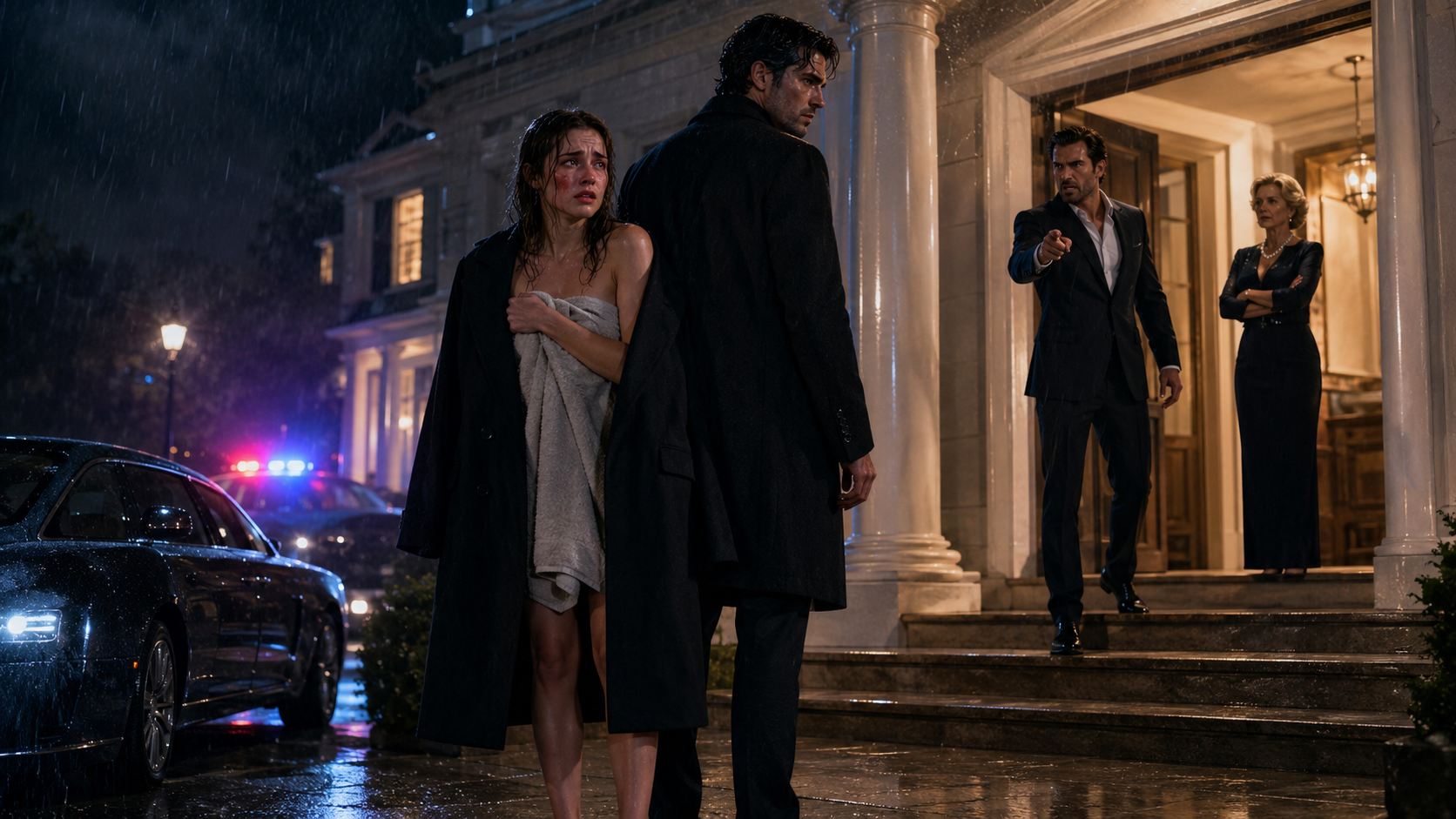
For one breathless second, the entire street seems to forget how to exist.
The rain keeps falling, but somehow it sounds farther away, as if the storm itself has stepped back to watch what happens next. Porch lights glow through the sheets of water. Curtains tremble in the houses across the road. Somewhere, a dog stops barking.
And on the front steps of the house you once thought was yours, Victor Vale stands barefoot in the doorway, staring at the man who just stepped between him and the ruined pieces of your life.
His face is twisted with disbelief.
Behind him, his mother, Lorraine, appears wrapped in a pale satin robe, one hand pressed to the pearls at her throat. She looks less frightened than offended, as though the real tragedy tonight is not that her son threw his wife into the rain wearing nothing but a towel, but that someone dared to witness it.
“Who are you supposed to be?” Victor snaps.
The man in the dark overcoat does not answer immediately.
Nathan Cross stands beside the black car at the curb, rain sliding down his hair, his jaw locked so tightly it looks painful. He is older than the last time you saw him. Harder. The boyish warmth you remember from childhood has been replaced by something colder, something sharpened by years of being kept away.
But his eyes are the same.
Your brother’s eyes.
“Nathan,” you whisper.
The name barely leaves your mouth, but he hears it.
He turns just enough to look at you.
You are shaking so violently that the coat he placed around your shoulders keeps slipping open. Beneath it, the towel is soaked through. Your cheek burns where Victor’s hand struck you. Your knees feel weak. Your whole body is screaming from cold, fear, shame, and disbelief.
For eight years, Victor made you believe no one would come.
For eight years, he told you your family had given up, your friends had moved on, your old life had closed its doors.
And now your brother is standing in the rain like he walked straight out of the lie Victor built.
Nathan’s driver steps out from behind the car holding a waterproof tablet under his coat. Two other men move silently with him, not threatening, not dramatic, simply present. Their calm makes Victor look even more unstable.
Victor points at Nathan.
“You don’t get to walk onto my property and act like you own the place.”
Nathan’s expression does not change.
“That’s the problem, Victor,” he says quietly. “You never did.”
Lorraine lets out a short laugh.
“This is absurd. Ava is having one of her episodes. My son was trying to calm her down.”
Your name in her mouth feels like ice.
Ava.
Not sweetheart. Not daughter-in-law. Not even woman.
Just Ava, the problem. Ava, the unstable wife. Ava, the thing to be managed.
Nathan’s eyes move to your face, then to the red mark on your cheek.
Something in him goes still.
Not peaceful.
Dangerous.
“Play it,” he tells the driver.
Victor stiffens.
“Play what?”
The driver lifts the tablet. The screen glows blue-white in the rain. You cannot see the image clearly from where you stand, but you hear it.
At first, only muffled movement.
Then your voice, shaking.
“Please, Victor, give me my phone.”
His voice answers, low and cruel.
“You don’t need a phone. Who are you going to call? Nobody wants to hear from you.”
Lorraine’s voice follows.
“Stop embarrassing yourself, Ava. A decent wife does not raise her voice.”
Then the sharp crack of a slap cuts through the storm.
You flinch so hard Nathan steps closer without thinking.
Victor’s face changes.
For the first time all night, real fear slips through his anger.
“You recorded me?” he says.
Nathan looks at him like he is something unpleasant left on a floor.
“No. You recorded yourself.”
The color drains from Victor’s face.
You see the moment he remembers.
The security system.
The expensive cameras he installed after telling the neighborhood he was protecting his family. The cameras he bragged about at dinners. The cameras covering the driveway, the foyer, the porch, the side entrance, even the hall outside the bedroom.
Every angle. Every motion alert. Every clip backed up to the cloud.
Victor liked proof when it made him feel powerful.
He never imagined proof would learn how to speak against him.
“That footage is private,” he says quickly. “You can’t use that.”
Nathan’s laugh is quiet and humorless.
“You threw my sister outside half-dressed in a storm, and your first concern is privacy?”
Lorraine steps forward, chin lifted.
“She provoked him. She always does. She cries, she twists things, she—”
Nathan looks at her.
Just looks.
Lorraine stops speaking.
For years, that woman ruled every room with a raised eyebrow and a cold sentence. She could make you apologize for breathing too loudly. She could make you feel childish for being hurt, selfish for being tired, ungrateful for wanting kindness.
But Nathan is not afraid of her.
And the sight of Lorraine losing her power is almost impossible to understand.
Victor takes one step down from the porch.
“You need to leave,” he says to Nathan. “Before I call the police.”
Nathan reaches inside his coat and removes a folded document sealed inside a clear plastic sleeve.
“You should,” he says. “They’re already on the way.”
Victor stops.
From far away, beneath the rain, you hear the first faint sound of sirens.
Not close yet.
But coming.
Nathan hands the document to his driver, who walks it up the steps and holds it out to Victor. Victor snatches it, angry enough to tear it, but then his eyes drop to the first page.
He reads.
His mouth opens.
He flips to the next page.
Then the next.
Every line steals something from his face.
“What is that?” you ask.
Your own voice sounds strange to you. Small. Hoarse. Like it belongs to someone who has been crying underwater.
Nathan turns toward you, and when he speaks, his voice softens.
“It’s the deed.”
Victor looks up sharply.
“No.”
Lorraine moves closer to her son.
“What does he mean?”
Nathan ignores her.
“The house,” he says to you. “This house. The land. The accounts tied to the renovation. They are not Victor’s.”
Your heartbeat stumbles.
You stare at the tall windows, the white porch columns, the garden beds you planted with your own hands, the kitchen you once dreamed of filling with warmth.
“This house is yours, Ava.”
The rain feels suddenly colder.
“No,” you whisper. “That’s not possible.”
Victor’s jaw tightens.
Nathan looks at him.
“Tell her.”
Victor says nothing.
“Nathan,” you say, because the world is spinning and you need one solid thing to hold. “What are you talking about?”
Your brother takes one careful breath.
“When Dad died, he left you more than you were told. He knew you were too young to manage it all, so he placed it in a protected trust. I was named temporary manager until you chose what to do with it.”
Your fingers tighten around the coat.
“I never knew.”
“I tried to tell you,” Nathan says. “For years.”
Victor looks away.
Only for a second.
But you see it.
Nathan sees it too.
“Every letter vanished,” Nathan continues. “Every email bounced. Every call went unanswered. Then your social accounts disappeared. Your old phone number changed. And whenever I came near you, Victor made sure I looked like the enemy.”
You turn slowly toward your husband.
“Victor?”
His lips press into a line.
Lorraine answers for him.
“You were overwhelmed. Victor handled everything because you could not. That is what a husband does.”
Something in Nathan’s expression turns deadly calm.
“No, Lorraine. That is what a thief does when he finds a lock no one is watching.”
Victor’s eyes flash.
“Careful.”
Nathan steps closer to the bottom of the porch.
“You don’t want me to be careful. You want me to be quiet. That’s finished.”
The sirens grow louder.
Porch lights turn on down the street, one after another.
The neighborhood that watched your humiliation through curtains now watches Victor’s unraveling through glass.
Nathan points to the document in Victor’s hand.
“Ava signed the purchase documents seven years ago. You told her they were tax forms for your business. The trust paid for the house. The deed was placed in her name. You moved into her property and spent nearly a decade convincing her she owned nothing.”
Your throat closes.
You remember that day.
Victor sitting beside you at the dining table, smiling, tapping each page with a pen.
Just routine paperwork, darling.
Don’t worry your pretty head about legal language.
You trusted him.
No — worse.
You had been trained to trust him more than yourself.
“You knew,” you say.
Victor’s expression changes instantly. The rage softens into wounded patience, the performance he used whenever he wanted to pull you back into confusion.
“Ava, listen to me. You’re upset. You’re freezing. This is not the time.”
“Did you know this house was mine?”
He steps lower.
Nathan shifts in front of you.
Victor notices and stops.
“A marriage is not a business transaction,” Victor says. “Everything we had belonged to both of us.”
“That is not an answer.”
His eyes sharpen.
“You’re letting him turn you against me.”
For years, that sentence would have worked.
It carried the weight of so many other sentences.
Your brother doesn’t love you the way I do.
Your friends are jealous.
Your father’s money made you spoiled.
You’re too sensitive.
You remember things wrong.
You should be grateful I stayed.
But tonight, standing barefoot in the rain, wrapped in your brother’s coat, you hear Victor’s words without the fog he used to wrap around them.
And they sound cheap.
“No,” you say.
It is not loud.
It does not need to be.
Victor stares as if you slapped him.
“What?”
“I said no.”
Lorraine scoffs.
“Oh, for heaven’s sake.”
You turn your eyes to her.
For eight years, you cooked her favorite meals after she insulted you. You smiled at charity luncheons while she told women you were fragile. You sat through family dinners where she corrected your clothes, your voice, your work, your weight, your grief.
You apologized to keep peace.
You became smaller to make the house less violent.
But standing in the rain tonight, you suddenly understand something.
Peace that requires your silence is only another kind of prison.
“No,” you say again, this time to both of them. “I am not going back inside with him.”
Victor’s face hardens.
“You’re my wife.”
The first police car turns onto the street, red and blue lights washing over the rain.
Nathan answers before you can.
“She is a person before she is anything of yours.”
The patrol car stops at the curb. Two officers step out, cautious, hands near their belts. Their eyes move over the scene — Victor on the porch, Lorraine behind him, you shivering in a towel under a man’s coat, Nathan standing between you and the house.
The older officer approaches slowly.
“Who called this in?”
Nathan lifts a hand.
“I did. So did a neighbor. We have video evidence of assault, forced removal from the residence, threats, and possible financial coercion.”
Victor barks out a laugh.
“Financial coercion? This is insane. Officer, my wife is unstable. She has been under stress. Ask my mother.”
Lorraine hurries down one step.
“Yes, Ava has emotional issues. She exaggerates things. My son is a respected executive. He would never—”
Nathan turns toward his driver.
The tablet plays again.
This time louder.
Your voice.
Victor’s voice.
Lorraine’s voice.
The slap.
The silence after.
Even the officers go still.
Victor lunges for the tablet, but one of Nathan’s men steps aside and the officer immediately raises a hand.
“Sir, stay where you are.”
“This is my house,” Victor shouts.
“No,” you say.
Everyone looks at you.
Your hands are shaking, but your voice is clearer now.
“It is not.”
Nathan’s eyes soften for one second.
Then another vehicle pulls up behind the first black car.
A woman gets out holding a wide black umbrella. She wears a charcoal coat, her silver hair pinned neatly at the back of her head, and her face has the calm focus of someone who charges by the hour and wins by the minute.
She walks straight to you, opens the umbrella over your head, and says, “Ava Cross?”
You nod.
“I’m Miriam Sloane. I represent the Cross Family Trust. And from tonight forward, I represent you personally, unless you choose otherwise.”
You blink at her.
“My trust has an attorney?”
Miriam gives you a small, kind smile.
“Your trust has three attorneys. Your husband has kept all of us busy.”
Victor’s expression darkens.
“Miriam, you are overstepping.”
She finally looks at him.
“Victor, I haven’t even started.”
Lorraine’s mouth opens.
Miriam turns to the officers.
“We will cooperate fully. In addition to tonight’s assault, we have documentation of intercepted communications, redirected emails, unauthorized financial control, and possible fraud involving trust assets.”
The words move through you slowly.
Intercepted communications.
Redirected emails.
Unauthorized control.
You look at Nathan.
“What does she mean?”
Your brother’s jaw tightens.
“I wanted to tell you somewhere safe.”
“Tell me now.”
The rain drums against the umbrella.
Nathan’s eyes fill with pain he refuses to let fall.
“Victor created filters in your email account. Anything from me, the trust, Dad’s attorney, your old office, certain friends — all of it was forwarded to him, then deleted before you saw it.”
For a moment, you cannot feel your body.
The street blurs.
The rain becomes a roar.
You think of the years you spent believing people had forgotten you.
Your old college roommate who stopped inviting you.
Your former boss who never answered your message.
Your cousin whose baby shower you missed because Victor said you had not been invited.
Nathan, who you thought had abandoned you after your father died.
All those empty spaces in your life were not empty.
They were emptied.
Carefully.
Quietly.
By the man standing on your porch with your house key in his hand.
“You isolated me,” you whisper.
Victor says nothing.
That is the answer.
The officer steps toward him.
“Sir, I need you to come down here and speak with us.”
Victor lifts both hands.
“This is a family matter.”
“No,” Miriam says. “It is a legal matter.”
Lorraine points at you.
“She is doing this for money. That girl has always wanted attention.”
Something almost like laughter rises in your chest.
Attention.
You, who learned to cry silently in bathrooms.
You, who hid bruises beneath makeup and humiliation beneath good posture.
You, who apologized when Victor raised his voice because you did not want the neighbors to hear.
Attention.
Nathan looks at Lorraine.
“You watched him hit her.”
Lorraine’s face tightens.
“She provoked him.”
The older officer’s expression changes.
Miriam closes her folder with a soft snap.
“Thank you for confirming you were present.”
Lorraine goes pale.
Victor’s head turns toward his mother, furious.
For the first time, the two of them are no longer united against you. Fear has made them look at each other for someone to blame.
The officer asks you gently, “Ma’am, do you want medical attention?”
You touch your cheek.
You think of all the times Victor said he was sorry after hurting you with words, with silence, with control, with money, with locked doors, with threats wrapped in concern.
You think of all the times you forgave him because forgiving felt safer than leaving.
Then the officer asks, “Do you want to make a statement?”
Victor’s eyes find yours.
They are not sorry.
They are warning you.
And that makes the choice simple.
“Yes,” you say. “I do.”
Lorraine gasps like you have committed a crime.
Victor erupts.
“You ungrateful—”
The officer steps between you.
“Sir, lower your voice.”
Victor points at Nathan.
“This is his fault. He poisoned her. He wants the trust. He always wanted the money.”
Nathan’s face stays still, but his voice cuts through the rain.
“I wanted my sister alive.”
That silences even Victor.
For a moment, no one speaks.
Then Miriam looks at the officers.
“We also have an emergency protective filing prepared, a copy of the deed, the trust authority documents, and enough evidence to request immediate removal from the property.”
Victor laughs bitterly.
“You cannot remove me from my own home.”
Miriam looks at him with almost polite boredom.
“We already established the first false statement.”
The younger officer receives something from dispatch and looks at Victor again.
“Sir, we’re going to need you to come with us while we sort this out.”
Victor steps back toward the doorway.
Lorraine grabs his arm.
“No. No, this is ridiculous. My son is an executive vice president. He sits on boards. He knows the mayor.”
Nathan glances at his phone.
“Not for long.”
Victor freezes.
“What did you do?”
“The emergency board meeting began twelve minutes ago.”
Victor’s mouth opens.
Nathan continues.
“Your access has been suspended. Company devices locked. Accounts frozen. Security notified.”
Victor’s face turns gray.
“You can’t do that.”
“I didn’t. The board did. I simply showed them what their executive did on camera.”
Lorraine’s voice cracks.
“You are destroying him.”
Nathan’s eyes move to you.
“No. He built the match. He poured the gasoline. He lit the fire. Tonight, someone finally opened a window.”
The officers guide Victor off the porch.
He fights them with words first.
Then with his shoulders.
Then with silence when he realizes the whole street is watching.
His wrists are brought behind his back. The click of the cuffs is softer than you expect. Almost gentle.
That somehow makes it worse.
Victor looks at you as they lead him toward the patrol car.
“You did this,” he says.
The old you would have apologized.
The old you would have begged him not to hate you.
The old you would have wondered whether he was right.
But the woman standing in the rain tonight has already been humiliated, struck, locked out, and still not broken.
“No,” you say. “I survived it.”
The car door closes.
And just like that, the man who made your home feel like a cage is taken away from a house that never belonged to him.
Lorraine remains on the porch, trembling with rage.
“You think this is over?” she says. “You think men like my son disappear because you cry to your brother?”
Miriam steps forward.
“Mrs. Vale, you have no lease, no ownership interest, and no lawful right to remain on Ms. Cross’s property. You may collect your purse and leave, or the officers can assist.”
Lorraine looks at you.
She waits.
Waits for the old Ava.
The one who lowered her eyes.
The one who made tea after being insulted.
The one who apologized for making everyone uncomfortable.
You meet her stare.
“You should go.”
Her mouth opens.
Nothing comes out.
She disappears inside the house.
The officers wait near the porch while she gathers her things. When she returns, she carries a designer purse and a coat she always said was too expensive for “women who didn’t earn their place.”
As she passes you, she leans close enough that only you can hear.
“He will never love you again.”
You look at her tired, beautiful, cruel face.
“That may be the first blessing you’ve ever given me.”
Her expression cracks with fury.
Then she walks into the rain and leaves.
When the street finally empties, you are still standing beneath Miriam’s umbrella.
The police cars are gone. Victor is gone. Lorraine is gone. The neighbors’ curtains have gone still, though you know they are still watching.
The house waits behind you.
The tall windows.
The white walls.
The porch where you were shamed.
The kitchen where you learned to measure your footsteps by Victor’s moods.
The bedroom where you stopped recognizing yourself in the mirror.
Nathan turns to you gently.
“Do you want to go inside?”
You look at the door.
For years, you prayed to be safe inside that house.
Now you understand the house was never the problem.
It was who held the keys.
“I don’t know,” you admit.
Nathan nods as if that is enough.
“Then we don’t go in tonight.”
He leads you to the car.
Inside, the heater is already running. On the back seat lies a folded blanket, a hoodie, sweatpants, socks, shoes, bottled water, and a small bag of toiletries.
Everything is your size.
The sight of it breaks you harder than the slap did.
“You brought clothes?”
Nathan looks away, giving you privacy even with his answer.
“I hoped you wouldn’t need them. I prepared as if you might.”
You change in the back seat while Miriam stands outside with the umbrella shielding the window. When you are dressed and wrapped in the blanket, Nathan sits beside you.
For a while, neither of you speaks.
Rain streaks the glass, turning the streetlights into trembling gold.
Then you whisper, “I thought you left me.”
His face twists.
“I know.”
“I hated you for it.”
“I know.”
Your throat aches.
“Why didn’t you come sooner?”
Nathan looks down at his hands. They are clenched so tightly his knuckles are white.
“At first I thought you wanted distance. Then I thought Victor was poisoning you against me. Then Dad’s attorney noticed strange account activity. A month ago, Miriam found the email filters. After that, we started building the case quietly.”
“A month?”
He nods.
“I wanted to come with proof. Real proof. Something he couldn’t twist. Then tonight, your neighbor called my office emergency line. Mrs. Palmer. Across the street.”
You think of the curtain that moved when Victor locked the door.
“She saw?”
“She saw enough to refuse to look away.”
You close your eyes.
For years, you believed the world was watching and choosing silence.
Tonight, someone watched and chose you.
Nathan’s voice lowers.
“When I saw you on that porch, I wanted to kill him.”
You open your eyes.
He is staring through the windshield, rainlight moving across his face.
“But that would have made tonight about my anger,” he says. “And tonight needed to be about getting you free.”
You begin to cry then.
Not beautifully.
Not quietly.
You cry like something inside you has finally been given permission to collapse.
Nathan pulls you into his arms, and for the first time since you were a girl, you let your older brother hold you while you fall apart.
You spend that night in a hotel under another name.
Not because you are hiding.
Because Miriam insists on safety, documentation, statements, account freezes, password resets, emergency filings, and one full night where Victor cannot reach you except through lawyers.
Your phone keeps lighting up until Miriam takes it from your hand.
Victor.
Lorraine.
Unknown numbers.
Messages arrive in waves.
Ava, please.
You misunderstood.
My mother made it worse.
Do not destroy my life.
We are married.
You owe me a conversation.
Then, when you do not respond, the tone changes.
You will regret this.
No one will believe you.
Your brother is using you.
You are nothing without me.
Miriam photographs every message and places them in an evidence folder.
“Do not reply,” she says.
You almost laugh.
For eight years, replying was your job.
Explaining.
Soothing.
Apologizing.
Repairing.
Making his cruelty smaller so he could pretend it was not cruelty.
Tonight, silence becomes the first thing you own.
By morning, Victor’s suspension is public inside his company. By noon, his office has been locked. By evening, his version of the story has changed three times.
At first, he tells people you had a breakdown.
Then he says Nathan planned a takeover.
Then he says you were manipulated by greedy lawyers.
But the footage exists.
And for once, the truth has teeth.
Two days later, Miriam brings a stack of files to the hotel suite.
You sit at the table with Nathan beside you while she lays out the architecture of your stolen life.
Bank accounts you never saw.
Credit cards opened in your name.
Trust distributions labeled as household expenses.
Payments to consultants who never consulted.
Messages from your old design firm asking whether you would ever consider returning.
You pick up one printed email with shaking hands.
It is six years old.
Ava, your waterfront project still comes up in our meetings. If you ever want to come back, there will always be a desk here for you.
Your vision was rare.
You read the last line three times.
Your vision was rare.
Victor had told you they replaced you within weeks.
You pick up another email.
Then another.
Friends asking where you went.
Your cousin inviting you to her wedding.
An old professor forwarding a fellowship.
A former client asking for you specifically.
Life had been reaching for you over and over.
Victor stood between you and the door, then told you nobody knocked.
Something colder than grief settles inside you.
Clarity.
“He didn’t just hurt me that night,” you say.
Miriam’s expression softens.
“No.”
You look at the papers.
“He built a system.”
“Yes.”
Your fingers stop shaking.
“Then we take it apart.”
Nathan looks at you for a long moment.
Then he smiles, but his eyes are wet.
“There she is.”
One week later, you return to the house.
Not because it is easy.
Because it is yours.
The locks are changed first. Then the codes. Then the cameras inside the house are removed one by one.
You stand in the bedroom doorway for nearly twenty minutes before stepping inside.
Nothing happens.
The walls do not collapse.
Victor’s voice does not rise from the floor.
The room is only a room.
So you open the windows.
Cold air floods in, rushing through curtains, carrying out the stale smell of his cologne, Lorraine’s perfume, old fear, old obedience, all the invisible things you breathed for years without knowing they were poison.
Nathan offers to hire decorators.
You say no.
For the first time in almost a decade, you want to decide where every chair belongs.
You sell Victor’s leather desk. You donate Lorraine’s china. You paint the dining room a soft green because Victor hated green. You turn his office into a studio with sunlight, drafting paper, plants, and shelves full of books you once packed away because he said they made the house look cluttered.
On the wall, you hang one photograph of your father.
He is laughing in the picture, standing at a summer barbecue with one hand lifted as if calling someone over.
You stand beneath that photograph and cry for him properly.
Not as Victor’s wife.
Not as the woman Lorraine pitied.
As his daughter.
As yourself.
The legal battle moves quickly, then slowly, then all at once.
Victor hires attorneys who speak of misunderstandings and marital stress. Lorraine signs a statement saying you were unstable. Two of Victor’s friends claim you were dramatic, difficult, and financially irresponsible.
Then Miriam plays the porch footage in court.
Victor’s voice fills the room.
“You live in my house. You eat because I allow it. You do not get to embarrass me.”
Then the slap.
Then the sound of the door locking.
Then you in the rain.
The courtroom becomes so quiet you can hear the judge turn a page.
Victor looks at the table.
Lorraine looks smaller than you have ever seen her.
The protective order is granted.
Temporary becomes permanent.
The financial investigation deepens. The company audit uncovers misuse of resources, hidden transfers, conflicts of interest, and attempts to conceal trust-related communications.
By the end of the month, Victor is no longer suspended.
He is terminated.
No farewell dinner.
No careful statement about pursuing new opportunities.
No graceful exit.
Just a closed door.
For a while, people talk.
They whisper in grocery aisles and charity committees. Some pity you. Some doubt you. Some say you should have handled it privately. Some say a wife should not ruin a husband’s life over “one mistake.”
You learn quickly that some people will protect a man’s reputation more fiercely than a woman’s safety.
But the people who matter do not ask why you stayed.
They ask what you need now.
That question changes you.
What do you need now?
At first, you do not know.
Then one morning, sitting at the drafting table in your new studio, you begin to draw.
Not a luxury home.
Not a tower.
Not the kind of project that once made clients call you brilliant.
You draw a building with wide windows and private entrances.
A legal office.
A counseling room.
Showers.
Childcare spaces.
A clothing closet.
A computer lab.
Small gardens hidden behind high walls, not to trap anyone inside, but to give women a place where no one can watch them without permission.
Nathan comes in quietly and stands behind you.
“What is it?”
You keep drawing.
“A place for women who are trying to leave.”
He says nothing.
You add a kitchen.
Not a show kitchen.
A real one.
Warm, bright, full of tables.
“A place where they can charge a phone. Open a bank account. Talk to a lawyer. Sleep without listening for footsteps.”
Nathan’s voice is rough when he asks, “How much?”
You look up.
“You haven’t even asked if I’m serious.”
He smiles faintly.
“I know my sister.”
The center opens eighteen months later.
You call it The Lantern House.
On opening morning, you stand outside the building in a navy dress you bought with your own money. Your hair is pinned back. Your hands are steady.
Nathan stands beside you pretending not to cry.
Miriam arrives with folders, donors, and the terrifying expression of a woman ready to make wealthy people write checks.
Mrs. Palmer comes too — the neighbor who called for help that night.
When you hug her, she holds you tightly.
“You saved my life,” you tell her.
She shakes her head.
“No, honey. I just decided your life was worth interrupting my evening.”
Inside, women begin arriving.
Some with children.
Some with bruises hidden under sleeves.
Some with nothing but a purse.
Some still defending the men who hurt them because love and fear do not untangle cleanly.
You recognize their eyes.
The way they scan exits.
The way they apologize for needing water.
The way they say, “It wasn’t always bad,” as if kindness on some days cancels cruelty on others.
You never rush them.
You never shame them.
You sit across from them and say the words you wish someone had said to you years earlier.
“You are not crazy. You are not weak. You are not what he called you.”
Years pass.
Victor tries to reach you once.
Not in person.
Through a letter sent by his attorney after his criminal case ends with a plea, probation, fines, and mandatory counseling. His career never fully returns. The men who once laughed at his jokes stop inviting him into rooms that matter.
You do not open the letter alone.
You sit in your studio with Nathan and Miriam nearby, not because you are afraid, but because you have learned that support is not weakness.
The letter is what you expect.
An apology shaped like an excuse.
A memory polished until it looks harmless.
A line about losing control.
You set it down halfway through.
Miriam asks, “Do you want to respond?”
You think for a moment.
Then you take a blank sheet of paper and write one sentence.
You did not lose control. You lost access.
You never send it.
Instead, you frame it and hang it in your office at The Lantern House.
Women ask about it sometimes.
You tell them the truth.
Sometimes closure is not a conversation.
Sometimes closure is a changed lock, a separate bank account, a lawyer who believes you, a brother who finds you, a neighbor who calls, and a morning where you wake up without fear.
On the third anniversary of that stormy night, The Lantern House hosts a fundraiser in the garden.
Lights hang between trees. Music drifts through the courtyard. Children run across the grass while their mothers laugh at tables full of flowers and candles. Lawyers, volunteers, survivors, donors, and social workers fill the building with voices.
Nathan gives a speech.
He embarrasses you by telling everyone you were brave even when you forgot it.
You roll your eyes.
Then you cry anyway.
Later, you step outside alone.
Rain begins to fall.
Not hard.
Not violent.
Just a soft spring rain whispering over the courtyard.
You stand beneath the covered walkway and hold out your hand.
For a moment, you are back on that porch in a towel, shaking, humiliated, believing the door had closed on your whole life.
But it had not closed.
It had opened.
Behind you, the door swings softly.
Nathan steps outside.
“You okay?”
You smile.
“I am.”
He stands beside you, shoulder touching yours.
“Dad would be proud.”
Your throat tightens.
“I hope so.”
“He would.”
Across the courtyard, Miriam is arguing with a donor twice her size and somehow making him look grateful. Mrs. Palmer is laughing with two volunteers. A young mother is dancing with her toddler near the kitchen doors.
The life Victor tried to erase is everywhere.
Alive.
Loud.
Yours.
The next morning, a new woman comes to The Lantern House.
She is young, maybe twenty-five, wearing borrowed clothes and holding a baby against her chest. Her eyes are red. Her voice shakes when she says she is not sure she belongs there.
You sit across from her.
You do not tell her what to do.
You simply slide a cup of tea across the table.
“Start wherever you can.”
She looks down.
“My husband says I’m nothing without him.”
The old words echo faintly.
But they do not own you anymore.
You lean forward gently.
“Mine said that too.”
Her eyes lift.
“What happened?”
You look around the center.
At the legal office.
At the childcare room.
At the wall of framed keys from women who changed their locks.
At your name on the director’s door.
Then you smile.
“I found out he was wrong.”
And that is the part Victor never imagined.
He thought throwing you into the rain would teach you shame.
He thought a locked door would make you beg.
He thought fear would send you crawling back.
Instead, that locked door became the first door you ever truly walked out of.
By morning, he had lost control.
By the end of the month, he had lost the house.
By the end of the year, he had lost the story he told about you.
And you?
You found your brother.
You found your voice.
You found the life that had been hidden from you piece by piece.
Most of all, you found the woman you were before Victor.
Only this time, she was stronger.
And she never asked permission to come home.

