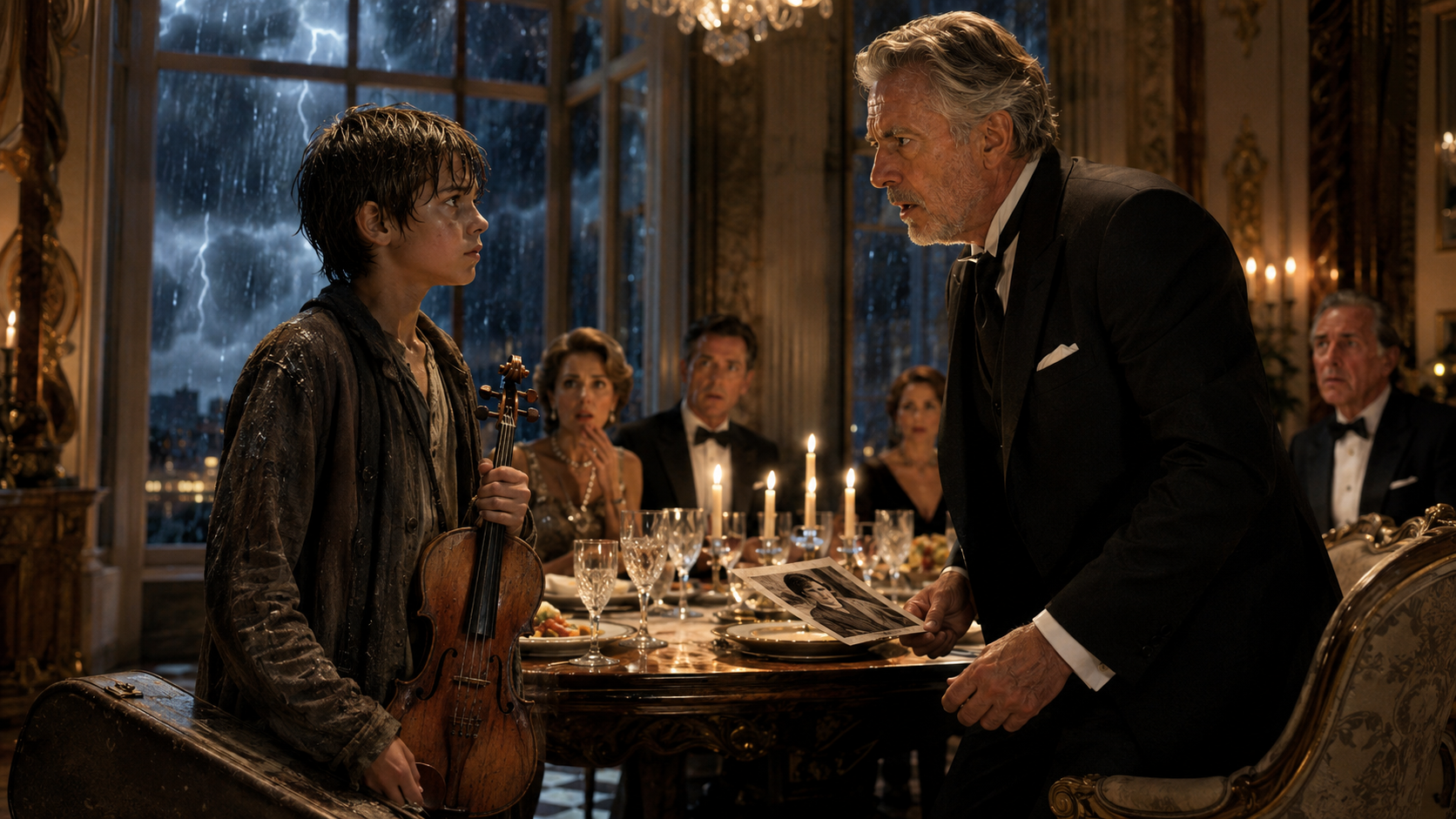
A thin thread of sound rose above the candlelight, trembling for half a breath before steadying itself. Then another note followed. And another.
The melody was simple.
Not the kind of music played in grand halls. Not the kind rich people applauded because they were told it was important. It sounded like something hummed beside a child’s bed. Something remembered from another room. Something a mother might sing when there was no money for medicine, no food in the cupboard, no heat in winter — only her voice, holding back the dark.
The table changed.
The red-faced man stopped smirking.
The woman in diamonds slowly lowered her hand.
The servants near the wall went still.
Even the rain outside seemed to hush against the windows.
Elias did not play perfectly. His violin had a rough edge. One string buzzed faintly. His bow slipped once. But none of that mattered.
Because the song did not sound performed.
It sounded survived.
Victor Hargrove stopped breathing.
At first, he did not understand why.
He had heard thousands of songs. At opera houses. Charity galas. Private islands. His money had bought music from the best performers in the world.
But this melody did not belong to them.
It belonged to a room with blue curtains.
A chipped white piano.
A woman laughing as sunlight caught in her copper-brown hair.
A woman turning from the window and saying, “No, Victor, not like that. You’re counting the notes. You have to feel where they hurt.”
Victor’s fingers curled around the arms of his chair.
The dining room blurred.
For one terrible second, he was thirty years younger.
He was not Victor Hargrove, hotel magnate, feared negotiator, untouchable widower.
He was Victor with paint on his shirtsleeve, no fortune yet, no walls around his heart, standing in a tiny rented apartment while Liana Vale played a melody she claimed she had written in a dream.
Liana.
The name went through him like a knife that had been waiting eleven years to move.
The boy reached the middle of the song.
Victor’s face drained of color.
Catherine saw it. She knew Victor well enough to notice even the smallest crack in his composure. But this was not a crack.
This was collapse wearing a tuxedo.
“Stop,” Victor said.
Elias did not hear him at first.
Or maybe he did and chose to finish the phrase.
Victor stood so abruptly that his chair scraped across the marble.
“Stop playing.”
The bow froze.
The last note died.
The room went silent.
Elias opened his eyes.
Victor stared at him.
“Where did you learn that song?”
The boy hesitated.
“My mother.”
The answer struck Victor harder than the music had.
“Your mother’s name.”
Elias looked down at the violin, then back up. “Mara Rowan.”
Victor blinked.
Not Liana.
Of course not.
Liana was dead.
That was what he had been told.
Eleven years ago.
A letter had come.
No, not a letter. A message. A neat, cruel statement delivered by his own attorney after months of silence.
Liana Vale had left the country. Liana Vale had wanted nothing from him. Liana Vale had married another man. Liana Vale had died in childbirth somewhere in Portugal.
And the child had not survived either.
That was what Victor had believed.
That was what had turned grief into stone inside him.
He looked at Elias again.
Dark hair.
Pale face.
That stubborn lift of the chin.
Not enough.
Not proof.
Only cruelty from memory.
“Your mother wrote that song?” Victor asked.
Elias nodded. “She says she did.”
“Says?”
The boy’s mouth tightened. “She used to say it. Before she got sick.”
Catherine’s expression softened.
Victor’s voice dropped. “Sick how?”
Elias glanced at the guests. He clearly hated being watched.
“She has trouble breathing. And her heart. And sometimes she forgets things when the fever gets bad.” He swallowed. “But she remembers the song.”
Someone at the table shifted uncomfortably.
The red-faced man muttered, “Victor, really, this is becoming—”
Victor lifted one hand.
The man stopped.
Victor stepped away from his chair and walked toward the boy.
Elias did not move, but his shoulders tensed as though he was ready to run.
Victor stopped a few feet in front of him.
“What is your full name?”
“Elias Rowan.”
“How old are you?”
“Eleven.”
The word hit the room like a glass dropped onto stone.
Eleven.
Catherine closed her eyes.
Victor stared at the boy’s face.
Eleven years.
Eleven years since Liana vanished.
Eleven years since Victor buried the only soft thing in him.
Eleven years since he allowed bitterness to replace love because the alternative was grief without a body.
“Who was your father?” Victor asked.
Elias’s expression hardened in a way no child’s face should.
“I don’t have one.”
“That was not my question.”
“My mother said he died before I was born.”
Victor’s jaw flexed.