“What was his name?”
“She never told me.”
“Never?”
Elias shook his head. “She said some names were too heavy to carry until I was older.”
A strange sound came from Catherine. Half breath, half sorrow.
Victor turned slightly. “Did you know about this?”
“No,” Catherine whispered. “I only heard him playing outside the old theater last week. He was raising money for medicine. I thought…” Her voice trembled. “I thought the song sounded familiar.”
Victor looked back at Elias.
The boy had begun to put the violin away.
“Leave it,” Victor said.
Elias froze. “What?”
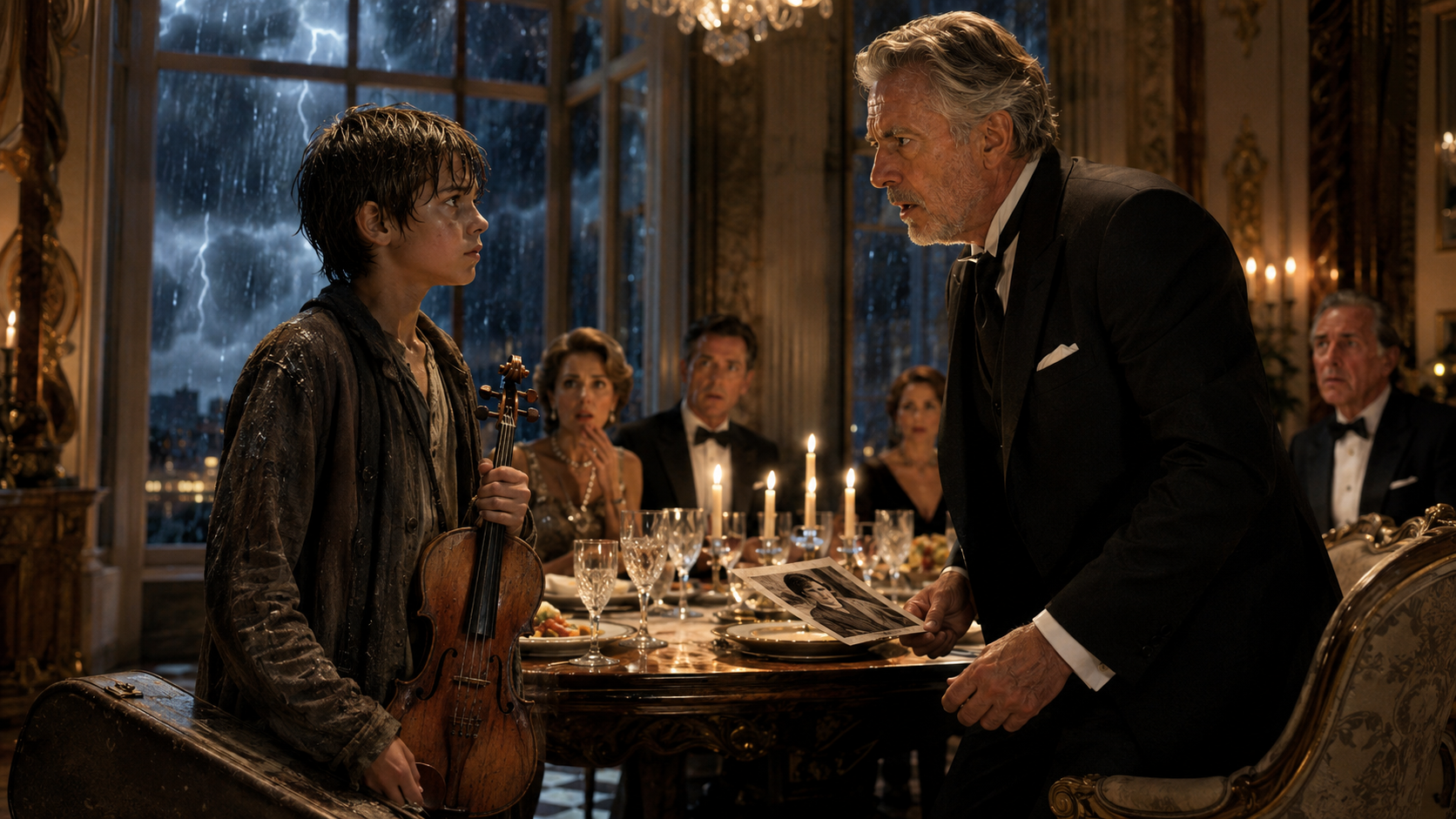
“The photograph in your case. Take it out.”
The boy’s face changed instantly.
Fear.
Not embarrassment. Fear.
“No.”
Victor’s eyes sharpened. “Why not?”
“It’s mine.”
“I’m not asking to keep it.”
“No.”
The red-faced man laughed nervously. “For heaven’s sake, Victor, don’t argue with the child over some gutter photograph.”
Victor did not look at him.
“I said,” Elias whispered, “no.”
That refusal did something to Victor.
It angered him, yes. He was used to being obeyed. But beneath the anger, something else moved — a recognition he did not want.
Liana had once looked at him that way.
When his father tried to buy her silence.
When Victor tried to convince her that people like them could not survive people like the Hargroves.
When she said, “Your money is loud, Victor, but it doesn’t make you right.”
Victor lowered his voice.
“Elias, I need to see it.”
The boy shook his head. “My mother said never show it to anyone from big houses.”
The room seemed to tilt.
Victor’s throat tightened.
“Why would she say that?”
“Because big houses take things.”
No one laughed this time.
Victor felt the words enter him slowly.
Big houses take things.
He had spent decades building big houses. Hotels. Estates. Towers. Restaurants with marble bathrooms and rooftop pools. He had built an empire of big houses.
And somewhere, an eleven-year-old boy had been taught to fear them.
Victor crouched slightly, bringing himself closer to the boy’s height.
“I won’t take it.”
“You don’t know that.”
“Yes,” Victor said quietly. “I do.”
Elias studied him.
Children who grow up poor learn to read adults quickly. Not words. Words are cheap. They read hands, eyes, posture, the space between a promise and a lie.
After a long moment, Elias reached into the violin case.
He took out the photograph.
It was small.
Faded.
Bent at one corner.
He held it tight for a second before offering it.
Victor accepted it with fingers that suddenly did not feel like his own.
The photograph showed a young woman sitting on the hood of an old blue car, laughing into the sun. Her hair was windblown. Her dress was white. One hand rested over her stomach, not enough to make the pregnancy obvious unless you already knew what you were looking for.
Beside her stood a younger Victor.
No gray in his hair.
No ice in his eyes.
His arm was around her shoulders, and he was looking at her as if the entire world had narrowed to one miracle.
On the back of the photo, written in blue ink, were four words.
For our little song.
Victor stopped breathing.
Catherine rose from her seat.
“Victor?”
He turned the photo over again.
His vision blurred.
He remembered that day.
Liana had refused to attend a formal family luncheon, saying she would rather eat peaches by the river than sit across from people who smiled like knives. Victor had skipped the luncheon too. His father had called him weak. His mother had called Liana a phase.
They had driven until the city disappeared.
Liana had played that melody on a cheap violin under a willow tree. Later, she told him she was pregnant.
Victor had lifted her into his arms and spun her around while she laughed and shouted that he would drop her.
That photograph had been in his study.
Then it vanished.
Just like Liana.
He looked at Elias.
The boy’s face was guarded, but his eyes were frightened.
Victor could barely force the words out.
“Where did your mother get this?”
“She keeps it in a tin box.” Elias’s voice was small now. “She said if anything happened to her, I should keep the picture and the violin. She said the song would tell me who loved me before I was born.”
The dining room had become unbearably quiet.
Victor stared at the boy’s mouth. The shape of it. The left eyebrow, slightly higher than the right. The way he stood with pride covering hunger.
“Your mother is alive,” Victor said.
Elias frowned. “Yes.”
“Where?”
The boy pulled back. “Why?”
“Where is she?”
“I’m not telling you.”
“Elias—”
“You’re scaring me.”
The words stopped Victor.
He looked down at himself — the expensive suit, the commanding posture, the photograph clenched in his hand — and realized the boy was right.
He was not acting like a man who had found a miracle.