French authorities entered the house before dawn. It had blue shutters, stone gates, and medical equipment hidden behind locked interior doors. Liora was in an upstairs bedroom with covered windows and a nurse who claimed she had believed the patient was mentally unstable.
Liora was thin.
Weak.
Furious.
Alive.
When her plane landed back in the city, Adrian waited on the tarmac without flowers.
He had remembered.
Liora hated cut flowers. She said they were beautiful things already dying.
He brought instead the old leather jacket she had worn the night he proposed, because she once told him it made her feel like herself.
She came down the steps slowly, one hand on the railing.
For one terrible second, she looked afraid.
Afraid that even now, after everything, he might hesitate.
Adrian crossed the tarmac and stopped in front of her.
He did not touch her until she reached for him.
“Liora,” he said.
Just her name.
Nothing else could carry enough.
She pressed her shaking hand against his face.
“You knew me?”
He broke then.
The kind of breaking no camera should film.
“I forgot how to trust what I knew,” he said. “But someone else didn’t.”
Her eyes moved past him.
Eli stood beside Mrs. Bell, half hidden behind her coat.
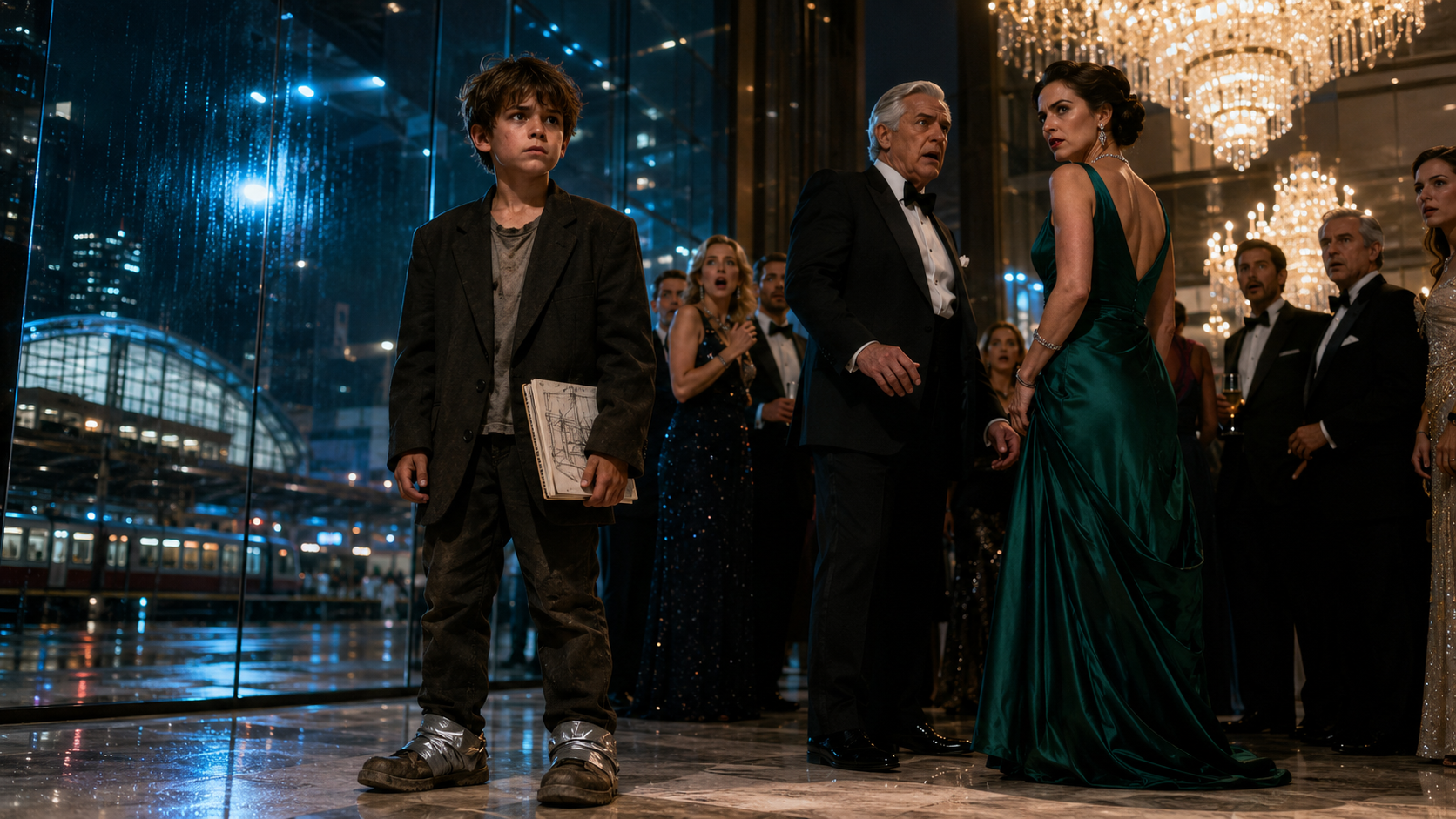
He wore the taped shoes.
Liora saw them.
Then she saw his face.
For a moment, the terminal came back: rain, stone, terror, a boy in the shadows.
“You remembered,” she whispered.
Eli nodded.
“You told me to.”
Liora walked to him carefully.
Everyone moved as if to help her.
She waved them away.
When she reached Eli, she knelt despite her weakness and took both his hands.
“I am sorry,” she said.
Eli frowned. “For what?”
“For giving a child a burden no child should have had to carry.”
Eli looked down.
Then he said, “I was already carrying things.”
Liora closed her eyes.
Mrs. Bell wiped her face with the back of her hand and pretended she was not crying.
After that, Eli did not return to sleeping beneath Grayson Terminal.
At first, he hated the bed Liora gave him.
It was too soft.
The room was too quiet.
The window locked too securely.
He hid crackers in the drawer of the nightstand. He slept with his shoes on the floor beside him, toes pointed toward the door. He woke at every footstep. He apologized for using too much soap. He folded towels no one asked him to fold.
Adrian tried to buy him things.
Liora stopped him.
“Trust is not a purchase,” she said.
So Adrian learned another way.
Every morning, he sat at the kitchen table with Eli and asked, “What did you notice today?”
At first, Eli shrugged.
Then he answered.
A sparrow with one white feather.
A driver who smiled only when people looked.
A woman in the bakery who gave the burned pastries to the old men outside and charged them nothing.
A guard at Cross Tower who limped more on rainy days but refused to sit.
Adrian listened to each detail like it mattered.
Because now he understood that details were not small.
They were where truth hid when power entered the room.
Selene Crosswell was convicted of kidnapping, fraud, conspiracy, and attempted theft of charitable assets. Mira Lane testified in exchange for a reduced sentence. The false control agreement was voided. The corrupt doctor lost his license. The men from the black car turned on each other before trial.
The Cross Horizon Foundation survived.
But Liora changed it completely.
The next year, there was no Glass Gala.
No chandeliers.
No champagne tower.
No society photographers pretending generosity was a costume.
Instead, Liora opened the Marrow House for Runaway and Homeless Children in the renovated wing of an old school near the river. It had beds without numbers, lockers with keys, hot meals at any hour, counselors who understood silence, legal advocates, showers with doors that locked, and an art room that smelled of paper, paint, and safety.
Above the entrance hung a framed copy of Eli’s drawing.
Not because it was perfect.
It wasn’t.
The proportions were rough. The shading was uneven. The rain looked like scratches.
But it had saved a woman’s life.
On opening day, a reporter asked Eli how he knew the woman at the gala was fake.
He was thirteen by then.
His new shoes were clean, but the taped ones sat in a box under his bed because he did not want comfort to make him forget what hunger had taught him.
He thought carefully before answering.
“She was too perfect,” he said.
The reporter smiled. “Perfect is suspicious?”
“Sometimes.” Eli looked toward Liora, who stood beside Adrian in a plain blue coat with her gold ring back on her right hand. “Real people have things that don’t match. Scars. Habits. Old pain. Favorite mistakes. If someone copies the face but misses the hurt, they copied the wrong thing.”
The reporter lowered her microphone.
No one laughed.