Years later, Eli Marrow became an artist.
His portraits did not flatter people.
That was why they mattered.
He painted judges with tired eyes, nurses with cracked hands, children who looked ready to run, old women who had survived men with money, fathers waiting outside prison gates, girls laughing with missing teeth, janitors under museum lights, billionaires without armor, and mothers who looked as if they had carried the whole weather of the world.
Critics said his gift was honesty.
Eli disagreed.
Honesty sounded too clean.
His gift was remembering.
At his first major exhibition, Liora stood in front of a painting called The East Arch and cried without hiding it.
The painting showed a woman beneath a terminal arch in the rain, her coat torn, her hand at her throat, her face turned toward the shadows.
In those shadows sat a boy with a notebook and taped shoes.
Not rescuing her yet.
Not understanding everything yet.
Only watching.
Only believing that a frightened woman was still a person even when powerful men called her confused.
Adrian stood beside Liora and held her hand.
Mrs. Bell, older now but no less dangerous, looked at the painting and sniffed.
“You made my basement look too clean in the other one,” she told Eli.
Eli smiled.
“I was being kind.”
“Be accurate.”
“Yes, ma’am.”
A young journalist asked Eli why he painted that night so often.
He looked at the canvas for a long time.
Then he said, “Because the world teaches people like me to be invisible. But invisible people still see. Sometimes we see what everyone else has trained themselves to ignore.”
“And what did you see that night?”
Eli looked across the gallery.
Liora was laughing through tears. Adrian was watching her the way a man watches sunrise after years underground. Mrs. Bell was arguing with a waiter about the size of the sandwiches.
Eli thought of rain.
A black car.
A torn sleeve.
A woman’s mouth forming two silent words.
Remember me.
“I saw that truth doesn’t always arrive with a badge or a camera,” he said. “Sometimes it arrives hungry. Sometimes it is scared. Sometimes its shoes are held together with tape.”
The journalist waited.
Eli added, “And sometimes the smallest person in the room is the only one brave enough to say what everyone powerful is afraid to hear.”
At the far end of the gallery, the taped shoes rested inside a glass case.
Not as a symbol of poverty.
Not as decoration.
As proof.
Proof that a boy had walked into a palace of glass with nothing but a drawing, a memory, and a sentence sharp enough to cut through a billion-dollar lie.
That sentence followed him for the rest of his life.
People repeated it in interviews. In documentaries. In classrooms. In courtrooms. They made it sound grander than it had been.
But Eli remembered the truth.
His voice had shaken.
His hands had gone cold.
His knees had nearly failed.
He had not felt brave.
He had felt terrified.
Still, he had reached for Adrian Cross’s sleeve, looked up at the man everyone feared, and spoken for the woman everyone else had failed.
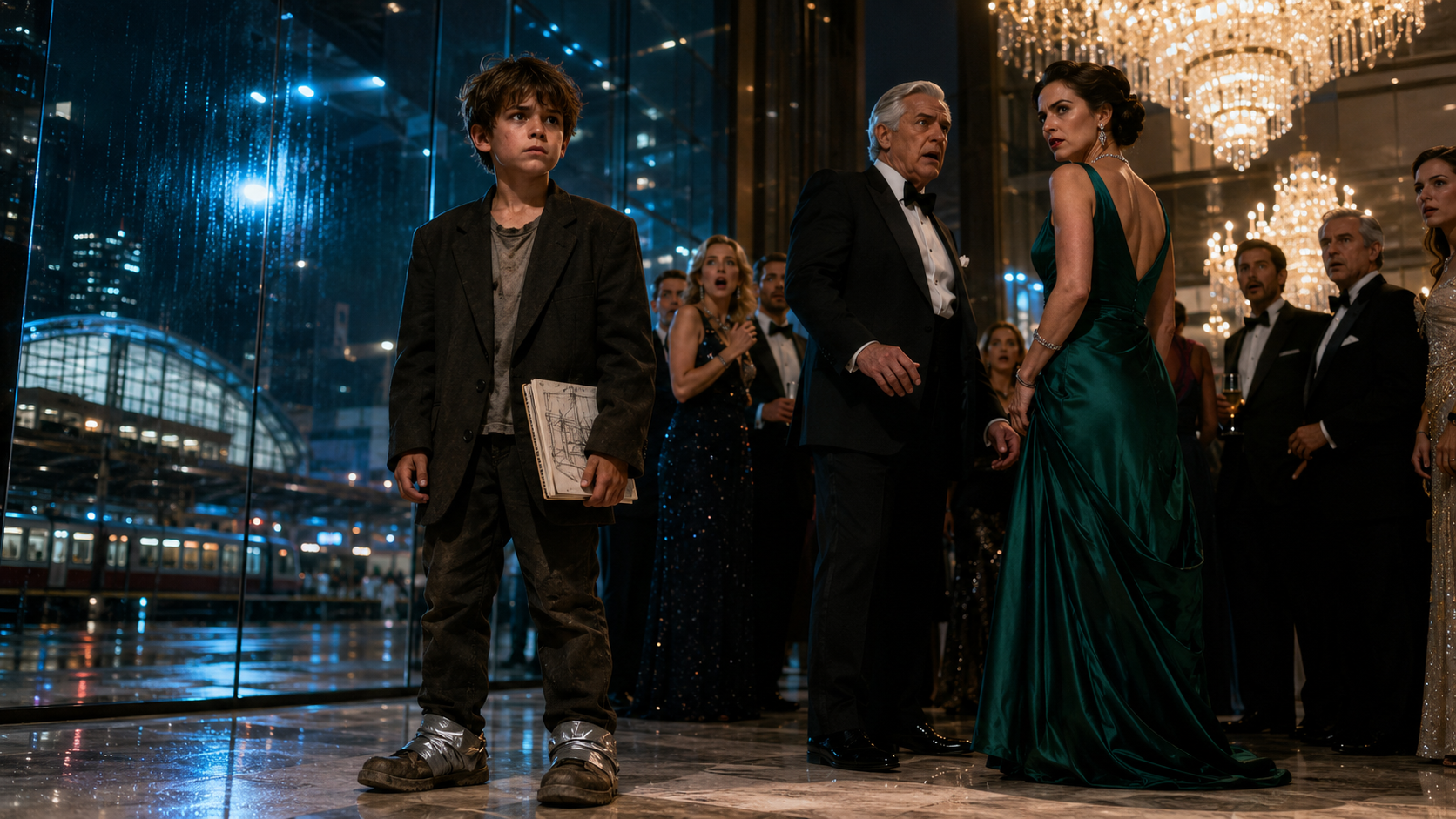
“Sir,” he had said, “that is not your wife.”
And because he said it, the glass room cracked.
Because he said it, a woman came home.
Because he said it, a foundation became a shelter.
Because he said it, a boy who had once slept under newspapers learned that being unseen was not the same as being powerless.
And somewhere in the city, whenever rain struck the stone arches of Grayson Terminal, Eli remembered the night he almost looked away.
He never did again.