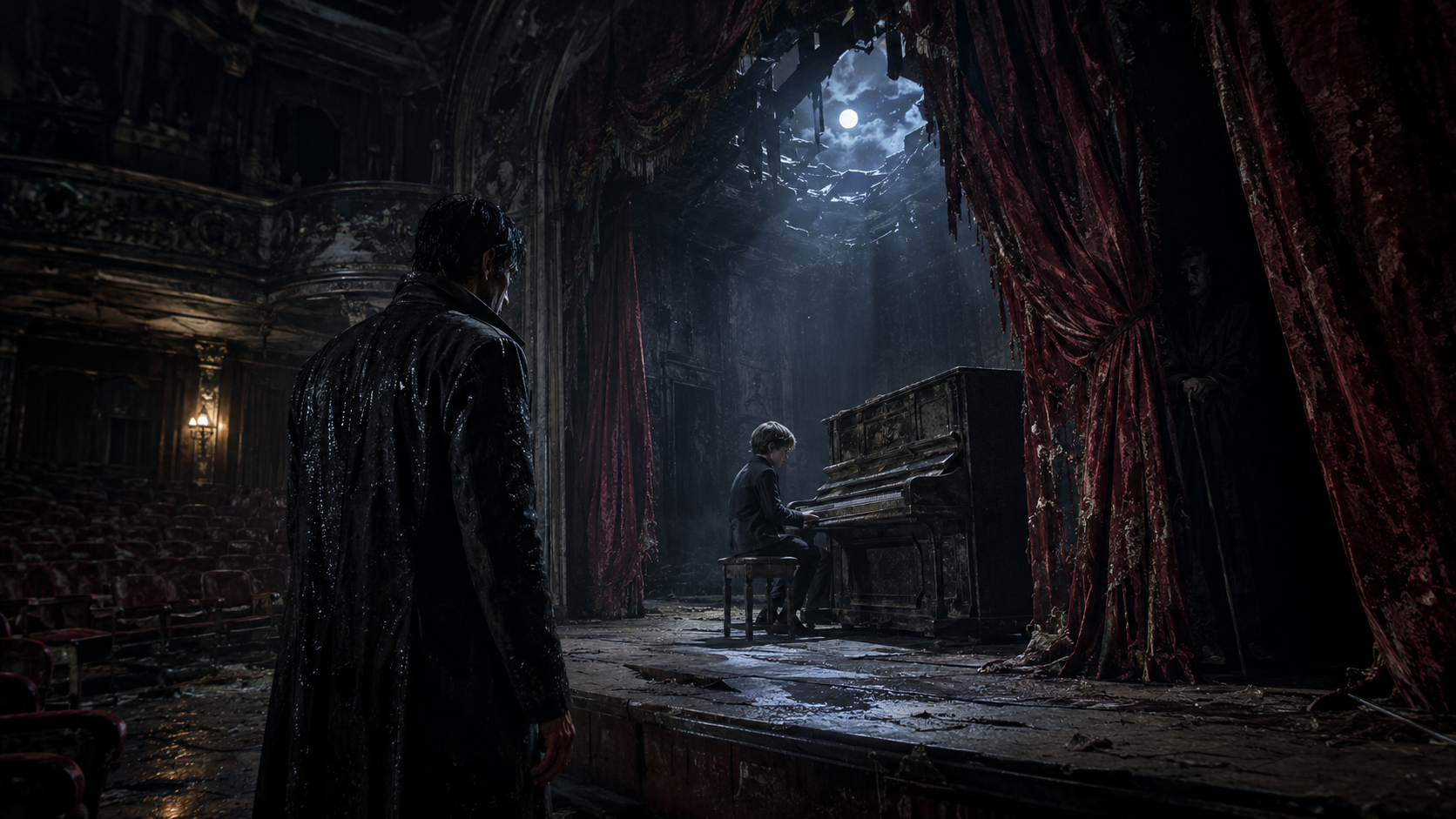
The Orpheum Theatre had been empty for ten years, yet someone was playing its piano.
The notes drifted through the ruined auditorium one by one—seven soft tones, a pause, and then the same seven tones played backward.
Elian Marr stopped beneath the balcony.
Rainwater slipped from his coat and gathered around his shoes. Above him, torn velvet curtains hung like dried blood. Rows of dusty seats disappeared into darkness, and pale moonlight entered through a hole in the ceiling.
The melody came again.
Seven notes.
A pause.
Seven notes in reverse.
Elian had not heard that sequence since the night his brother died.
“Theo?” he called.
The piano stopped.
His voice traveled across the empty theatre and returned as a whisper.
Elian moved toward the stage. At thirty-eight, he no longer looked like the celebrated illusionist whose face had once appeared outside theatres from Paris to Prague. His dark hair had begun to turn silver near the temples. A thin scar crossed his left palm, and exhaustion had settled permanently beneath his eyes.
Ten years earlier, the Orpheum had burned during the final performance of his career.
Elian had escaped.
His younger brother, Theo, had not.
At least, that was what everyone believed.
Elian climbed the steps beside the orchestra pit.
A small figure sat at the piano.
It was a boy, perhaps eleven or twelve years old, wearing a brown coat several sizes too large. His black hair had been cut unevenly, as though he had done it himself with a pair of kitchen scissors. Mud covered his boots.
He did not turn around.
“Who taught you that melody?” Elian asked.
The boy pressed one key with his index finger.
A low note trembled through the theatre.
“The man who lives behind the curtain.”
Elian looked toward the decaying red curtain at the back of the stage.
“There is no one behind it.”
The boy finally faced him.
His eyes were an unusual shade of gray, almost silver in the moonlight.
“He said you would say that.”
Elian’s stomach tightened.
“Who are you?”
“My name is Jun.”
“How did you get inside?”
Jun ignored the question.
Instead, he removed a copper ring from a cord around his neck and placed it on the piano.
Elian recognized it immediately.
A tiny eight-pointed star had been carved into the metal.
He had made that ring for Theo when they were teenagers. It had been part of their first professional illusion, a trick involving two identical rings that appeared to pass through solid glass.
Theo had been wearing it on the night of the fire.
Elian picked it up.
The copper felt warm.
“Where did you find this?”
“I didn’t find it.”
“Then who gave it to you?”
“The man behind the curtain.”
Elian closed his hand around the ring.
“My brother died here.”
Jun looked past him into the darkness of the auditorium.
“No,” he said quietly. “Your brother learned how to disappear.”
A metallic sound echoed somewhere above them.
Elian turned.
One of the theatre’s side doors had opened.
A narrow beam of white light moved across the seats.
Then a second light appeared.
Jun jumped down from the piano bench.
“We have to go.”
“Who is that?”
“They followed me.”
Two men entered the auditorium. Both wore dark coats and featureless white masks.
One of them raised a flashlight toward the stage.
“There!” he shouted.
Jun ran toward the rear curtain.
Elian grabbed his shoulder.
“That leads to a wall.”
Jun twisted free.
“Only when the theatre wants it to.”
He pulled a brass lever hidden beneath the stage floor.
A section of scenery shifted with a deep wooden groan, revealing a narrow opening behind the curtain.
Jun disappeared through it.
The masked men were already climbing onto the stage.
Elian followed the boy.
The opening closed behind them just as something heavy struck the other side.
They entered a passageway barely wide enough for one person. Its walls were lined with ropes, counterweights, broken pulleys and rusted machinery left from another century.
Jun moved confidently through the darkness.
Elian struggled to keep up.
“How do you know this place?”
“I lived underneath it.”
“That’s impossible.”
Jun stopped.
“You use that word too often.”
A door slammed somewhere behind them.
The masked men had found another entrance.
Jun hurried onward.
The passage descended beneath the stage and opened into a maze of brick tunnels. Faded symbols had been painted on the walls: circles, stars, arrows and human eyes with black lines drawn through them.
Elian touched one of the markings.
“What is this?”
“A route.”
“To where?”
“Everywhere.”
Jun led him through three intersections before entering a chamber filled with old theatre props. There were cracked mirrors, empty cages, artificial trees and wooden boxes once used to make assistants vanish.