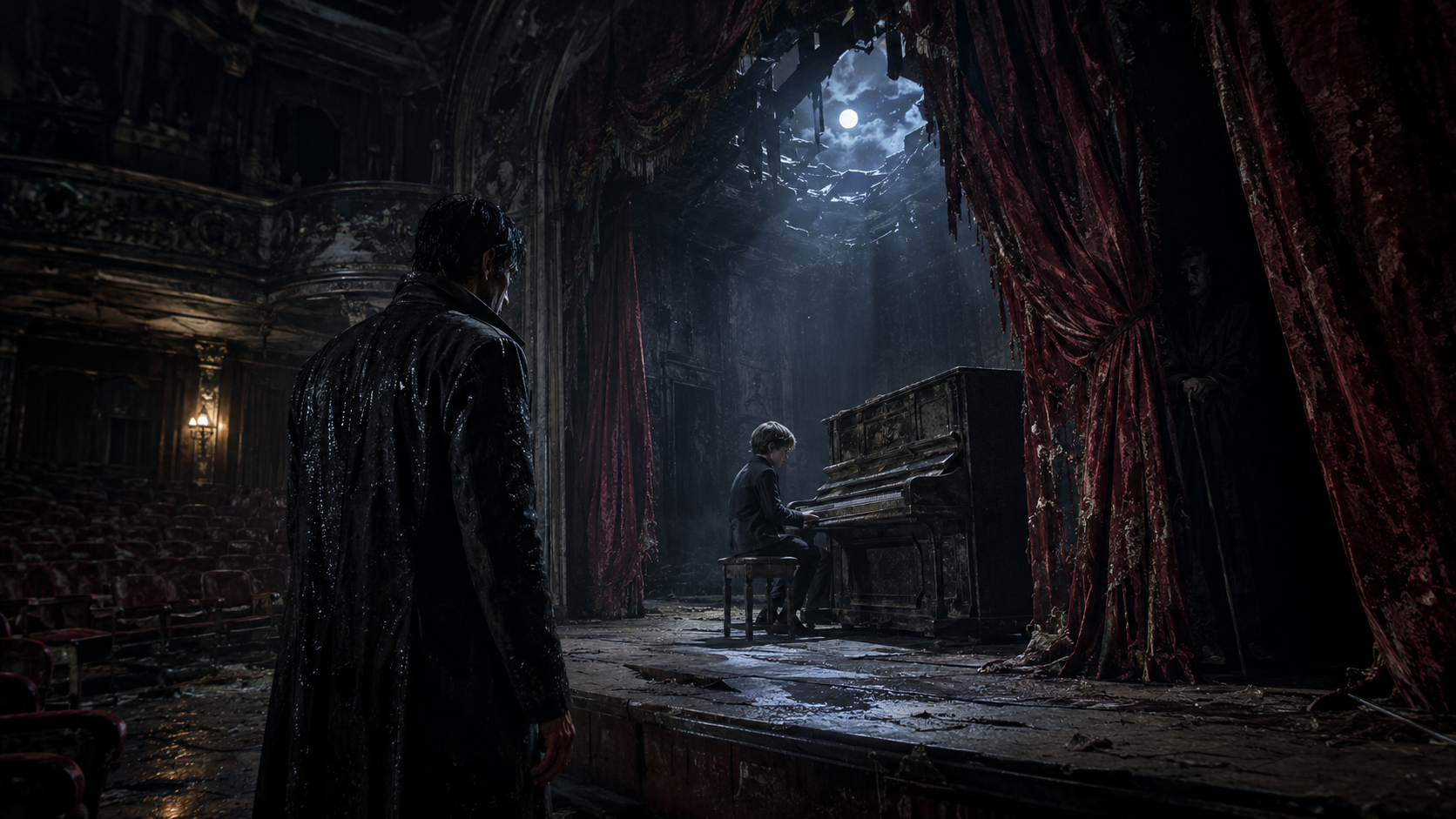
Jun closed the door.
For several seconds, neither of them spoke.
Then Elian knelt in front of him.
“You are going to tell me the truth.”
Jun folded his arms.
“You won’t believe me.”
“Try.”
The boy glanced at the copper ring in Elian’s hand.
“The man who gave me that calls himself Silas.”
Elian frowned.
“That isn’t my brother’s name.”
“He said names are dangerous.”
“What does he look like?”
“Tall. Thin. Burn marks on one side of his neck. He walks with a metal cane when the weather is cold.”
Elian felt the room tilt around him.
Theo had broken his left leg when they were children. Years later, the injury still bothered him during winter performances.
Jun continued.
“He knows how to build false rooms. He knows how to make cameras see empty hallways when people are walking through them. He taught me how to listen for hollow walls.”
“Where is he now?”
“In the Lantern House.”
“What is that?”
Jun hesitated.
“A place where people are erased.”
The answer should have sounded childish.
It did not.
Elian stood slowly.
“What do you mean, erased?”
“They take your name first. Then your clothes. Then every photograph they can find. They teach you a new voice and give you a history that never happened. After a while, even you aren’t sure who you were.”
Elian stared at him.
“Who runs this place?”
“A woman named Celeste Vane.”
The name struck him harder than the copper ring.
Celeste Vane was one of the wealthiest patrons of the arts in Europe. She funded museums, hospitals and restoration projects. Her charitable foundation had purchased the Orpheum after the fire.
The theatre was scheduled to reopen the following evening.
Elian had been invited to perform at the gala.
He had returned to refuse.
“Celeste saved this building,” he said.
Jun’s expression did not change.
“She saves buildings because buildings have doors.”
A sound came from the corridor.
Three slow knocks.
Then two quick ones.
Jun went pale.
“They found us.”
Elian looked around the prop room. There was no second exit.
The door handle began to turn.
Jun backed toward a tall wooden cabinet.
“This box,” Elian said. “Get inside.”
Jun opened it and stared at the solid back panel.
“It doesn’t go anywhere.”
“It will.”
Elian pushed him inside, closed the cabinet and pulled a loose rope hanging from the ceiling.
The floor beneath the cabinet dropped six inches.
Ancient gears moved under the boards.
Elian rotated the cabinet, opened a concealed panel in its side and climbed into a second compartment beside Jun.
The outer door burst open.
Flashlights swept through the room.
Elian held a finger to his lips.
A masked man approached the cabinet.
Jun’s breathing became fast and shallow.
The doors opened.
The compartment appeared empty.
The man struck the wooden walls, searching for a hidden panel, but Elian had already released the counterweight. The false interior had rotated silently, carrying them into the wall behind the cabinet.
They crawled through a narrow shaft and emerged in an alley behind the theatre.
Jun looked at Elian with open astonishment.
“You made us disappear.”
“No,” Elian said. “I made them look in the wrong place.”
They spent the rest of the night in a room above a closed tailor’s shop.
The building belonged to Mara Saye, the Orpheum’s former stage manager and the only person Elian still trusted in Port Calder.
Mara was sixty-three, broad-shouldered and unimpressed by nearly everything. She listened to Jun’s story without interrupting, then examined the copper ring through a magnifying glass.
“There’s something inside it,” she said.
She pressed a needle into the star.
The ring separated into two pieces.
A thin strip of photographic film had been rolled inside.
Mara carried it into her darkroom.
Twenty minutes later, an image appeared on a sheet of paper.
It showed a handwritten diagram of the Orpheum. Several rooms had been circled beneath the stage, but one location was marked above the auditorium.
The old pipe organ.
Elian remembered Theo spending hours inside the instrument, repairing pipes and hiding cards for future tricks.
At dawn, they returned to the theatre through an entrance beneath the river wall.
The organ stood behind a decorative screen above the balcony.
Elian removed the center pipe and reached inside.
His fingers touched a metal cylinder.
Within it, he found a miniature audio recorder and a key made of black glass.
Mara turned on the recorder.
Static filled the balcony.
Then a man began to speak.
“Elian, this message is for you.”
Elian gripped the railing.
Time had changed the voice, roughening it and draining away its warmth, but he knew it.
Theo.
“If Jun reached you, then I failed to get him out alone. Listen carefully. The fire was not intended to kill us. It was an audition.”