Samuel had always said things like that so simply. As if love were a fact. As if kindness were something you could point to, like a tree in the yard.
I looked back down at the letter.
There was more.
Ellie,
You once asked why I kept taking extra shifts when we were comfortable enough.
This is why.
I wanted to help Jonah quietly until he could stand on his own.
He is smart. Gentle. And carrying more than any boy should carry alone.
I know this is unfair to place in your hands after I am gone.
But I know the woman I married.
You do not abandon people when they are hurting.
That is one of the reasons I loved you for twenty-eight years.
There is money set aside in the blue file cabinet in my office. Enough for his schooling. Enough so he will not lose his future because life was cruel to him early.
Please do not let him think he is alone.
I could not save everyone in this world.
But maybe, together, we can save one boy.
Love always,
Samuel
By the time I finished, I was crying too hard to speak.
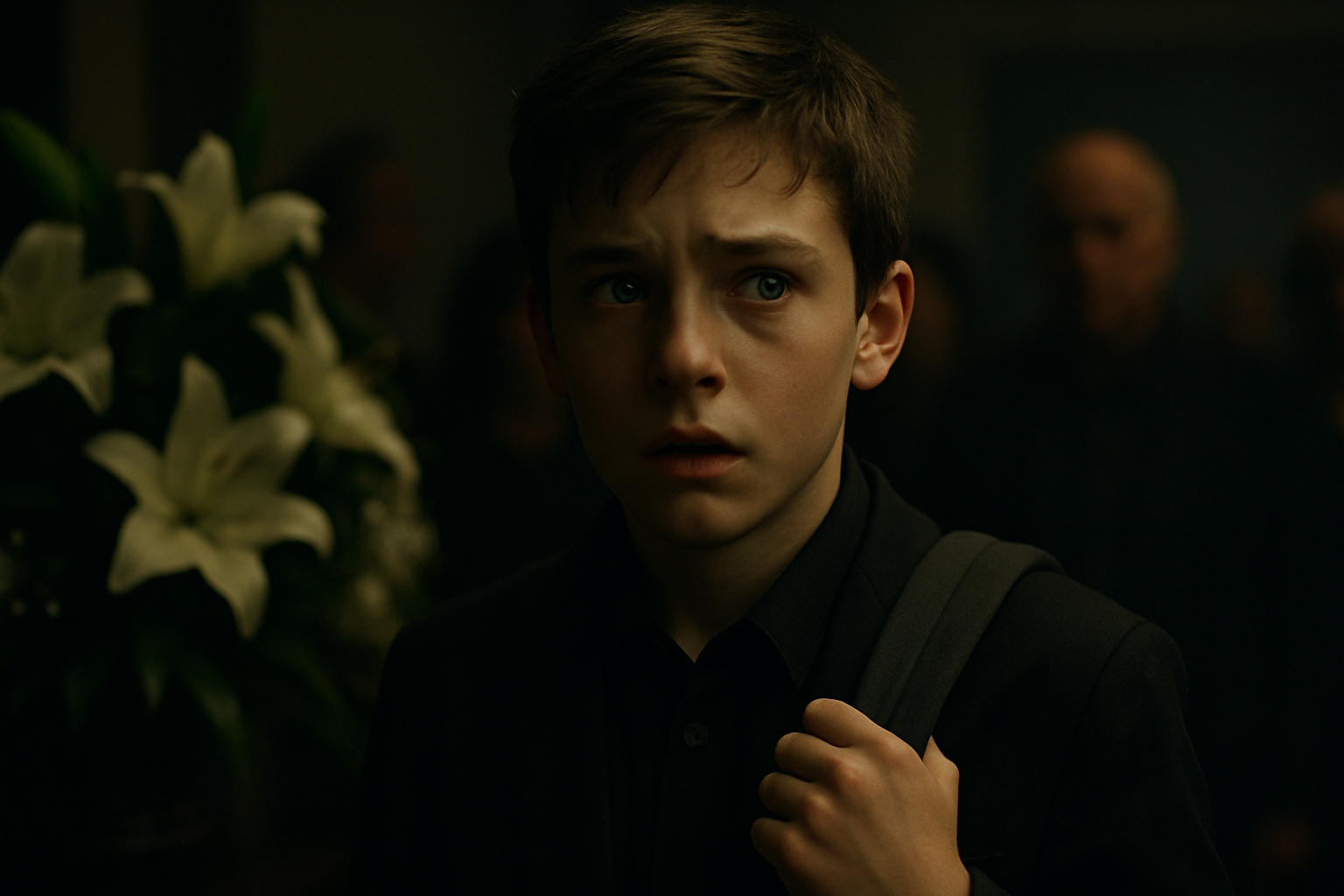
Jonah sat across from me, staring at the carpet as if he already regretted coming. As if he expected me to say no. As if no was the answer life had taught him to expect.
And suddenly I was furious.
At grief.
At hospitals.
At hunger.
At a world where children learn too young not to ask for help.
I wiped my face.
“Have you eaten today?”
He blinked. “What?”
“Have you eaten?”
He hesitated.
“Not really.”
Of course.
My heart cracked again.
I stood slowly.
“Well,” I whispered, my voice shaking, “Samuel would haunt me if I let a teenage boy sit hungry at his funeral.”
For the first time, Jonah laughed.
Small.
Broken.
Real.
And somehow, hearing that sound in a room full of death made something inside me keep breathing.
I took Jonah home that evening.
Not because I had answers.
Not because I knew how to carry my own grief and someone else’s at the same time.
But when we stepped outside the funeral home, I realized the terrible truth.
The boy had nowhere to go.
No relatives waiting.
No friend coming to pick him up.
No safe place.
Just one backpack and the exhausted expression of a child who had been asked to survive too much, too soon.
The drive home was quiet.
Rain tapped softly against the windshield. The sky darkened around us. Jonah sat stiffly in the passenger seat, clutching his backpack on his lap like it held everything he had left in the world.
Every few minutes, he whispered an apology.
“Sorry about this.”
“Sorry for showing up today.”
“Sorry if people talked.”
Finally, I tightened my hands around the steering wheel.
“You do not need to apologize for existing.”
The words came out sharper than I meant.
Jonah blinked.
Then he looked down.
That broke my heart in a new place.
Because it told me he was used to apologizing for taking up space.
When we pulled into the driveway, he stared at the house for a long moment.
Samuel and I had lived there for twenty-two years.
White shutters.
Blue hydrangeas.
A porch swing Samuel promised to fix every summer and never did.
Home.
Only now it felt unbearably empty.
Jonah hesitated before getting out of the car.
“You’re really sure?”
No.
I was not sure of anything anymore.
My husband was dead. A stranger had arrived at his funeral carrying secrets and letters. My entire future had changed in one afternoon.
But when I looked at that boy, soaked with rain and trying not to look frightened, there was only one answer I could live with.
“Yes,” I said softly.
Inside, the silence hit me at once.
The kind grief makes.
Too still.
Too large.
Samuel’s coat still hung by the door. His reading glasses still rested on the kitchen counter beside yesterday’s newspaper.
Jonah noticed everything, carefully, like he had stepped onto holy ground.
“I can sleep on the couch,” he said quickly.
“You are not sleeping on the couch.”
“I don’t mind.”
“I do.”
He stopped arguing.
I showed him the guest room upstairs. It was small but warm, with pale green walls and quilts my mother had sewn years ago.
Jonah stood awkwardly in the doorway.
“You can lock the door if you want,” I said.
His eyes lifted. “Why would I need to?”
The question startled me.
Then I understood.
Children who grow up safe do not think much about locks.
Children who do not grow up safe think about them all the time.
“Because sometimes new places feel scary,” I said gently.
He looked at me for a long moment, then nodded once.
“Okay.”
I turned to leave, then paused.
“There are clean towels in the bathroom. And Samuel kept extra clothes in the hall closet. Some might fit you.”
His face changed at Samuel’s name.
Not just sadness.
Something deeper.
Attachment.
Loss.
“You really loved him, didn’t you?” I asked.
Jonah looked down.
“He was the only adult who ever kept showing up.”
That sentence followed me downstairs like a ghost.
Later that night, I stood alone in Samuel’s office.
The blue file cabinet sat exactly where the letter said it would.
Third drawer.
Locked.
The key was taped underneath the desk.
Typical Samuel.
I opened the drawer slowly.