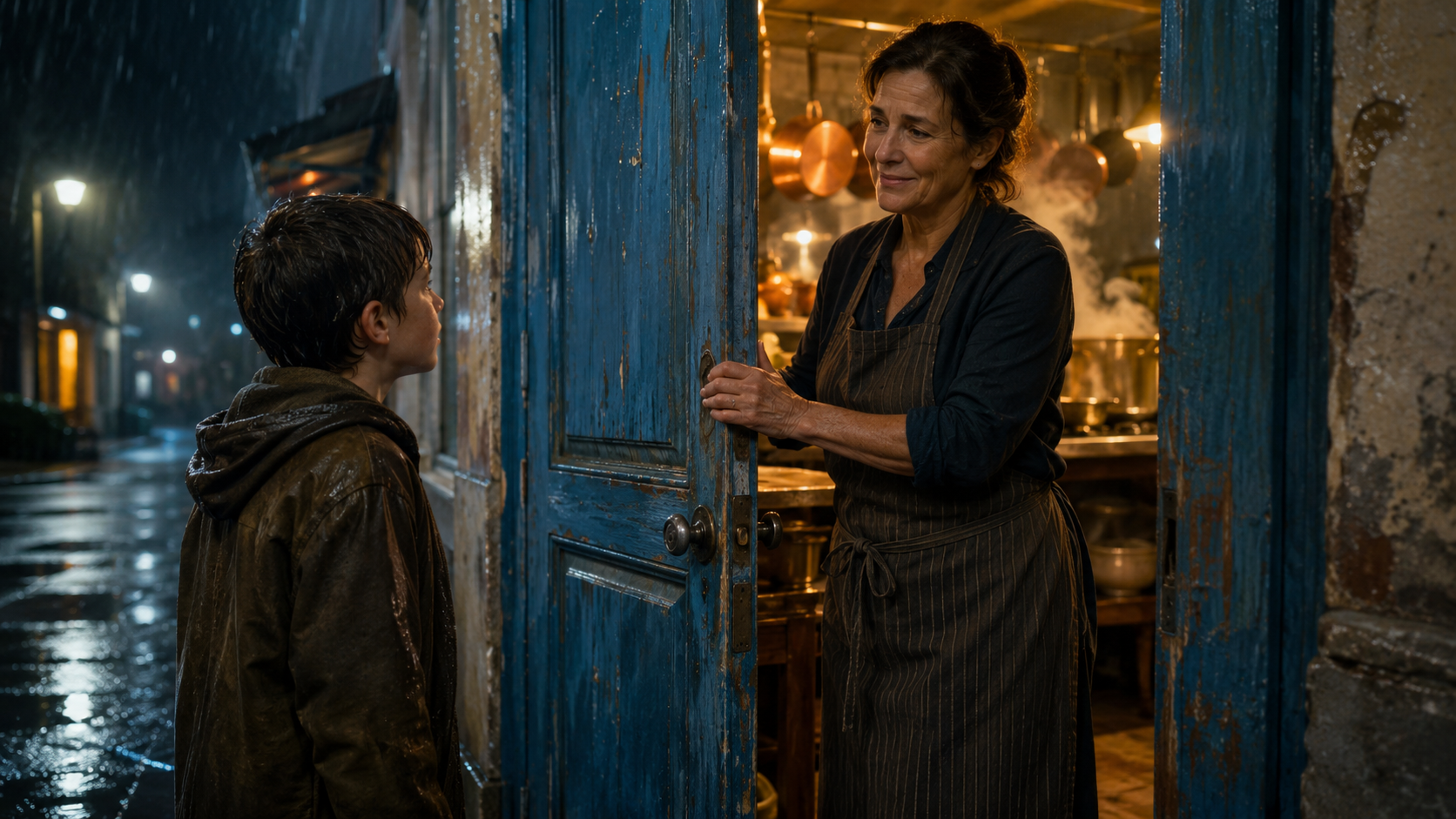
“So that’s it? We let them take everything?”
Mara touched the edge of the old stove.
“Buildings are not everything.”
“This one is.”
“No. The people who came through it are everything.”
During the following weeks, word spread that The Copper Ladle might close.
Former employees returned to help repair the dining room. Customers brought tools, paint, and envelopes containing whatever money they could spare. A retired carpenter replaced the damaged floorboards without charging for his labor.
Children painted small blue doors on pieces of cardboard and hung them in the windows.
But the donations were not enough.
On the final day, the restaurant opened one last time.
There was no printed menu. Mara cooked what she had always cooked: stew, roasted vegetables, fresh bread, and lemon cake.
Nobody was asked to pay.
By noon, every table was occupied.
People shared stories about first dates, birthdays, reconciliations, and meals Mara had quietly provided during hard times. A former dishwasher told the room that Mara had once kept him employed for six months even though she knew he was sleeping in the railway station.
An elderly woman lifted her bowl.
“You fed my children when I could not,” she said. “They never knew we were poor.”
Mara lowered her eyes.
At four o’clock, two representatives from Alder Crest entered the restaurant.
Their dark coats were spotless despite the rain. One carried a leather case; the other held a ring of newly cut keys.
“Ms. Ellison?” the taller man asked.
“Yes.”
“We are here to complete the property transfer.”
Sophie stepped between them and the counter.
“You said we had until five.”
“We are prepared to wait.”
“Then wait outside.”
The man’s expression remained calm.
“We are not responsible for the terms of the loan.”
“No,” Sophie replied. “You are only responsible for profiting from them.”
The room fell silent.
Mara placed a hand on Sophie’s shoulder.
“It’s all right.”
“No, it isn’t.”
“It is not their decision.”
The taller representative checked his watch.
“Someone from our executive office is joining us. We cannot proceed until he arrives.”
“Why?” Sophie asked.
“I wasn’t informed.”
At exactly half past four, a dark gray car stopped outside.
A man stepped onto the wet sidewalk.
He appeared to be in his mid-forties. His coat was simple but perfectly tailored. Gray touched his temples, and a narrow scar crossed his chin. He carried no umbrella and had no assistant beside him.
He remained across the street for several seconds, looking at the restaurant.
Then he walked toward the entrance.
The brass bell rang when he opened the door.
Both Alder Crest representatives stood straighter.
“Mr. Reed,” one of them said. “We expected you at the regional office.”
The newcomer did not respond.
His gaze moved across the room, past the crowded tables, the repaired floor, and the photographs covering the walls.
Then he saw Mara.
She stood behind the counter in her white chef’s jacket, one hand resting beside a bowl of stew.
The man’s composure faltered.
“Mara Ellison?”
She studied his face.
“Yes?”
He took a step closer.
“You still put thyme in the chicken stew.”
Mara’s eyes narrowed.
“Most people do.”
“But you crush it between your palms first.”
Something changed in her expression.
The man reached into his coat and removed a folded piece of paper, yellow with age.
He placed it on the counter.
It was a child’s drawing of The Copper Ladle.
The proportions were uneven. The windows leaned to one side, and the chimney was far too tall. At the back of the building stood an enormous blue door.
Mara covered her mouth.
“Noah?”
The man smiled, but his eyes filled with tears.
“You remembered.”
“You drew buildings.”
“I still do.”
She came around the counter and touched his face as though she needed proof that he was real.
“You vanished.”
“My mother got a job in another city. We left in the middle of the night because she was afraid the landlord would stop us. I came back three years later, but the restaurant was closed for renovations.”
“I looked for you.”
“I know.”
“How could you know?”
“I found your note.”
Mara stared at him.
“The note beneath the apartment door?”
“The new owner found it when he replaced the frame. He kept it because my drawing was on the envelope. Years later, I tracked him down.”
Noah unfolded the old note.
The ink had faded, but Mara recognized her handwriting.
There will always be a bowl waiting for you. Remember the blue door.
She pressed the paper to her chest.
Sophie looked from Mara to Noah.
“You’re Noah Reed?”
One of the customers whispered the name to the person beside him.
Recognition moved through the dining room.
Noah Reed was an architect and the founder of Open Threshold, an international organization that transformed abandoned properties into affordable homes, community kitchens, and vocational schools.