He had designed hospitals, shelters, and entire residential districts.
His buildings were famous for one unusual detail.
Every one of them had a blue entrance.
Mara looked toward the Alder Crest representatives.
“Why did they call you Mr. Reed?”
Noah turned to them.
The taller man opened the leather case.
“Mr. Reed became the controlling owner of Alder Crest this morning.”
Sophie’s face hardened.
“You bought the company that is taking our restaurant?”
“I bought the company that was taking the neighborhood.”
Noah faced the room.
“For the past six months, my organization has been investigating property acquisitions on Harbor Street. Alder Crest intended to remove fourteen businesses and sixty-three households from this district.”
He looked at Mara.
“Yesterday, I discovered the name of this restaurant in the final transfer documents.”
Mara gripped the counter.
“And now?”
Noah took the ring of keys from the representative’s hand.
“Now there will be no transfer.”
The room remained silent, as though nobody trusted what they had heard.
Noah continued.
“The debt has been cleared. The building will be placed in a community trust, which means it cannot be sold to private developers. The apartments above the shops will be restored and protected as affordable housing.”
Sophie blinked.
“What about the restaurant?”
“That decision belongs to Mara.”
Everyone turned toward her.
Mara looked around the dining room—the cracked photographs, the mismatched chairs, the people who had carried the restaurant through floods, grief, unemployment, loneliness, and time.
“My hands are not what they used to be,” she said.
Noah nodded.
“Then we will find you more hands.”
“The kitchen needs rebuilding.”
“We will rebuild it.”
“Some customers cannot afford restaurant prices.”
“They will not need to.”
Noah placed the keys on the counter.
“I want The Copper Ladle to become the first permanent Open Threshold kitchen. At night, it can operate as the restaurant you created. During the day, it will serve meals to anyone who needs one. It will also train young people who have nowhere else to go.”
Mara stared at him.
“You planned all this today?”
“No. I began planning it thirty-two years ago.”
He pointed to the drawing.
“You told me everyone has a door. I spent my life building them.”
Mara shook her head slowly.
“I gave you a few bowls of stew.”
“You gave my mother enough food to recover. You gave me a place where I was not treated like a problem. You showed me that dignity can be served with bread.”
“I told you not to repay me.”
“I’m not repaying you.”
Noah moved the keys closer to her.
“I’m opening the door.”
A sound came from the back of the room.
Someone began to clap.
Then another person joined.
Within seconds, the restaurant filled with applause. Sophie wrapped her arms around Mara, who finally allowed herself to cry.
Noah stood beside them, no longer an important architect or a company owner.
For a moment, he was simply a hungry boy who had found his way back to the warmest room he had ever known.
The Copper Ladle reopened five months later.
The damaged kitchen was replaced, but the old stove remained. The tables were restored rather than discarded. The photographs returned to the walls, and Noah’s childhood drawing was placed in a wooden frame near the entrance.
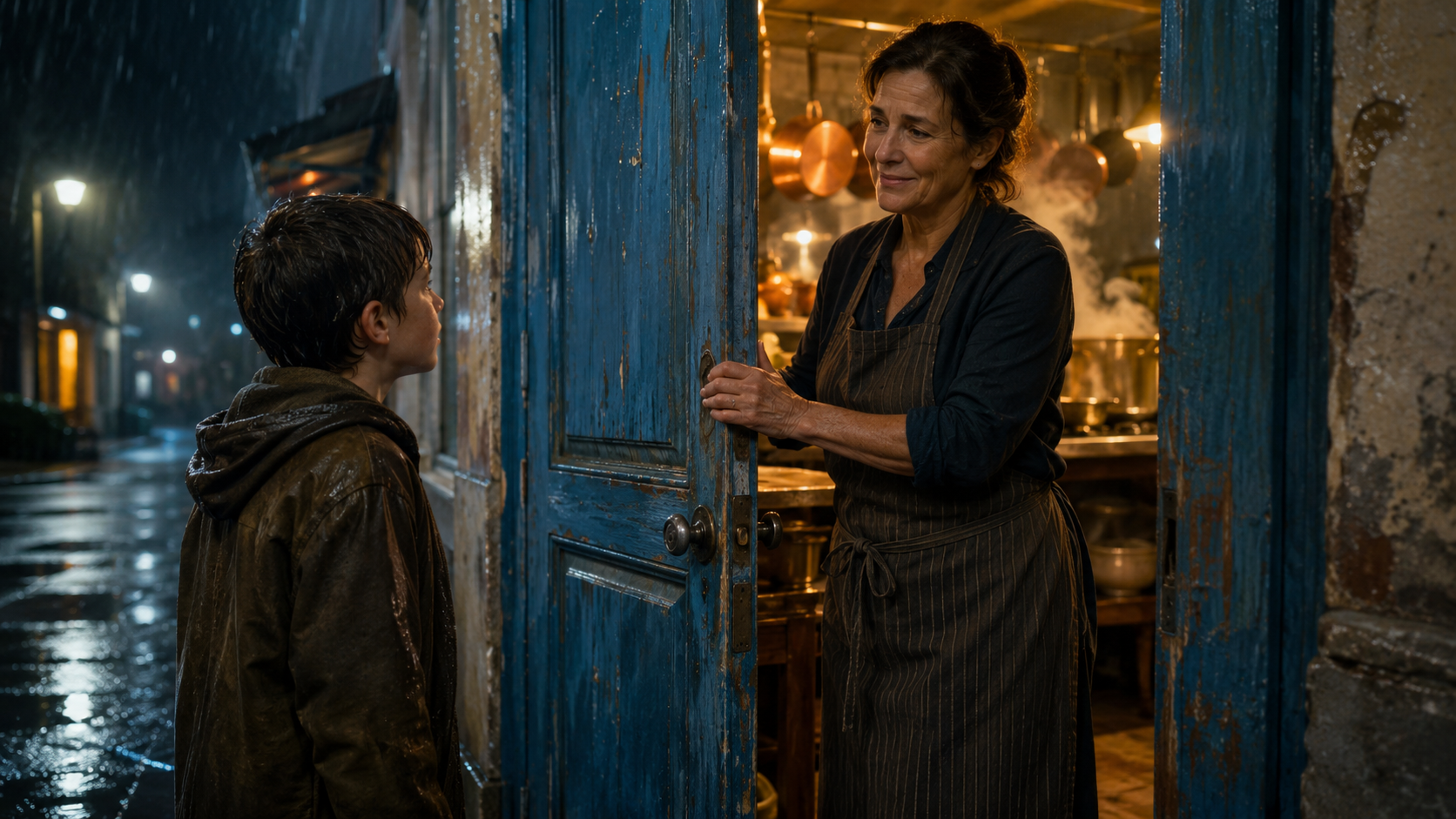
Mara insisted that the blue kitchen door remain exactly as it had been.
A small community pantry was built beside it. People could leave food there or take what they needed without asking permission.
Every weekday afternoon, teenagers learned to cook under Mara’s supervision. She taught them to sharpen knives, season soup, bake bread, and remain patient with themselves.
Noah visited whenever his work brought him to Bellhaven.
Sometimes he arrived in a suit after a meeting. Sometimes he came early in the morning, rolled up his sleeves, and peeled potatoes in the same corner where he had worked as a child.
One winter evening, he noticed a girl standing outside the blue door.
She was perhaps ten years old. Her coat was wet, and she was staring at the pantry without touching anything.
Noah opened the door.
She stepped back.
“I wasn’t stealing,” she said.
“I know.”
“I don’t have money.”
“Good,” Noah replied. “Because this meal isn’t for sale.”
Behind him, Mara looked up from the stove.
For an instant, Noah saw the past and the present standing in the same doorway.
He invited the girl inside.
Mara placed three bowls on the table.
Outside, the winter wind continued through the city, cold and restless.
Inside, bread was broken, soup was shared, and an old promise quietly became a new beginning.
Because kindness does not always return as money.
Sometimes it returns as a building saved from demolition.
Sometimes it returns as a key placed on a counter.
And sometimes, after traveling through decades of hardship, memory, and hope, it returns to open the same blue door.