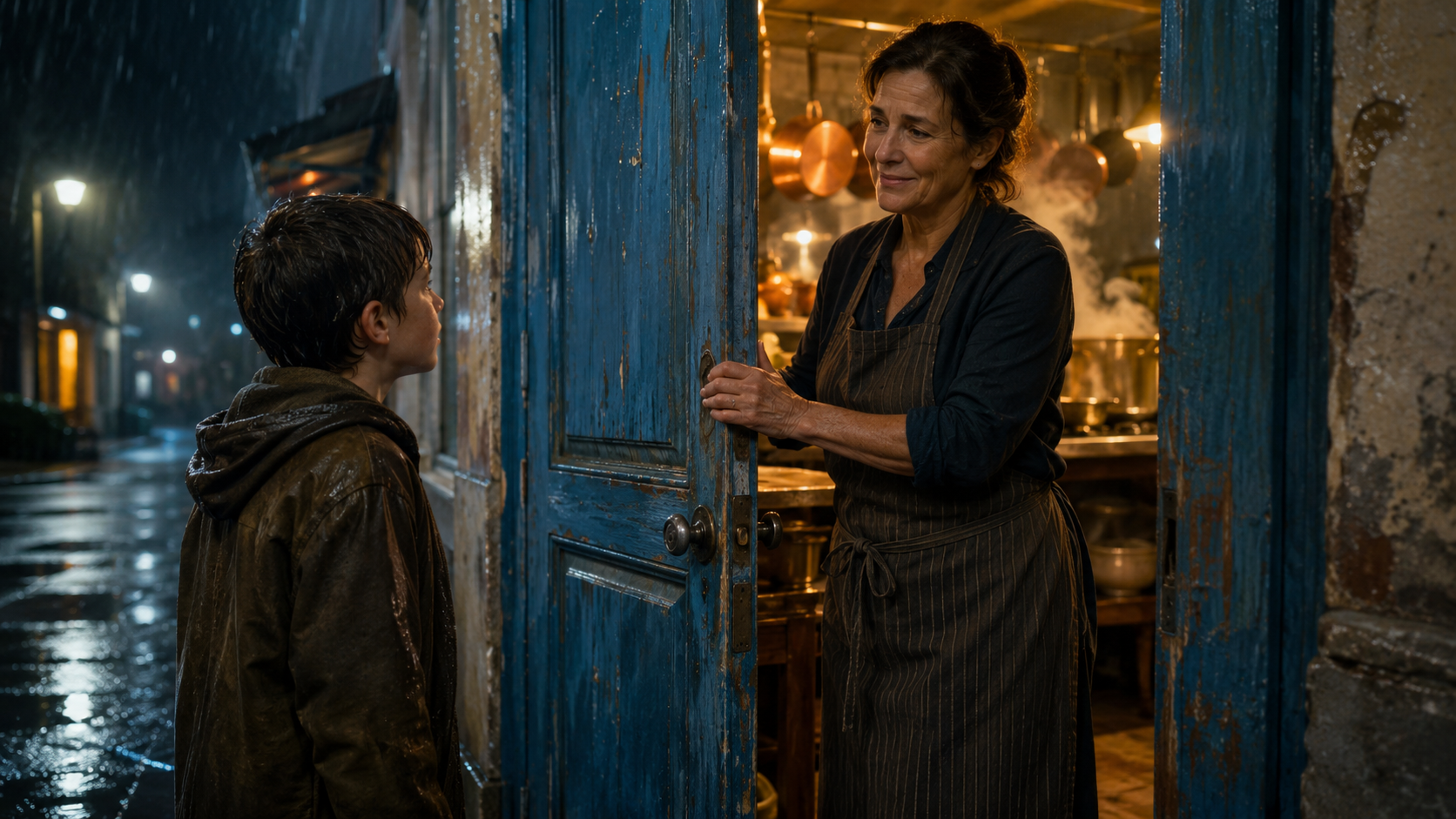
“Don’t repay me, Noah. Just remember the blue door.”
He frowned.
“What does that mean?”
“It means that one day you may find someone standing outside the warmth. When you do, open the door.”
Noah held the bag against his chest.
“What if I don’t have a restaurant?”
“Everyone has a door.”
He returned the following evening.
This time, he did not sit outside. He knocked.
Mara put him to work washing potatoes before she fed him. The next day, he polished cutlery. By the end of the week, he had learned how to peel carrots without wasting half of each one.
Mara never called the meals charity.
She called them wages, although Noah knew that no restaurant in the world paid a child with enough food for two people.
During the following months, the kitchen became his refuge.
Mara taught him how to chop onions, how to rescue a sauce, and how to recognize fresh fish by its eyes. She showed him that bread dough could not be hurried and that soup tasted different when cooked by someone who was angry.
“Food remembers the hands that make it,” she told him.
Noah rolled his eyes.
“That doesn’t make sense.”
“Most important things don’t, at first.”
He learned that Mara had inherited the restaurant from her father. He had opened it after returning from military service with almost nothing except a dented soup pot and the belief that a full table could repair nearly any disagreement.
Mara learned that Noah loved drawing buildings.
He sketched them on receipts, paper bags, and the backs of old menus. He drew apartment houses with gardens on their roofs, schools with enormous windows, and shelters that looked like homes rather than institutions.
One afternoon, she found him drawing The Copper Ladle.
In his picture, the blue kitchen door had become twice its actual size.
“Why did you make it so big?” she asked.
“So everyone can find it.”
Mara pinned the drawing above her desk.
Noah continued visiting until early summer.
Then, without warning, he disappeared.
For three evenings, Mara prepared an extra bowl.
On the fourth, she walked to the apartment address Noah had once mentioned. The building manager told her Evelyn Reed had been offered a position at a hotel several hundred miles away. Mother and son had left before sunrise.
“They were behind on the rent,” the manager added. “They didn’t have time for goodbyes.”
Mara wrote a note and slipped it beneath the apartment door anyway.
It remained there until the building was renovated and the old door was replaced.
Years passed.
Harbor Street changed.
The tailor’s shop became a mobile phone store. The family bakery became a chain café. Old brick homes were purchased, emptied, polished, and rented to visitors at prices local families could never afford.
The Copper Ladle survived longer than most.
It survived a recession, two floods, a kitchen fire, and the arrival of a luxury restaurant whose menu described ordinary potatoes in six different ways.
Mara survived too.
Her hair turned white. The burn scar on her hand faded, and arthritis made it difficult to lift the largest pots. Her niece, Sophie, began managing the dining room and handling the accounts.
Mara still arrived before sunrise every morning.
She still baked bread.
And she never changed the color of the blue kitchen door.
Thirty-two years after Noah disappeared, a storm struck Bellhaven.
It began with heavy rain and ended with water surging through Harbor Street. The restaurant’s basement flooded. The refrigeration system failed, the wooden floor warped, and part of the kitchen ceiling collapsed.
Insurance covered only a fraction of the repairs.
For the first time in more than sixty years, The Copper Ladle remained dark for an entire week.
Then came the second blow.
A development company named Alder Crest had purchased the restaurant’s mortgage from the local bank. The company planned to transform the entire block into luxury residences, private shops, and an underground parking garage.
The letter Sophie received was polite, precise, and devastating.
The remaining debt had to be paid within thirty days.
Otherwise, the property would be seized.
Sophie read the letter twice before carrying it into the damaged kitchen.
Mara was standing beneath the broken ceiling, staring at rainwater dripping into an empty stockpot.
“Aunt Mara,” Sophie said quietly.
Mara looked at the papers.
“How long?”
“Thirty days.”
“And the repairs?”
“More than we can afford.”
“We have savings.”
“Not enough.”
“We can sell the apartment.”
“And then where will you live?”
Mara did not answer.
Sophie placed the letter on the counter.
“We can contact the newspapers. People love this place.”
“Love does not always survive an invoice.”
“The neighborhood will help.”
“The neighborhood is fighting the same battle.”
Sophie’s eyes filled with tears.