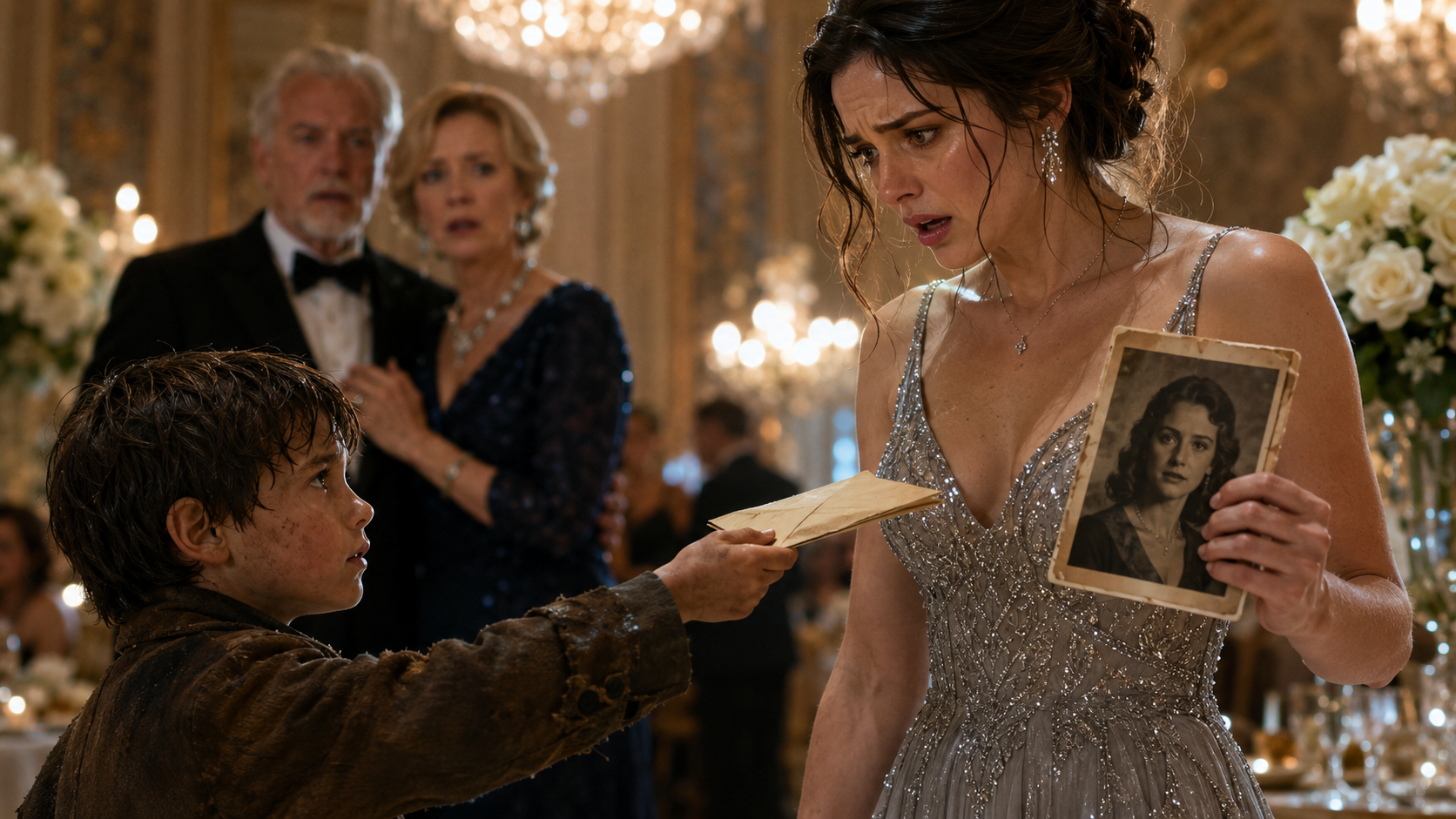
“Your father called the police.”
The words hollow you out.
“Did I see her?”
Vivienne’s voice breaks.
“You were in the nursery window. You waved.”
You close your eyes.
Somewhere inside you, a memory moves.
Not clear. Not complete.
Rain on glass.
A woman outside the gate.
A child beside her.
Your small hand pressed against a window.
Then your nanny pulling the curtains shut.
For years, you dreamed of rain and woke up crying for no reason.
Now the reason is sitting across from you with pearls at her throat.
“You let me wave goodbye to my mother,” you whisper, “and then you closed the curtains.”
Vivienne reaches for you.
You step back.
“No.”
She freezes.
“No more touching me to make yourself feel forgiven.”
Your father’s voice is low.
“You think the world will embrace them? Lena and her boy? You think they won’t resent you? You think blood fixes poverty?”
“No,” you say. “But truth gives us somewhere honest to start.”
You leave with three boxes of files and the first real piece of your life.
By evening, the Ashford story breaks.
Not the polished version.
Not the statement your father’s crisis team drafts, full of words like private family matter and painful misunderstanding.
The real story.
Hospital records.
Payments.
Sealed filings.
A nurse’s testimony.
A lawyer on camera stealing a sick woman’s bag.
A foundation built on saving children while its founders paid to erase one.
The city reacts the way cities always do: with shock, hunger, judgment, sympathy, and noise.
Your father resigns from two boards before midnight.
Edmund Price disappears for twelve hours, then reappears with an attorney of his own.
Vivienne does not leave the mansion.
You do not go back.
For three days, you stay at the hospital.
You learn your sister in pieces.
Lena likes coffee too sweet. She hates roses. She hums when she is nervous. She can fix a broken zipper with a paperclip. She remembers every place she and Maribel ever lived, not by addresses, but by what they could hear at night: trains, sirens, church bells, a neighbor’s television, dogs fighting in an alley.
You tell her about yourself too, though every detail feels embarrassing now.
Private schools. Riding lessons. French tutors. Summers in places she has only seen in magazines.
But Lena does not make you feel ashamed.
That is the worst mercy.
She listens.
Sometimes she laughs.
Once, when you admit you never learned to cook anything beyond toast, she looks at you in horror and says, “Maribel would haunt me if I let that continue.”
For the first time, you both laugh together.
It sounds strange.
Like a door opening in an abandoned house.
Milo begins sleeping properly after the second night.
He still wakes if someone enters too quickly. He still hides food in napkins until Lena gently reminds him there will be breakfast. He still watches you like he is trying to decide whether you are temporary.
On the fourth day, Lena is strong enough to sit in a chair by the window.
You bring the boxes.
She stares at them for a long time.
“Our whole life fits in cardboard,” she says.
“Not our whole life,” you answer. “Only what they stole.”
Together, you open the first box.
There are documents inside. Birth certificates. Court filings. Letters returned unopened. Photographs of Maribel as a young woman.
You look like her too.
Not exactly.
But enough.
She had your eyes and Lena’s smile.
One photograph shows Maribel holding both of you as newborns. She is exhausted, hair stuck to her forehead, hospital gown falling off one shoulder.
But she is smiling.
Not because she is comfortable.
Because she is holding everything she loves.
On the back, in her handwriting:
My girls. Serena and Lena. No one will ever split my heart.
Lena touches the words.
A tear falls onto the cardboard.
You do not tell her not to cry.
You cry with her.
A week later, you stand outside the Ashford mansion again.
This time, you are not alone.
Lena stands beside you, thinner than you but upright. Milo holds her hand. Hannah waits near the car. A lawyer stands by the gate.
Your father has agreed to meet.
Not because he wants to.
Because he has run out of locked doors.
The mansion looks smaller now.
You used to think it was beautiful.
Now all you see are windows where a little girl once waved at the mother she was taught to forget.
Vivienne opens the door.
She sees Lena.
Her face collapses.
For a moment, no one speaks.
Then Lena says, “You saw us at the gate.”
Vivienne puts one hand to her mouth.
“I did.”
“My mother begged you.”
“Yes.”
“You had my sister upstairs.”
Vivienne nods, tears spilling.
“Yes.”
Lena’s voice shakes, but she does not break.
“Then I don’t have anything to say to you.”
Vivienne makes a sound like pain.
You feel it.