But you do not rescue her from it.
Some pain is simply the shape of consequence.
Malcolm is in the study, thinner somehow, though only days have passed. He looks at Lena the way a man looks at evidence he cannot discredit.
Milo stays behind his mother.
Your father notices.
For the first time, shame flickers across his face.
Not enough.
But something.
Lena places a photograph of Maribel on his desk.
“You remember her?” she asks.
He does not answer.
“You should,” Lena says. “She spent her life remembering you.”
His hands tighten.
“I did what I thought was best.”
“No,” you say. “You did what you wanted and paid people to call it best.”
Silence.
Then Milo steps forward.
He is small in the huge room.
But his voice is steady.
“My grandma loved both babies,” he says. “My mom told me.”
Your father looks at him.
And maybe this is the first time Malcolm Ashford truly understands what he stole.
Not a file.
Not a legal problem.
A grandmother.
A mother.
A sister.
A nephew.
A life where two girls might have grown up knowing each other’s laugh.
He lowers his eyes.
“I’m sorry,” he says.
The words are late.
Too late to heal anything by themselves.
But they lie on the desk between you, small and insufficient.
Lena looks at you.
You look at Milo.
Then at Maribel’s photograph.
Sorry is not justice.
But it can be evidence that the lie has finally stopped pretending to be love.
Months later, the Ashford name no longer opens every door.
Some remain open because people are curious.
Some close because people are afraid of scandal.
Some were never worth entering.
You legally restore part of your name.
Serena Vale-Ashford.
Not because you forgive.
Because you refuse to choose between the life stolen from you and the life you survived.
Lena gets stronger.
Not quickly. Not magically.
Real healing is slow and often inconvenient. There are doctors. Lawyers. Nightmares. Arguments. Days when she cannot look at you because your face reminds her of everything she lost. Days when you cannot look at her because her life reminds you of everything you were given.
But then there are other days.
Milo’s first proper birthday party.
Lena teaching you to make Maribel’s soup, laughing when you burn the onions.
You and your sister sitting on a kitchen floor at midnight, comparing childhood scars, favorite songs, the strange way you both hate sleeping with closet doors open.
Blood does not fix everything.
It does not erase poverty.
It does not return the dead.
It does not rewind thirty-two years.
But it recognizes.
And recognition is where truth begins.
On the first anniversary of the night Milo found you, the three of you visit Maribel’s grave.
The stone is simple.
Too simple for a woman who fought giants with empty pockets.
You place white lilies there.
Lena places a photograph of both of you together.
Milo places a toy car because, he says, grandmothers should get presents too.
You kneel and touch the engraved name.
Maribel Vale.
Mother.
The word feels strange.
Sacred.
Yours.
“I’m sorry,” you whisper.
Lena kneels beside you.
“She knew you were out there.”
You close your eyes.
Rain begins softly, tapping leaves overhead.
For once, no one closes the curtains.
Lena takes your hand.
Milo leans against your shoulder.
And for the first time in your life, you understand that family is not the story powerful people tell about you.
It is the hand that reaches through the lie.
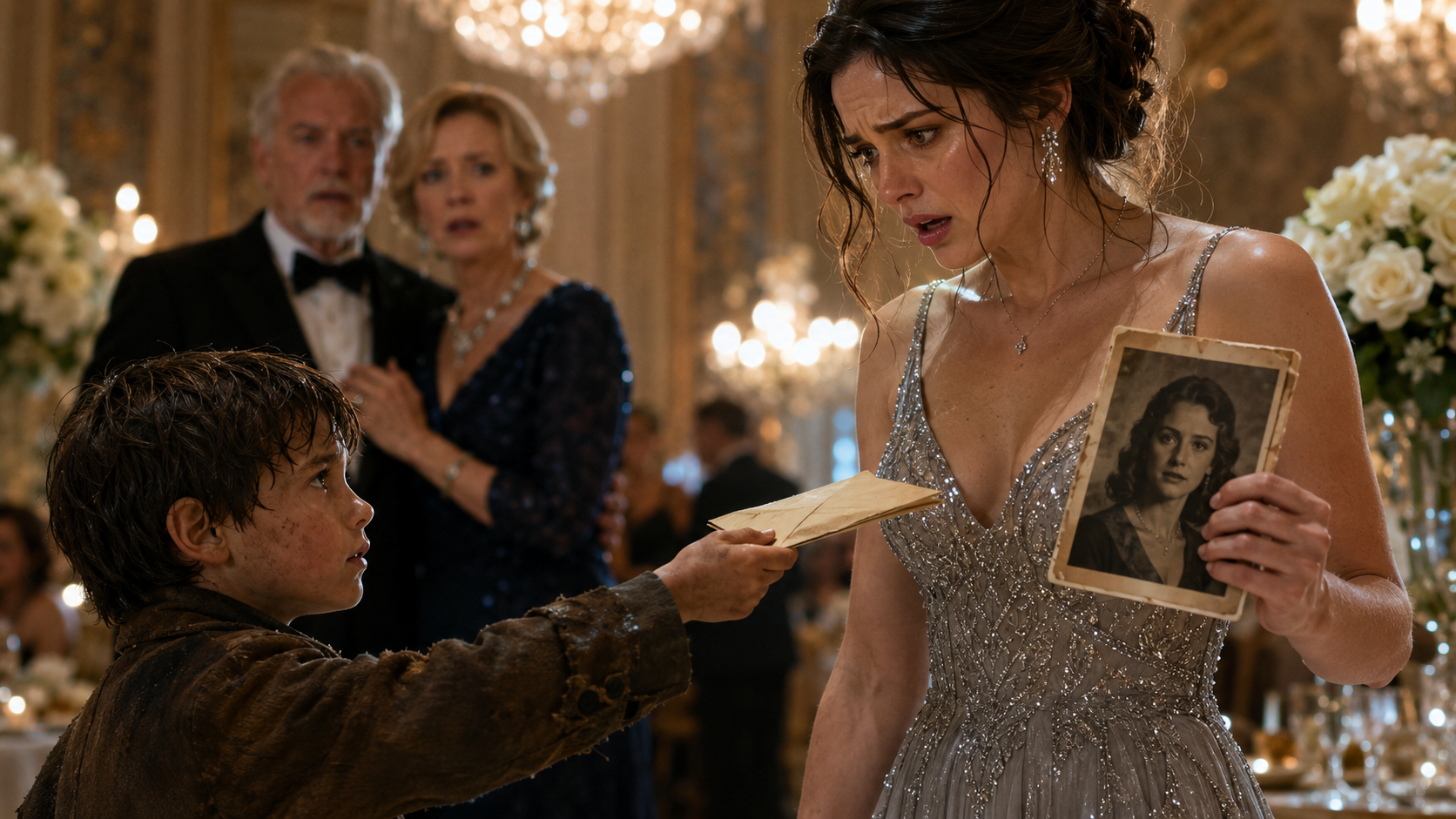
It is the child brave enough to cross a city with an old envelope.
It is the sister who never stopped believing your face would remember hers.
It is the mother who lost one daughter but taught the other to find her.
You look at Lena.
She looks back.
Same eyes.
Same blood.
Different lives.
One truth.
And this time, no one gets to erase either of you.