THE BOY AT THE OLD HARBOR

Sixteen-year-old Leo Arden had spent his entire life learning how to disappear.

Not literally.

He knew how to enter a room without drawing attention. He knew how to listen while powerful adults forgot he was there. He knew how to wear ordinary clothes, take public transportation, and answer questions without mentioning the surname that appeared on skyscrapers, research centers, cargo ships, and university buildings across the country.

His father had taught him that invisibility was a privilege.

“People perform when they know you have power,” Sebastian Arden once told him. “But when they believe you can do nothing for them, they stop performing. That is when you meet the person they truly are.”

Leo had been eleven when he first heard those words.

At the time, he thought his father was simply being dramatic.

Five years later, he understood.

The Arden family was worth more money than Leo could comfortably imagine. His father controlled Arden Maritime, a global engineering and shipping company that designed ports, built research vessels, and financed coastal development projects.

The family owned homes in four countries.

Leo lived in only one of them.

He attended an expensive school, but he arrived by city bus whenever possible. He owned formal suits, but preferred faded jackets. He had access to private drivers, but spent most weekends walking through neighborhoods where nobody recognized him.

His father allowed it.

In fact, he encouraged it.

There was only one rule.

Leo was never to use the Arden name as a weapon.

He could defend himself. He could tell the truth. He could call for help when he was in danger.

But he was never to threaten someone simply because his family had influence.

Power, his father believed, revealed character just as clearly as poverty did.

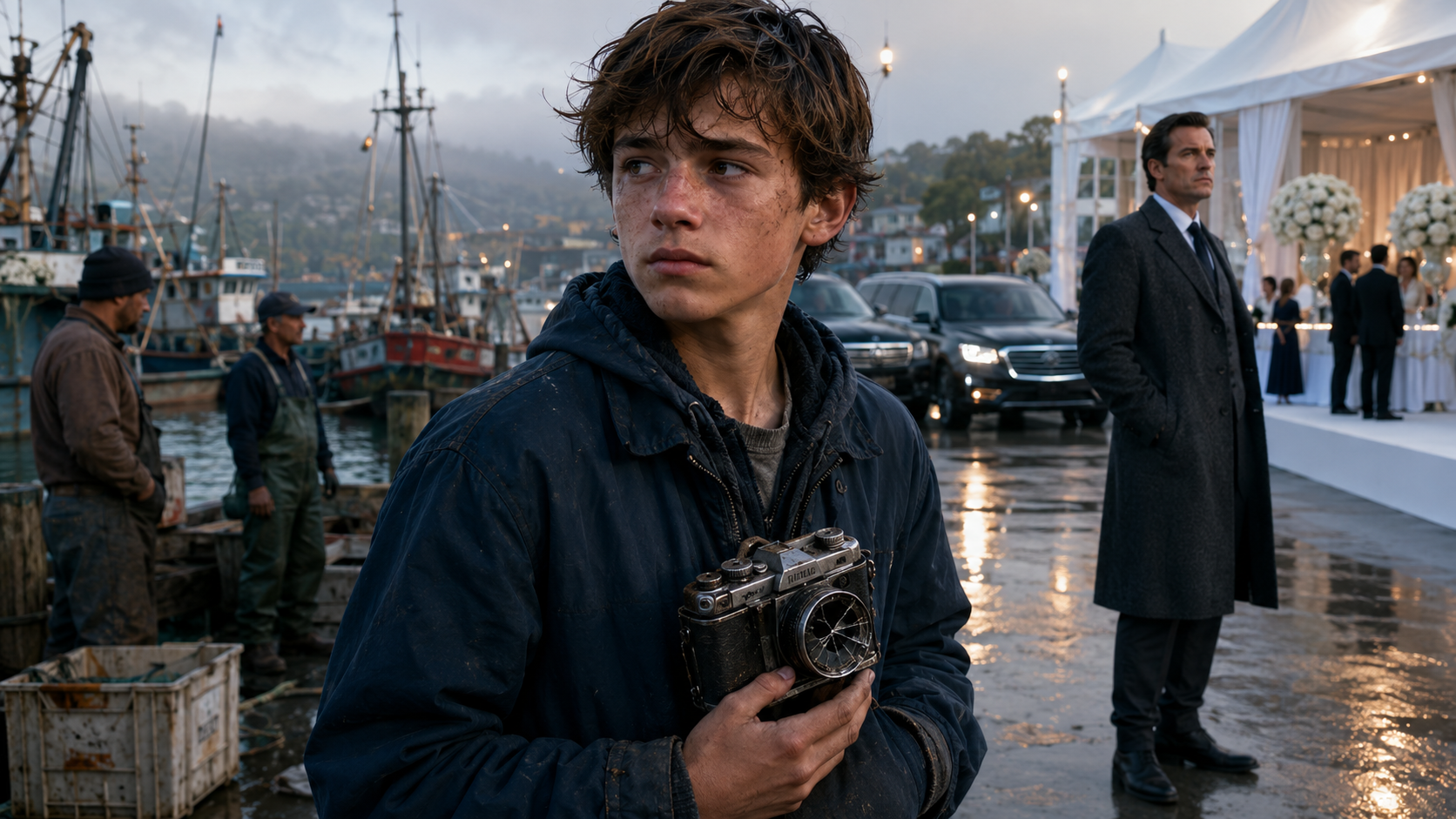
That Saturday morning, Leo left home wearing an old navy jacket, dark jeans, and boots scratched from years of use.

A leather camera case hung from his shoulder.

Inside it was a vintage film camera that had belonged to his mother.

It was not the most expensive camera she had owned. It was not the most advanced. The metal body was dented near the shutter, and the leather grip had faded from black to gray.

But it was the camera she had carried on the last day they visited Grayhaven Harbor together.

That made it priceless.

Leo’s mother, Elena, had been a documentary photographer. She had traveled to fishing villages, storm-damaged islands, refugee camps, and forgotten coastal towns. Her photographs rarely showed wealthy people.

She preferred faces marked by weather, work, hope, and survival.

Grayhaven had been one of her favorite places.

Before the new towers appeared.

Before the restaurants with glass walls.

Before investors began calling the harbor “underdeveloped waterfront property.”

Elena had loved the old eastern pier, where wooden fishing boats returned before sunrise and elderly sailors repaired nets beneath rusted lamps.

“This place remembers everyone,” she once told Leo.

He had asked what that meant.

She smiled and raised her camera.

“One day you’ll understand.”

She died two years later after a sudden illness.

Leo had been thirteen.

Since then, he visited the harbor every year on her birthday.

He took photographs.

He spoke to the fishermen who remembered her.

He sat at the edge of the pier and watched the tide move beneath the boards.

That morning, however, the harbor did not look the way he remembered it.

Metal barriers surrounded the eastern pier.

Black vehicles occupied the loading area.

Workers in spotless uniforms were attaching silver fabric to temporary fences. A white platform had been constructed beside the water, decorated with flowers, lights, and rows of expensive chairs.

Leo stopped near the entrance.

A large private event was clearly being prepared.

Men with communication devices moved between the vehicles. Assistants carried tablets and shouted instructions. Caterers arranged glasses beneath a polished canopy.

Beyond the barriers, the old fishermen stood beside their boats.

They looked confused.

And angry.

Leo approached a woman wearing a security badge.

“Excuse me,” he said. “Is the pier closed?”

She barely looked at him.

“Private event.”

“For how long?”

“All day.”

“Is there another way to reach the eastern dock?”

“No.”

Leo glanced toward the fishermen.

“They need access to their boats.”

The woman sighed as if he had asked an exhausting question.

“Talk to event management.”

“Where are they?”

She pointed without speaking.

Near the platform stood a tall man in a charcoal coat. His silver tie reflected the morning light. Two assistants followed him while he inspected the decorations.

Leo recognized him immediately.

Julian Voss.

Founder and chief executive of Voss Urban Development.

His company had purchased warehouses, apartment blocks, and abandoned factories throughout Grayhaven. He transformed old districts into luxury developments with private gyms, rooftop pools, and prices that forced longtime residents to leave.

Voss called it renewal.

The newspapers called it progress.

The people who lost their homes used different words.

Leo had seen Julian at charity dinners. They had never been introduced, and Julian had no reason to recognize him.

Today was apparently important for Voss Urban Development.

Leo looked at the banners being installed near the platform.

They carried no text yet, only a gold geometric symbol representing the company.

A presentation was probably planned.

The eastern harbor redevelopment project had been discussed for months. Julian wanted to replace the fishing pier with a luxury marina, hotel, shopping district, and private residential complex.

The project required approval from the city.

It also required financing.

Leo knew more about that financing than Julian could possibly realize.

He walked toward him.

One of Julian’s assistants stepped into his path.

“You can’t be here.”

“I need access to the pier.”

“It is closed.”

“There are working boats behind those barriers.”

“They were given notice.”

An elderly fisherman standing nearby heard the statement.

“No, we weren’t,” he called.

The assistant ignored him.

Leo turned toward Julian.

“Mr. Voss?”

Julian continued examining the platform.

“Mr. Voss,” Leo repeated.

Julian finally looked around.

His eyes moved over Leo’s worn jacket, old boots, and camera case.

Whatever he saw did not interest him.

“What?”

“My mother used to photograph this harbor. I come here once a year. I only need twenty minutes on the eastern pier.”

Julian’s expression remained blank.

“Then come back tomorrow.”

“The fishermen need their boats today.”

“That is not your concern.”

“It seems like it should be someone’s concern.”

One of Julian’s assistants shifted uncomfortably.

Julian turned fully toward Leo.

“Young man, this is a private site. Important guests will be arriving shortly. Leave before security removes you.”

Leo looked beyond him.

A fisherman named Tomas Aguilar was attempting to move a metal barrier. A security guard blocked him.

“My equipment is on that boat,” Tomas said. “I sail in forty minutes.”

“Nobody crosses the event zone,” the guard replied.

“I have had that berth for thirty-two years.”

“Not my problem.”

Tomas tried to step around him.

The guard pushed him back.

Leo moved immediately.

“Don’t touch him.”

The guard looked at Leo.

“Walk away.”

“He wasn’t threatening you.”

“He crossed the barrier.”

“It is a public pier.”

“Not today.”

Leo turned to Julian again.

“You cannot prevent licensed fishermen from reaching their vessels without proper notice.”

Julian smiled faintly.

It was not a friendly smile.

“Are you a lawyer?”

“No.”

“A city official?”

“No.”

“Then perhaps you should stop pretending your opinion matters.”

Leo felt several people watching them.

Workers had slowed down. Assistants stood silently. The fishermen waited behind the barriers.

Julian stepped closer.

“Do you know what is happening here today?”

“A presentation.”

“A final investment inspection.”

Leo already knew that.

Julian continued, clearly enjoying the opportunity to explain his importance.

“Representatives from one of the largest infrastructure companies in the country are coming to evaluate this site. If they approve my proposal, this decaying harbor will become the most valuable waterfront district in the region.”

“Decaying?”

Leo looked toward the weathered boats.

Families had worked there for generations.

“That pier still supports more than sixty local businesses.”

“It supports men repairing fishing nets beside buildings that should have been demolished twenty years ago.”

“They work here.”

“They occupy space,” Julian corrected. “Valuable space.”

Tomas stared at him.

Julian did not notice.

Or did not care.

Leo lowered his voice.

“You invited investors to see the harbor, but you’re hiding the people who actually keep it alive.”

Julian’s expression hardened.

“I am removing distractions.”

The answer disturbed Leo more than open anger would have.

To Julian, the fishermen were not citizens.

They were not workers.

They were not families.

They were visual problems that needed to disappear before wealthy visitors arrived.

Leo glanced at his mother’s camera case.

She had spent her life photographing the people men like Julian preferred not to see.

“I’m going to the pier,” Leo said.

Julian laughed once.

“No, you are not.”

Leo stepped toward the barrier.

A security guard grabbed his arm.

“Let go.”

“Leave the property.”

“This isn’t your property.”

The guard tightened his grip.

Leo pulled free.

His camera case swung forward and struck the barrier. The clasp opened.

The vintage camera fell onto the wooden boards.

Leo froze.

Before he could reach it, Julian placed one polished shoe beside the camera.

For a second, nobody moved.

Leo looked up.

“Please step away from it.”

Julian glanced down.

“This old thing?”

“It belonged to my mother.”

“Then you should have taken better care of it.”

Leo bent down.

Julian moved his shoe.

Not backward.

Forward.

The camera scraped across the pier and struck a metal support.

The lens shattered.

The sound was small.

A sharp crack of glass and metal.

But to Leo, it seemed louder than the engines, the workers, and the waves beneath the dock.

He stared at the broken camera.

The object itself was replaceable.

Its history was not.

Julian watched him with mild amusement.

“Perhaps now you will remember that restricted areas are restricted for a reason.”

Leo slowly picked up the camera.

A thin line of blood appeared across his finger where the broken glass cut his skin.

Tomas moved toward him.

“Leo, are you all right?”

Julian noticed the name but showed no reaction.

Leo wrapped the camera in a cloth from the case.

His hands were steady.

His voice was not angry.

That made Julian smile.

He assumed the boy had finally understood his position.

Leo reached into his jacket and removed his phone.

Julian sighed.

“Let me guess. You’re calling the police?”

“No.”

“Your school principal?”

Leo looked directly at him.

“My father.”

Several workers exchanged glances.

Julian laughed.

“Of course you are.”

Leo pressed a contact.

The call connected after one ring.

“Leo?”

His father’s voice was quiet.

“I’m at Grayhaven Harbor.”

There was a pause.

“You were going there this morning. Are you all right?”

“I’m not injured badly.”

The warmth vanished from Sebastian Arden’s voice.

“What happened?”

“Security grabbed me. One of the fishermen was pushed. Julian Voss blocked everyone from reaching the eastern pier.”

Julian’s smile disappeared for half a second.

Leo continued.

“He also destroyed Mom’s camera.”

Silence followed.

Not an empty silence.

A controlled one.

The kind of silence that appeared when Sebastian Arden was choosing every word before allowing himself to speak.

“Where is Mr. Voss now?”

“Standing in front of me.”

“Put the call on speaker.”

Leo touched the screen.

His father’s voice became audible.

“Mr. Voss.”

Julian stared at the phone.

He did not recognize the voice immediately.

“Who is this?”

“Sebastian Arden.”

The change in Julian’s face was almost invisible.

Almost.

His jaw tightened.

His shoulders became rigid.

One of his assistants lowered her tablet.

Julian looked at Leo again.

This time, he did not see a teenager in an old jacket.

He saw the eyes.

The shape of the face.

The calmness.

Details he would have noticed earlier if he had believed the boy was worth observing.

“That is not possible,” Julian said.

Sebastian’s response came through the speaker.

“My son rarely finds things impossible. Inconvenient, perhaps. But not impossible.”

Julian’s face lost color.

“Your son?”

“Yes.”

“I believe there has been a misunderstanding.”

Leo looked at the broken camera in his hand.

“No,” Sebastian said. “I believe there has been an unusually clear understanding.”

Julian glanced toward his staff.

Nobody spoke.

“The site inspection is scheduled for eleven,” Sebastian continued. “My team and I are seven minutes away.”

Julian checked his watch.

It was 10:53.

His eyes moved toward the harbor entrance.

Then back to Leo.

“Mr. Arden, I can explain.”

“You will have that opportunity.”

The call ended.

For several seconds, the only sound came from water striking the posts beneath the pier.

Julian forced a smile.

“Leo, correct?”

Leo said nothing.

“I think we both reacted emotionally.”

“You broke the camera on purpose.”

“It was an accident.”

“You moved your foot forward.”

Julian glanced around.

Too many people had seen it.

He lowered his voice.

“You must understand the pressure surrounding a project of this size.”

“The project made you destroy my mother’s camera?”

“I did not know who you were.”

Tomas let out a bitter laugh.

Julian turned toward him.

The fisherman shook his head.

“That is the problem,” Tomas said.

Julian’s eyes narrowed.

Tomas pointed at Leo.

“You are not sorry because you hurt him. You are afraid because you discovered his last name.”

Julian looked toward the harbor entrance again.

The first vehicle appeared less than a minute later.

It was not a limousine.

It was a dark electric van carrying engineers from Arden Maritime.

A second vehicle followed with members of the company’s legal department.

Then came two city cars.

The mayor’s deputy stepped out with the director of coastal planning.

A final black sedan stopped beside the platform.

The rear door opened.

Sebastian Arden emerged.

He was fifty-one, tall, and dressed in a simple dark suit without a tie. His hair was beginning to turn gray near the temples.

He did not look furious.

He did not look hurried.

He looked focused.

That frightened Julian more than anger would have.

Sebastian walked past the platform, the flowers, and the waiting executives.

He did not greet Julian.

He went directly to his son.

His eyes examined Leo’s face, arms, and hands.

“You said you were barely hurt.”

“It is only a cut.”

Sebastian saw the blood on Leo’s finger.

Then he noticed the camera wrapped in cloth.

For the first time, his expression changed.

“Is that Elena’s?”

Leo nodded.

Sebastian opened the cloth carefully.

The cracked lens reflected the morning sky.

His fingers rested against the damaged metal.

He remembered his wife carrying it through rainstorms, airport terminals, fishing villages, and crowded city streets.

He remembered her lifting it toward him on the day they met.

He remembered Leo at six years old, trying to hold it with both hands.

Sebastian closed the cloth.

“What happened?”

Leo explained.

He did not exaggerate.

He described the blocked pier, the fishermen, the guard, and Julian’s words.

Sebastian listened without interrupting.

When Leo finished, his father looked at Tomas.

“Were you prevented from reaching your vessel?”

“Yes.”

“Did anyone notify you in advance?”

“No.”

Sebastian turned to the other fishermen.

Several gave the same answer.

He looked toward the director of coastal planning.

“Was this closure authorized?”

The director checked with an assistant.

“No. The event permit covers the loading square and the western platform. It does not include the working pier.”

Julian stepped forward.

“There was confusion among the event staff.”

Sebastian faced him at last.

Julian attempted a professional smile.

“Sebastian, I deeply regret what happened. I had no idea Leo was your son.”

Sebastian studied him.

Nobody moved.

“That statement,” he said quietly, “is more damaging than you realize.”

Julian’s smile faded.

“I only meant that I would never intentionally disrespect your family.”

“But you would intentionally disrespect someone else’s.”

“That is not what I said.”

“You had a fisherman pushed away from the boat that provides his income. You described working families as distractions. You allowed your guards to seize a minor. You destroyed a personal possession because you believed the owner lacked the power to hold you accountable.”

Julian swallowed.

Sebastian took one step closer.

“And your defense is that you did not know he belonged to me.”

“I was under pressure.”

“So were your employees. They did not crush his camera.”

“It can be replaced.”

“No the power to hold you accountable.”

Julian swallowed.

Sebastian took one step closer.

“And your defense is that you did not know he belonged to me.”

“I was under pressure.”

“So were your employees. They did not crush his camera.”

“It can be replaced.”

“No,” Leo said. “It cannot.”

Julian looked at him.

For once, he had no answer.

Sebastian turned toward the temporary platform.

“Your proposal describes Grayhaven as a community-centered redevelopment.”

“It is.”

“No. It is an extraction project wearing the language of restoration.”

Julian’s breathing became shallow.

“We have spent eighteen months negotiating this partnership.”

“Yes.”

“Your board approved the preliminary financing.”

“Conditional financing.”

Julian understood immediately.

Every conversation stopped.

Sebastian continued.

“The conditions included lawful site access, community protection, and responsible treatment of existing harbor businesses.”

“We can correct today’s mistakes.”

“Today was not a mistake.”

Sebastian gestured toward the polished platform.

“You did not accidentally hide these fishermen. You planned it because their presence interfered with the image you wanted to sell us.”

Julian’s voice became desperate.

“You cannot cancel a nine-hundred-million-dollar development because of a damaged camera.”

Sebastian looked at him without emotion.

“The camera revealed the decision. It did not cause it.”

The mayor’s deputy folded his arms.

Arden Maritime’s legal director began typing on her tablet.

Julian looked from face to face.

He realized that the presentation was over before it had started.

“The inspection is suspended,” Sebastian said. “Our financing team is withdrawing from the current proposal. Legal counsel will issue formal notice this afternoon.”

“You will destroy the project.”

“No. We will redesign it.”

Sebastian turned toward the fishermen.

“The eastern pier will remain operational.”

Tomas stared at him.

Sebastian continued.

“Arden Maritime will submit an alternative plan with protected commercial berths, a public market, affordable workshop leases, and a permanent community advisory board.”

The coastal planning director nodded slowly.

It was the first hopeful expression Leo had seen that morning.

Julian’s anger finally broke through his fear.

“You think one emotional story gives you the right to take this from me?”

Sebastian’s gaze became cold.

“You never owned the harbor.”

“I assembled this deal.”

“You assembled property options. The city owns the waterfront, the fishermen hold valid operating rights, and my company controls the financing you required.”

Julian looked at Leo.

Resentment twisted his face.

“This happened because of you.”

Leo met his stare.

“No. It happened because you thought nobody important was watching.”

The words settled over the pier.

Sebastian looked at his son.

There was sadness in his expression, but also pride.

Julian opened his mouth, perhaps to argue again.

Tomas interrupted him.

“You wanted the harbor to look empty.”

The old fisherman stepped beside Leo.

“Now everyone can see exactly what was missing from your plan.”

One by one, the workers who had remained silent began moving the barriers.

The fishermen crossed toward their boats.

Security guards stepped aside.

A woman from Julian’s event team removed the silver fabric hiding the eastern pier.

Morning light spread across the weathered boards.

Engines started.

Ropes were untied.

The harbor came alive again.

Sebastian placed a hand on Leo’s shoulder.

“Let us get that cut cleaned.”

Leo looked down at the broken camera.

“Mom would have hated this.”

“The camera?”

“The entire event.”

Sebastian almost smiled.

“She would have photographed it.”

Leo looked toward Julian, standing alone beside his perfect platform.

“Yes,” he said. “She would have.”

Three months later, the city rejected the Voss redevelopment proposal.

A revised plan was approved the following spring.

The luxury marina became a mixed-use public harbor. Old warehouses were restored as workshops, classrooms, seafood markets, and small business spaces. Fishing families received long-term berth protections. A waterfront gallery was created inside the former customs building.

Its opening exhibition featured Elena Arden’s photographs.

At the center of the gallery stood a glass case.

Inside it rested her damaged camera.

Leo had refused to repair the cracked lens.

Beside the case was a small card explaining that the camera had recorded thousands of moments before it was broken by someone who believed its owner did not matter.

Leo visited the gallery on opening morning.

He wore the same worn jacket.

Tomas found him standing beside the display.

“You could have bought a new one,” the fisherman said.

“I did.”

Leo lifted a newer film camera.

“Then why keep the broken one?”

Leo looked through the gallery windows toward the crowded pier.

Children were watching boats return.

Workers were unloading crates.

Tourists stood beside families who had lived in Grayhaven for generations.

The harbor had not been polished into silence.

It was loud.

Imperfect.

Alive.

Leo smiled.

“Because some broken things still have work to do.”

Tomas considered the answer.

Then he nodded.

Together they walked outside.

Leo raised the new camera and focused on the people crossing the pier.

Before pressing the shutter, he remembered something his mother had told him years ago.

A place remembers everyone.

Now he finally understood.

Places did not remember through buildings, signs, or expensive monuments.

They remembered through the choices people made when they believed nobody powerful was watching.

And sometimes, all it took was one quiet witness to make the truth impossible to hide.