His company had purchased warehouses, apartment blocks, and abandoned factories throughout Grayhaven. He transformed old districts into luxury developments with private gyms, rooftop pools, and prices that forced longtime residents to leave.
Voss called it renewal.
The newspapers called it progress.
The people who lost their homes used different words.
Leo had seen Julian at charity dinners. They had never been introduced, and Julian had no reason to recognize him.
Today was apparently important for Voss Urban Development.
Leo looked at the banners being installed near the platform.
They carried no text yet, only a gold geometric symbol representing the company.
A presentation was probably planned.
The eastern harbor redevelopment project had been discussed for months. Julian wanted to replace the fishing pier with a luxury marina, hotel, shopping district, and private residential complex.
The project required approval from the city.
It also required financing.
Leo knew more about that financing than Julian could possibly realize.
He walked toward him.
One of Julian’s assistants stepped into his path.
“You can’t be here.”
“I need access to the pier.”
“It is closed.”
“There are working boats behind those barriers.”
“They were given notice.”
An elderly fisherman standing nearby heard the statement.
“No, we weren’t,” he called.
The assistant ignored him.
Leo turned toward Julian.
“Mr. Voss?”
Julian continued examining the platform.
“Mr. Voss,” Leo repeated.
Julian finally looked around.
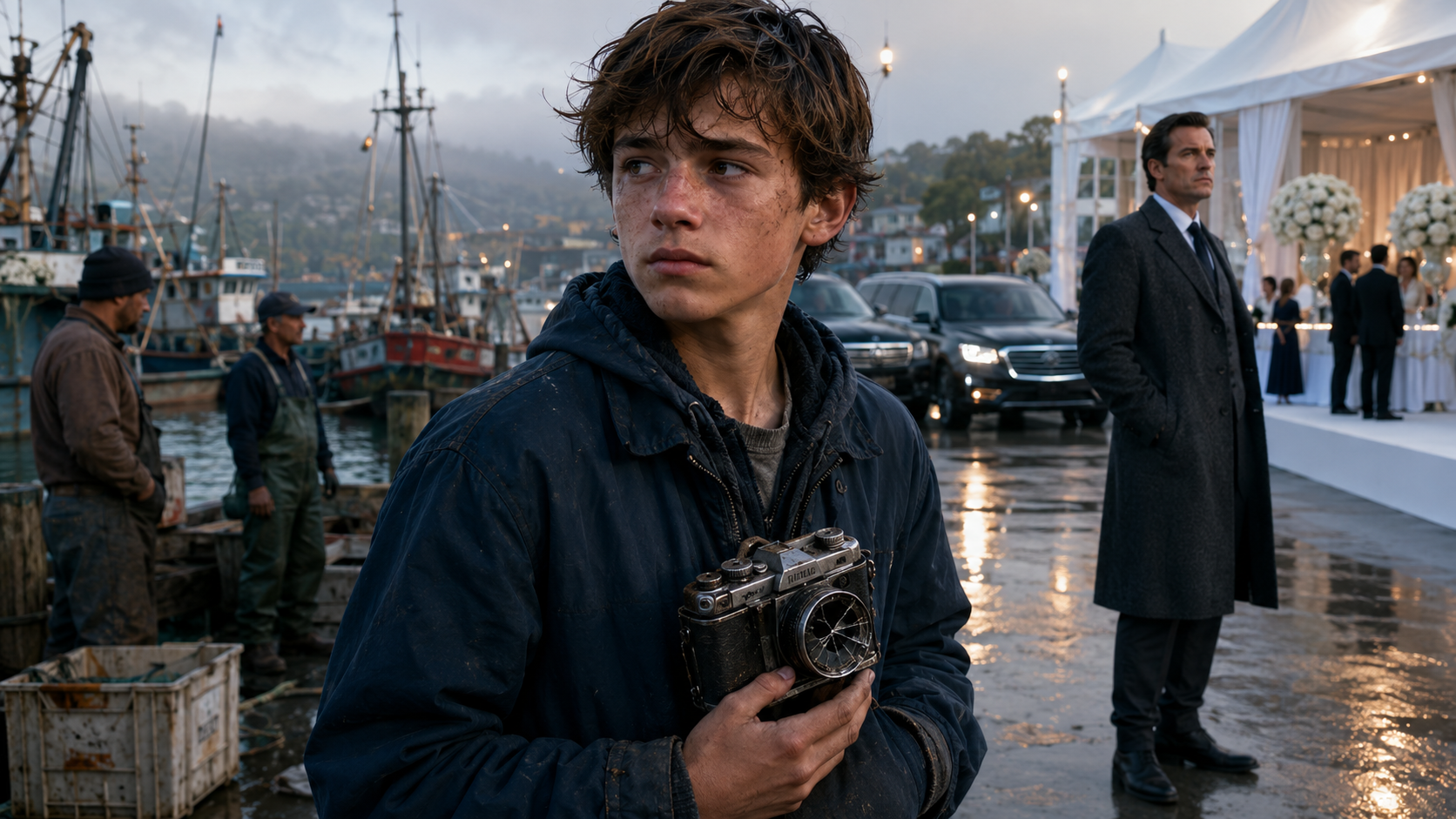
His eyes moved over Leo’s worn jacket, old boots, and camera case.
Whatever he saw did not interest him.
“What?”
“My mother used to photograph this harbor. I come here once a year. I only need twenty minutes on the eastern pier.”
Julian’s expression remained blank.
“Then come back tomorrow.”
“The fishermen need their boats today.”
“That is not your concern.”
“It seems like it should be someone’s concern.”
One of Julian’s assistants shifted uncomfortably.
Julian turned fully toward Leo.
“Young man, this is a private site. Important guests will be arriving shortly. Leave before security removes you.”
Leo looked beyond him.
A fisherman named Tomas Aguilar was attempting to move a metal barrier. A security guard blocked him.
“My equipment is on that boat,” Tomas said. “I sail in forty minutes.”
“Nobody crosses the event zone,” the guard replied.
“I have had that berth for thirty-two years.”
“Not my problem.”
Tomas tried to step around him.
The guard pushed him back.
Leo moved immediately.
“Don’t touch him.”
The guard looked at Leo.
“Walk away.”
“He wasn’t threatening you.”
“He crossed the barrier.”
“It is a public pier.”
“Not today.”
Leo turned to Julian again.
“You cannot prevent licensed fishermen from reaching their vessels without proper notice.”
Julian smiled faintly.
It was not a friendly smile.
“Are you a lawyer?”
“No.”
“A city official?”
“No.”
“Then perhaps you should stop pretending your opinion matters.”
Leo felt several people watching them.
Workers had slowed down. Assistants stood silently. The fishermen waited behind the barriers.
Julian stepped closer.
“Do you know what is happening here today?”
“A presentation.”
“A final investment inspection.”
Leo already knew that.
Julian continued, clearly enjoying the opportunity to explain his importance.
“Representatives from one of the largest infrastructure companies in the country are coming to evaluate this site. If they approve my proposal, this decaying harbor will become the most valuable waterfront district in the region.”
“Decaying?”
Leo looked toward the weathered boats.
Families had worked there for generations.
“That pier still supports more than sixty local businesses.”
“It supports men repairing fishing nets beside buildings that should have been demolished twenty years ago.”
“They work here.”
“They occupy space,” Julian corrected. “Valuable space.”
Tomas stared at him.
Julian did not notice.
Or did not care.
Leo lowered his voice.
“You invited investors to see the harbor, but you’re hiding the people who actually keep it alive.”
Julian’s expression hardened.
“I am removing distractions.”
The answer disturbed Leo more than open anger would have.
To Julian, the fishermen were not citizens.
They were not workers.
They were not families.
They were visual problems that needed to disappear before wealthy visitors arrived.
Leo glanced at his mother’s camera case.
She had spent her life photographing the people men like Julian preferred not to see.
“I’m going to the pier,” Leo said.
Julian laughed once.
“No, you are not.”
Leo stepped toward the barrier.
A security guard grabbed his arm.
“Let go.”
“Leave the property.”
“This isn’t your property.”
The guard tightened his grip.