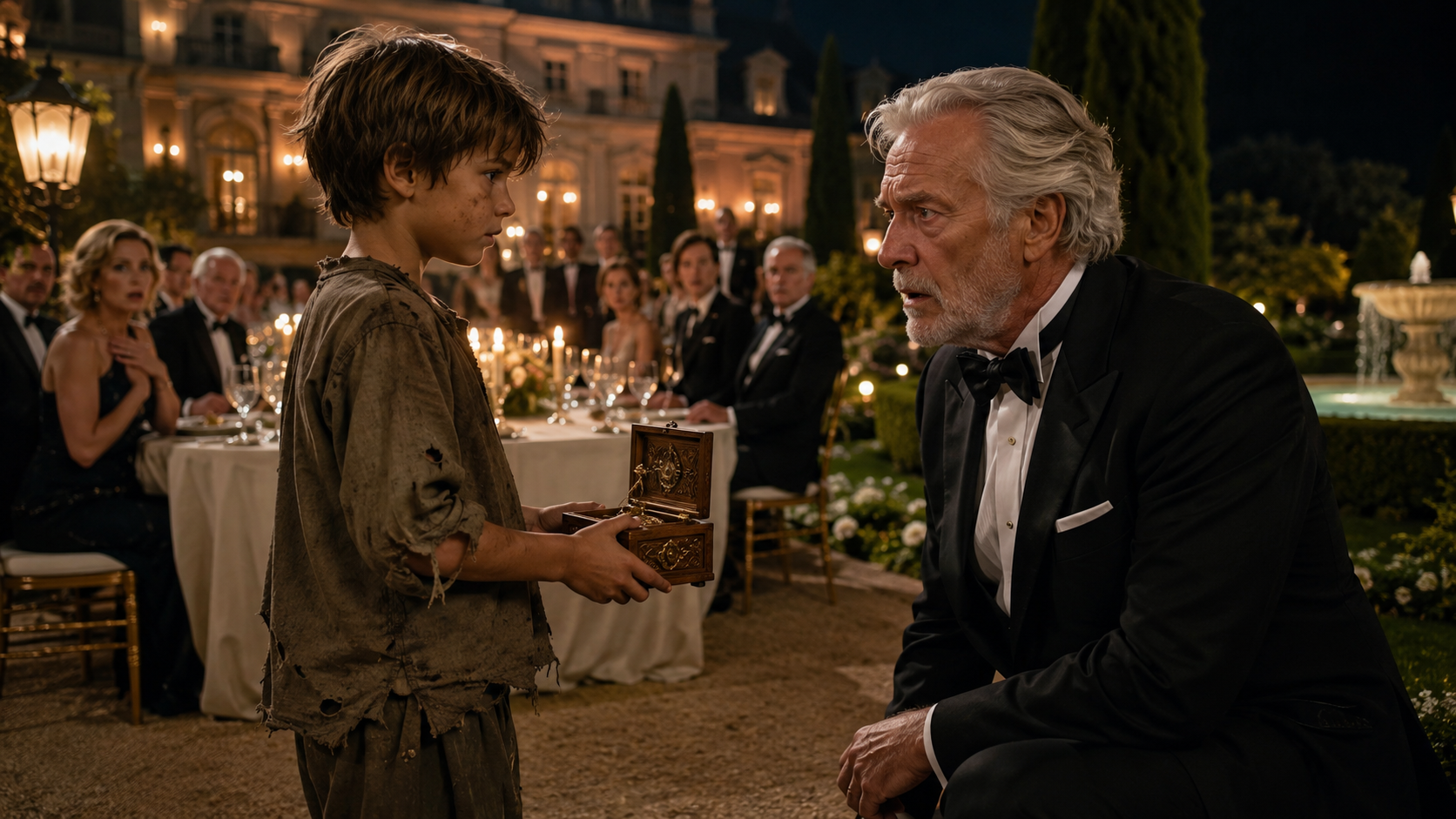
For most of his life, Victor Harrow believed silence was a form of strength.
He had built an empire with it.
A pause at the end of a boardroom table could make grown men confess their weaknesses. A quiet glance across a courtroom could make attorneys forget their own arguments. A single unanswered letter could punish a daughter for twenty-two years.
Silence had made him feared.
Silence had made him rich.
And on the night his past walked barefoot through the gates of Harrow House, Victor was hosting a dinner designed to remind the world that he was still untouchable.
The estate rose above the city like a private kingdom. White stone terraces overlooked a garden trimmed so perfectly it looked less grown than manufactured. Lanterns floated above the lawn. Silver cutlery gleamed beside crystal glasses. Violin music drifted through warm spring air, polite and expensive.
Around the long outdoor table sat senators, bankers, museum trustees, foreign investors, and people who laughed softly at things that were not funny because Victor Harrow expected them to laugh.
At the head of the table, Victor lifted his glass.
He was seventy-four, tall even with age bending at his shoulders, his white hair brushed back from a face carved by discipline and disappointment. His tuxedo fit as if the tailor feared him. His eyes, pale gray and sharp as winter water, moved over his guests with practiced boredom.
“To the Harrow Foundation,” he said. “May generosity remain useful.”
The guests laughed.
Victor did not.
Beside him, his nephew Bennett Chase smiled with polished confidence. Bennett was forty, handsome in the smooth and hollow way of men who had never truly suffered. For twelve years, he had stood close enough to Victor to look like an heir without ever being named one. He chaired committees. Shook hands. Appeared in photographs. Remembered donors’ wives by name.
And waited.
Everyone knew he was waiting.
Everyone also knew Victor had no children.
Not anymore.
The first course had just been cleared when the music faltered.
At first, Victor thought one of the hired violinists had made an error. Then he noticed the waiters had stopped near the garden arch. A security guard stood frozen beside the gravel path, one hand near his earpiece, unsure whether to interfere.
A boy stood under the archway.
He could not have been more than ten.
His trousers were too short. His coat was too thin. His hair, dark and messy, clung to his forehead as if he had walked through rain or sweat or both. His face was pale with hunger, his cheeks smudged with dirt. One shoe was missing. The other had a split at the toe.
In both hands, he held a small wooden music box.
The dinner fell silent.
The boy took one step forward.
“Mr. Harrow?” he asked.
His voice was so small it almost vanished beneath the fountain.
Several guests looked away with embarrassed smiles, the way wealthy people often did when poverty appeared too close to the table.
Victor set down his glass.
“This is private property.”
The boy swallowed. His hands tightened around the music box.
“I know. I’m sorry. I tried the front gate, but they wouldn’t let me in.”
Bennett leaned toward Victor and murmured, “Security will remove him.”
Victor raised one finger.
Bennett stopped.
The boy looked at Victor as though he had spent all his courage getting there and had very little left.
“I need help,” he said.
A woman near the middle of the table gave a soft, uncomfortable laugh.
Victor heard it. So did the boy.
“What kind of help?” Victor asked.
“My mother is sick.”
“That is unfortunate.”
The boy flinched, but continued. “She said your name in her sleep.”
A few guests exchanged glances.
Bennett’s smile thinned.
Victor leaned back in his chair. “Many people know my name.”
“She said it like she knew you.”
At the far end of the table, someone whispered, “Oh dear.”
Victor’s jaw tightened.
“What is your mother’s name?”
The boy hesitated.
Then he said, “Mara Vale.”
The name moved through Victor like a blade that had waited twenty-two years to be pulled free.
For a moment, the garden disappeared.
The lanterns, the guests, the crystal, the servants, the fountain—all of it faded until there was only a young woman standing in a marble foyer with a suitcase in her hand and tears in her furious green eyes.
Mara.
His daughter.
His only child.
The child he had loved with the kind of love powerful men often ruin by trying to own it.
Victor did not speak.
Bennett did.
“That’s impossible,” he said quickly. “Mara has been gone for years.”
The boy turned toward him. “She’s not gone. She’s at Mercy General.”
Victor’s eyes moved to Bennett.
“Mercy General?”
Bennett’s smile returned, but weaker now. “Uncle, this is clearly some kind of trick. Someone sent him. Perhaps a journalist. Perhaps one of the protesters from last month.”