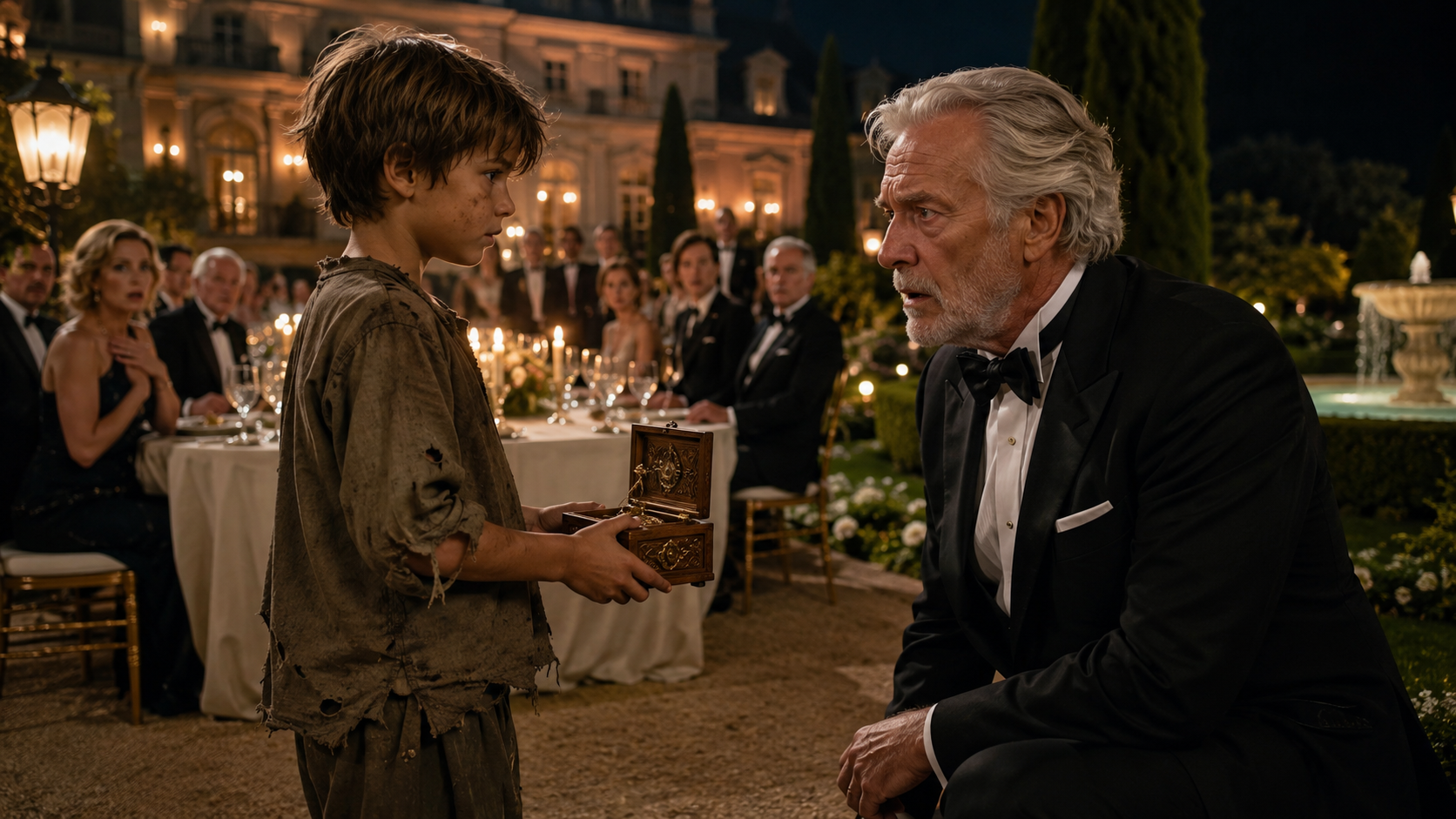
“I’m not a trick,” the boy said.
The guests shifted.
Victor looked back at the child. “What is your name?”
“Eli.”
“Eli what?”
“Eli Vale.”
The name struck again.
Vale.
Not Harrow.
Never Harrow.
Victor remembered the man Mara had chosen. Jonah Vale. A pianist with worn shoes, gentle hands, and no family fortune. Victor had called him temporary. Mara had called him good. Victor had forbidden the marriage. Mara had married him anyway.
So Victor had done what Victor Harrow did best.
He punished.
He cut off her accounts. Removed her from the family trust. Ordered the staff not to accept her calls. Returned her letters unopened until she stopped sending them.
At first, he told himself she would come back.
Then he told himself she was stubborn.
Then he told himself she was gone.
And finally, he stopped telling himself anything at all.
Now a barefoot boy stood in his garden holding a music box.
Victor’s voice lowered. “Why did you come here?”
Eli looked down at the box. “Because Mom needs medicine. The doctor said they can’t keep doing the treatment unless we pay more. I don’t know how much. It sounds like a lot.”
One of the guests sighed with theatrical pity.
Bennett stood. “This has gone far enough.”
Eli stepped back.
Victor noticed it.
The child expected to be grabbed.
Expected to be dragged out.
Expected cruelty.
Victor hated that he recognized the expectation.
Bennett gestured to the guard. “Take him to the service entrance and call whoever handles these situations.”
Victor did not raise his voice.
“Sit down, Bennett.”
Bennett froze.
“I’m only trying to protect you.”
“You are trying to protect dinner.”
The table went still.
Bennett’s face tightened, but he sat.
Victor turned back to Eli.
“What is in your hands?”
The boy lifted the wooden music box.
“My mother said it belonged to her mother. She told me if I ever got lost, I should keep it because it knew the way home.”
Victor’s breath stopped.
He knew that box.
Of course he knew it.
His wife, Celeste, had carved it herself when Mara was seven. Dark walnut, polished smooth, with a small silver bird inlaid on the lid. Celeste had loved birds. “They leave,” she once told Victor, “but only because they trust the sky.”
Victor had hated that sentence after she died.
He had hated anything that sounded like leaving.
The music box had disappeared with Mara the night she walked out.
Victor stood so suddenly his chair scraped against the stone.
The guests watched him with widened eyes.
“Bring it here,” he said.
Eli hesitated.
Victor heard himself then, heard the command in his own voice, and softened it with visible effort.
“Please.”
The boy approached slowly.
Every step seemed to cost him.
When he reached the head of the table, Victor held out his hand, but Eli did not immediately give him the box.
“My mom said not to let anyone take it.”
“Then don’t,” Victor said.
Eli looked confused.
Victor lowered his hand.
“Open it.”
The boy placed the box on the table and lifted the lid.
A thin melody began to play.
Not perfect anymore. Age had made it uneven. One note dragged. Another trembled. But Victor knew it before the third turn.
Celeste’s lullaby.
She had sung it to Mara when storms shook the windows.
She had sung it when Mara cried after falling from a horse.
She had sung it in the hospital when illness made her voice soft and far away.
And Victor, who had not cried at his wife’s funeral because grief felt too public, closed his eyes.
A memory rose unwanted.
Celeste in bed, pale but smiling. Mara curled beside her. Victor standing at the window, pretending not to listen.
“One day,” Celeste had whispered to their daughter, “when your father forgets how to be gentle, remind him.”
Mara had asked, “How?”
Celeste had tapped the music box.
“With this.”
Victor opened his eyes.
The boy was watching him.
Eli’s eyes were green.
Mara’s green.
Celeste’s green.
Victor gripped the edge of the table.
“How old are you?”
“Ten.”
“When is your birthday?”
“October third.”
Victor closed his eyes again.
Ten years.
Ten years he had been a grandfather and had not known.
Or had chosen not to know.
“Uncle,” Bennett said carefully, “even if the box is genuine, that proves nothing. Mara could have given it away. She could have—”
Victor turned on him.
“Say her name once more like she is an inconvenience, and you will leave this house with nothing but the suit you wore in.”
Bennett’s mouth closed.
The guests looked down at their plates.
Victor stepped away from the table and knelt in front of Eli.
The movement shocked the garden.
Victor Harrow did not kneel. Not before kings, presidents, judges, or God. Yet there he was, one knee pressed to the stone path, lowering himself until his eyes met the child’s.