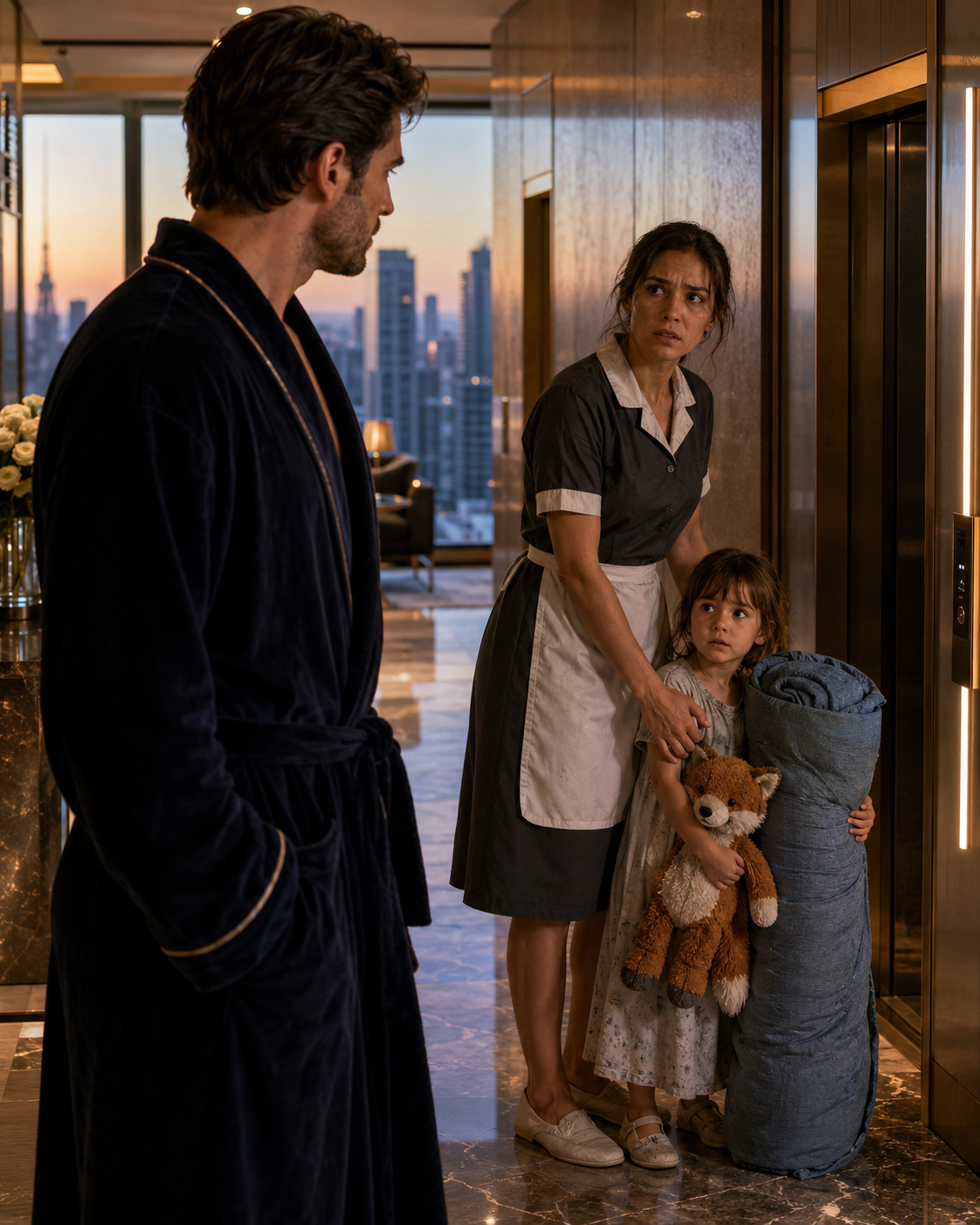
“This is for you,” she said.
Julian looked at Mara.
Mara looked surprised too. “Luna?”
The child pushed the fox into Julian’s hands.
“He watched us in the stairs. Now he can watch you so you don’t be lonely.”
The world blurred.
Julian Vale, who had negotiated billion-dollar deals without blinking, stared at a battered stuffed fox and had to look away.
Mara’s voice softened. “Luna, sweetheart, that’s your favorite.”
Luna shrugged. “Mr. Hallway needs him.”
Julian held the fox carefully.
“I’ll take very good care of him.”
Luna patted his arm. “Don’t spill coffee.”
“I won’t.”
“And don’t let fancy people be mean.”
Mara made a strangled sound. “Luna.”
Julian looked at the child, then at her mother.
“I’ll do my best,” he said.
A year later, Solstice Tower looked the same from the outside.
Glass. Steel. Money. Lake views.
But beneath the surface, things had changed.
The staff break room had been moved from a windowless basement corner to a renovated second-floor space with lockers, couches, a real coffee machine, and a bulletin board full of resources written in plain language. The family support fund helped pay for emergency childcare, transportation, and certification programs. Every contractor working in the building had to submit to wage audits.
Residents complained for two months about the increased fees.
Then most of them forgot.
People with money were very good at surviving minor inconvenience.
Mara did not work at Solstice Tower anymore.
She completed her nursing program on a cold April afternoon while Luna sat in the audience wearing a yellow dress and clapping before anyone else did. Mara crossed the stage with tears on her face, and when she saw Julian standing in the back beside Nora, she laughed through them.
After graduation, she took a job in the pediatric unit at St. Brigid’s Medical Center.
During her first week, she sent Julian a photo of her hospital badge.
The message beneath it said:
No stairwell. No mattress. Just work I’m proud of.
Julian saved it.
He had changed too, though not in ways magazines cared about.
Vale Dynamics remained successful, but he stopped treating constant growth like proof of virtue. He put hourly workers on his company advisory board. He funded overnight childcare pilot programs in three cities. He stopped attending charity events where wealthy people spent more energy praising themselves than helping anyone else.
Most importantly, he started looking.
At doormen.
Cashiers.
Cleaning crews.
Nurses.
Delivery drivers.
The people who kept life functioning while being treated like background scenery.
Once you truly saw them, you could not unsee them.
One Saturday in June, almost eighteen months after the morning with the mattress, Julian received an invitation drawn in purple crayon.
It showed a tall rectangle, a smaller rectangle, a sun with too many rays, and three stick figures holding hands. One stick figure seemed to be a fox.
Mara had written beneath it:
Luna insists you are invited to her birthday picnic. No pressure, but she says Button will be disappointed if you don’t come.
Button had eventually returned to Luna after she decided Julian was “less lonely now.” He had returned the fox in excellent condition, with a tiny scarf Nora ordered online because Nora had become emotionally invested and refused to discuss it.
The picnic was in Lincoln Park under a wide green tree.
There were cupcakes, juice boxes, balloons, and a small group of people who loved Luna enough to wear paper crowns on a Saturday afternoon. Mara’s mother came from Ohio using a walker covered in stickers. Rafael the night janitor came with his wife. Nora arrived with a gift bag and pretended she had not cried in the card aisle.
Julian arrived late because a meeting ran over, and Luna greeted him by yelling across the park.
“Mr. Hallway!”
Every adult turned.
Julian laughed and accepted his fate.
Luna ran to him in a blue dress, taller now, faster now, still serious when serious things were required.
“You came,” she said.
“I was invited by official crayon.”
She nodded. “That’s the most important kind.”
Mara walked over, smiling.
She looked different in daylight. Not because she had become someone else, but because survival was no longer using all her strength. Her hair was loose around her shoulders. There was color in her face. She had laugh lines now that Julian suspected had been waiting years for permission to appear.
“Hi,” she said.
“Hi.”
For a moment, the noise of the picnic moved around them. Children shouting. Wind in the trees. Someone opening a cooler. Luna explaining to Nora that cupcakes should count as dinner because they had eggs.
Mara looked at Julian.
“I never thanked you properly.”
“You did.”
“No,” she said. “I thanked you for the lawyer. For the resources. For the fund. I don’t think I thanked you for following her that morning.”