He looked across the grass at Luna, who was trying to place a paper crown on Button’s head.
“I almost didn’t,” he admitted.
Mara turned back.
“I was tired. I wanted to go inside. I wanted to pretend a toddler with a mattress was somebody else’s problem. For about two seconds, I almost did.”
“But you didn’t.”
“No.”
“That matters.”
He nodded.
She looked down at her hands. “I used to be ashamed that you saw us like that.”
“I know.”
“I hated that Luna remembered you from the worst morning of my life.”
Julian said nothing.
Mara smiled softly. “But she doesn’t remember it that way. She says that was the morning the hallway stopped being scary.”
His throat tightened.
From across the grass, Luna shouted, “Mommy! Mr. Hallway! Cake!”
Mara laughed. “You heard the boss.”
They walked toward the picnic table together.
There was no sudden romantic confession beneath the tree.
No instant fairy-tale ending wrapped in wealth and rescue.
Life was not that simple, and Mara Ortiz would have rolled her eyes at any story that tried to make it so.
But there was friendship.
There was respect.
There was the possibility of love someday, growing slowly in honest soil instead of appearing like a reward at the end of suffering.
And there was a little girl turning four in a park, surrounded by people who saw her.
Later, after candles were blown out and cupcakes reduced the children to frosting-covered chaos, Luna climbed onto the bench beside Julian and leaned against his arm with the easy trust of a child who had decided someone belonged.
“Do you still live in the tall building?” she asked.
“I do.”
“Do people still sleep in the stairs?”
“No,” he said. “Not anymore.”
She considered that.
“Good.”
“Yes,” Julian said. “Good.”
Luna looked across the park at her mother, who was laughing with Rafael’s wife near the cooler.
“Mommy helps sick kids now.”
“She does.”
“She says helping is not the same as feeling sorry.”
Julian smiled. “Your mom is very smart.”
Luna nodded solemnly. “She says you had to learn that.”
He laughed, surprised. “She’s right.”
Luna leaned closer and whispered, “I knew before you.”
“Knew what?”
“That Mommy was strong.”
Julian looked at Mara again.
“So did I,” he said quietly. “I was just late.”
That evening, Julian returned to Solstice Tower alone.
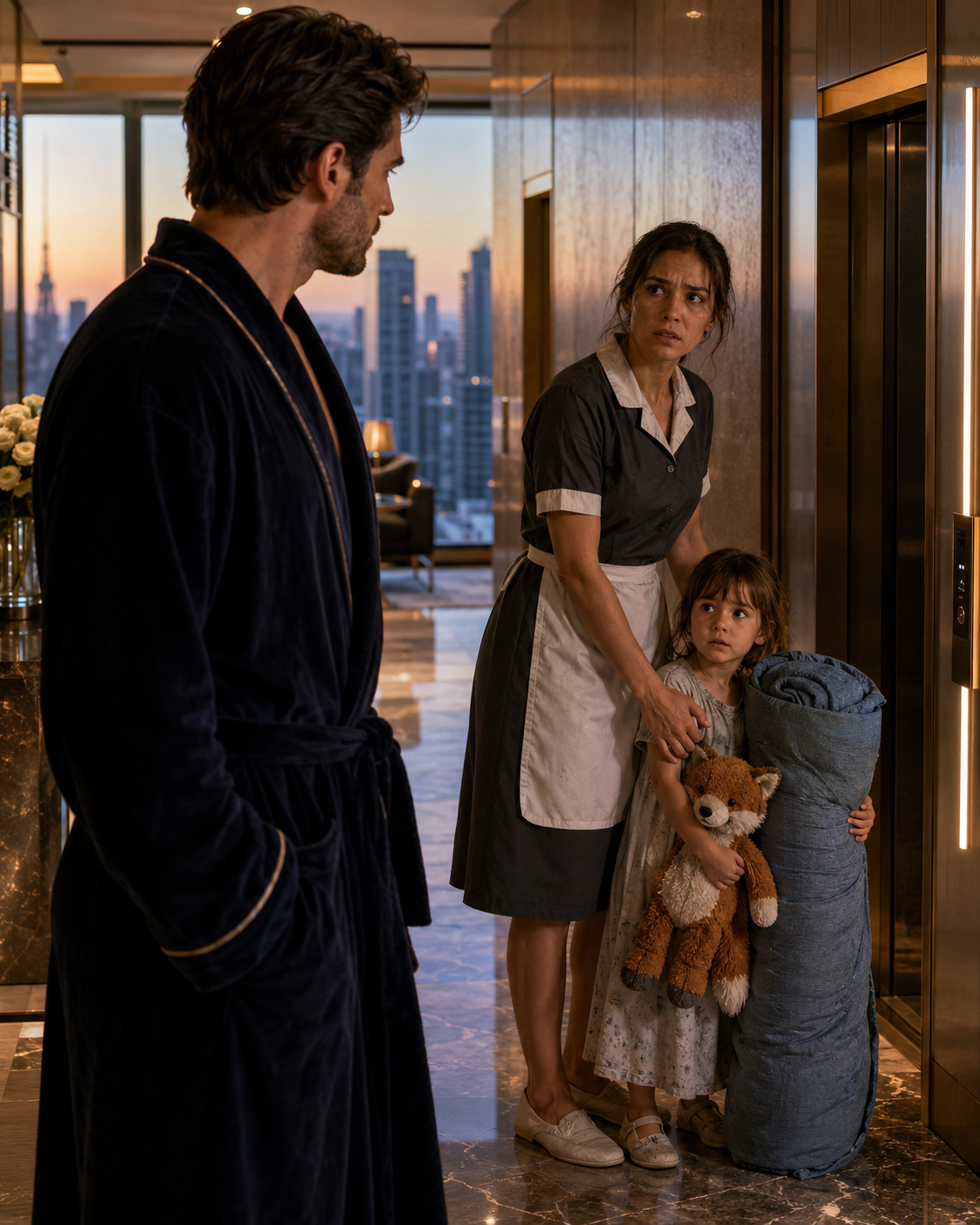
The private elevator carried him to the forty-third floor. The doors opened to the same quiet corridor where he had once seen a toddler dragging a mattress before dawn.
The carpet had been replaced.
The sconces still glowed warmly.
The paintings still hung at careful intervals.
To anyone else, it was just an expensive hallway.
To Julian, it was the place where truth had interrupted his life.
He walked to the service stairwell and opened the door.
The landing below was empty now.
No blanket.
No grocery bag.
No hidden mattress.
No one-eyed fox guarding a sleeping child.
Just concrete, railings, and humming lights.
But on the wall beside the utility cabinet, someone had taped a small drawing inside a plastic sleeve.
Julian stepped closer.
It was old, drawn in crayon on the back of a paper grocery bag.
A tall rectangle.
A tiny circle.
A purple worm.
At the bottom, in Mara’s handwriting, were the words:
Luna insisted this belongs here.
Beneath that, in purple crayon, Luna had added:
Stairs are for feet. People are for seeing.
Julian stood there for a long time.
He thought about his mother.
About Mara.
About Vivienne.
About every person who had ever been treated as invisible until their suffering became inconvenient.
He thought about how easy it was to succeed at everything and still miss the point of being alive.
Then he did something he had not done that first morning.
He sat down on the concrete step.
Not because he was tired.
Because he needed to remember the height from which Luna had seen the world when she dragged that mattress with both hands, believing she was only helping her mother, never knowing she was about to wake a man who had been asleep in a different way for years.
Julian Vale still had the penthouse.
The company.
The lake view.
The kind of wealth that opened doors before he reached them.
But now, on his refrigerator, among schedules and invitations and photographs, there was a picture from Luna’s birthday picnic. In it, Mara was laughing, Luna was holding Button upside down, Nora was wearing a paper crown against her will, and Julian was smiling like a man who had finally found the room in his life where his heart was supposed to live.
He had once believed power meant building something so high no one could touch you.
He knew better now.
Power was bending down when a child dragged a mattress through a hallway and asking where she was going.
Power was refusing to let rules become weapons.
Power was seeing someone clearly, then changing what you could so they did not have to be brave every minute just to survive.
And sometimes, if you were lucky, grace arrived in light-up sneakers, carrying more than she should, leading you down one flight of stairs to a truth you had been too comfortable to notice.
That was the morning Julian Vale lost the life he thought he wanted.
It was also the morning he began becoming the man his mother had raised him to be.