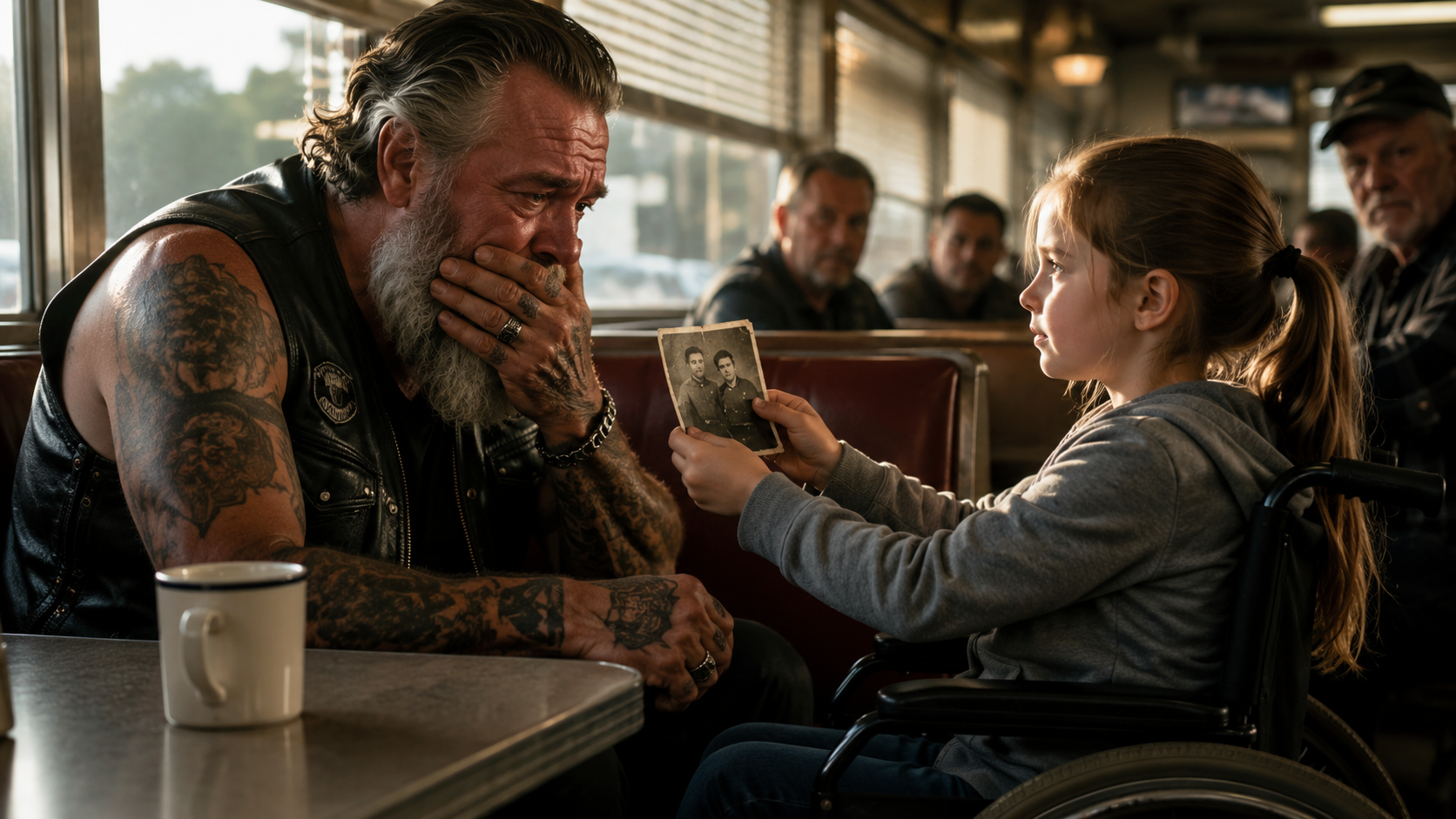
Noelle nodded once.
“It’s okay.”
“No,” Iron said quietly. “It isn’t.”
He looked back at the letter.
His lips moved, but no sound came out for several lines.
Then he read again.
“Her name is Noelle. She is my daughter. She is brave, bossy when she is hungry, terrible at hiding when she is scared, and she likes pancakes with strawberries. She pretends she doesn’t care when people stare at her chair, but she does. Please don’t let her pretend with you.”
Noelle looked away quickly.
The diner blurred.
Her mother had written that during one of the bad nights.
One of the nights when the machines beeped too slowly and the nurses spoke too softly.
Iron kept reading.
“I know I have no right to ask you for anything. I know I am arriving in your life as a ghost and leaving you with a child who deserves more than grief. But if there is any part of you that ever loved the baby you thought you buried, please look at my daughter and know this: she is your blood too.”
Iron stopped again.
His eyes lifted to Noelle.
For the first time, she saw tears in them.
Not falling.
Just waiting.
“My mother died last Thursday,” Noelle said.
The words were small, but they landed hard.
Iron looked like someone had struck him.
The old woman behind Noelle stepped forward.
“She fought a long time,” she said softly. “Heart failure. It got worse this year. She wanted to come herself, Mr. Vale. She tried. But by the end…”
Her voice broke.
“I promised her I would bring Noelle.”
Iron looked at the woman.
“Who are you?”
“Ruth Bell. I lived across the hall from Lily for eleven years.”
“You knew about me?”
Ruth’s face tightened with guilt.
“Not at first. Lily didn’t know the truth herself until near the end. When she found the files, she started searching. Your old address was gone. Your club had moved. People told her not to look for you. They said you were dangerous.”
A bitter smile crossed Iron’s face.
“They weren’t wrong.”
Noelle spoke before Ruth could.
“My mom said dangerous people aren’t always bad people.”
Iron looked at her.
Noelle held his gaze.
“She said sometimes they’re only dangerous because they had to survive something.”
The old biker’s face turned away.
For a moment, he stared out the window at his motorcycle parked near the curb. Black paint. Chrome pipes. A machine built for leaving.
He had spent his life leaving.
Leaving towns.
Leaving fights.
Leaving women before they could ask why he never stayed.
Leaving birthdays, weddings, funerals, anything that smelled like family.
Because family was a room in a hospital.
Family was Mara screaming.
Family was a white coffin so small he could carry it under one arm.
Family was something life had taken from him before he had learned how to hold it properly.
And now family was sitting beside his booth with silver tape on her wheelchair and his daughter’s eyes.
Iron looked back down at the letter.
The last page was folded around something small.
He opened it.
A hospital bracelet fell into his palm.
The plastic had yellowed with age.
The printed name was nearly faded, but still readable.
Baby Girl Vale.
Iron made a sound then.
It was not a sob.
Not exactly.
It was the sound of a man being crushed by proof.
Sheriff Mercer took one step closer.
“Iron.”
The old biker did not look at him.
“You knew?” Iron asked.
Mercer’s face paled.
The diner went even quieter.
“I was twenty-three,” the sheriff said. “A deputy. I didn’t know everything.”
Iron turned his head slowly.
“But you knew something.”
Mercer swallowed.
“There were rumors.”
Iron rose from the booth.
Every person in the diner stiffened.
He was still a big man, even at sixty-two. Broad shoulders. Heavy boots. Leather vest over a dark shirt. Gray hair pulled back at the nape of his neck. When he stood, the room seemed smaller.
Noelle’s hands tightened on her wheels.
Iron noticed.
He sat back down.
Not because he was weak.
Because the child had looked nervous.
That was the second thing that changed the diner forever.
The most feared man in town sat down because a little girl needed him to.
“What rumors?” Iron asked.
Mercer took off his hat.
It made him look older.
“There was a nurse at County General. Ellen Price. She disappeared two days after the funeral. People said she had gambling debts. People said she’d been paid.”
Iron’s eyes darkened.
“By who?”
Mercer hesitated.
Noelle felt Ruth’s hand settle on her shoulder.
“By your mother-in-law,” Mercer said.
Iron went still.
The name did not need to be spoken.
But he spoke it anyway.
“Vivian.”
Maggie whispered, “Oh God.”
Everyone in Millstone knew the old story.
Iron’s wife, Mara, had come from money. Not fortune-level money, but enough to make her family believe they were better than men who wore leather and fixed motorcycles. Her mother, Vivian Cross, had hated Iron from the beginning.