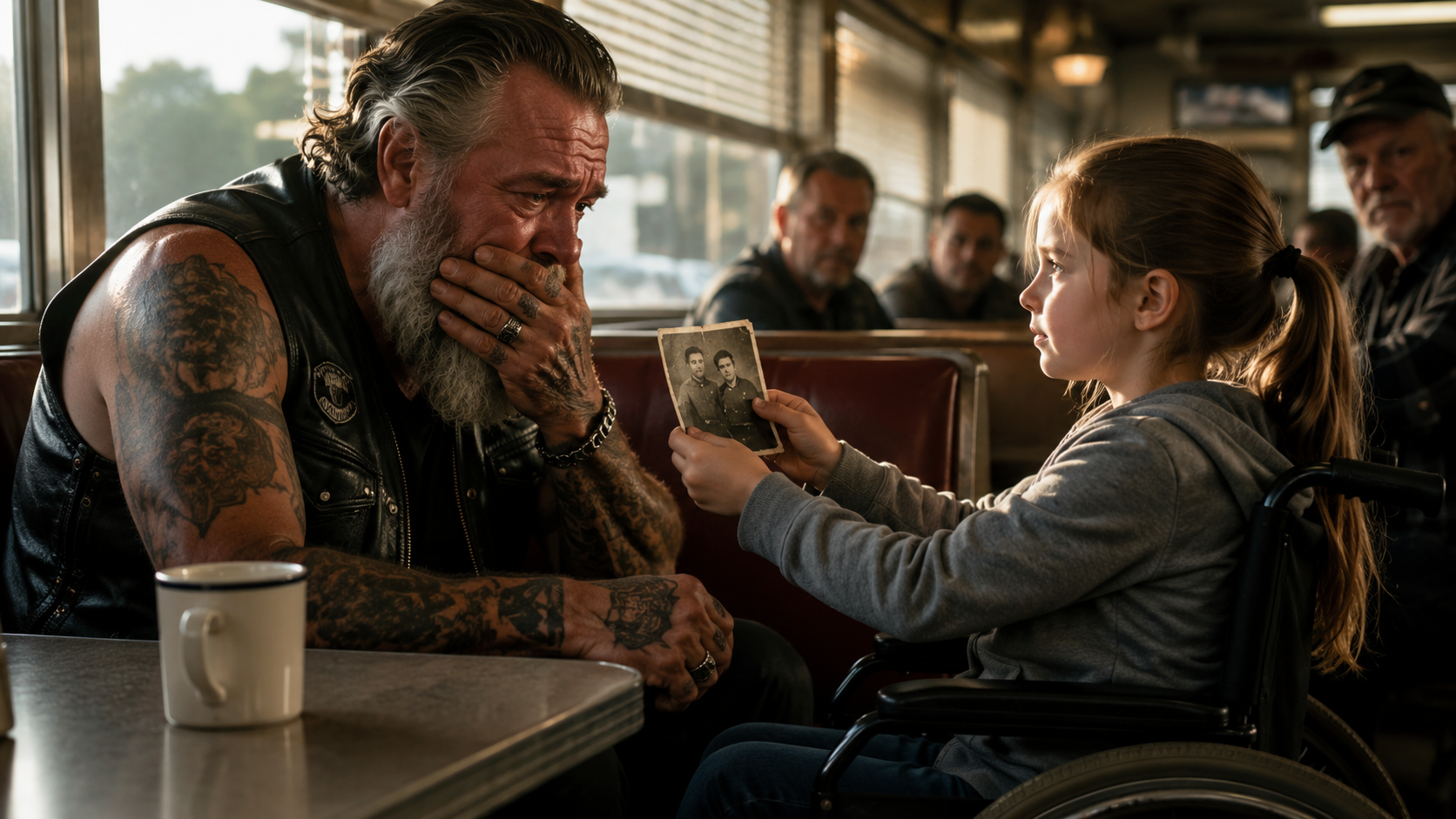
She hated his club.
His tattoos.
His lack of manners.
His last name.
Most of all, she hated that Mara loved him anyway.
When Mara died seven years after the baby, people said grief had killed her.
Iron knew better.
It was not grief alone.
It was the way grief had been sharpened by Vivian’s voice.
You should never have married him.
You should have listened.
That child was doomed the moment she had his blood.
Iron had thrown Vivian out of the house the night after Mara’s funeral.
He had not seen her since.
He had assumed she died alone somewhere, surrounded by furniture too expensive to love her back.
“She’s alive,” Noelle said.
Iron looked at her.
“My mom found her.”
The diner seemed to tilt.
“She lives in a private care home outside Tulsa,” Ruth added. “Lily went to see her before she got too sick. Vivian admitted some of it, but not all. She said she ‘saved’ Lily from being raised around bikers.”
Iron’s face drained of color.
Noelle pulled another item from her backpack.
A small digital recorder.
“My mom recorded her.”
Ruth’s hand tightened.
“Noelle, honey, maybe not here.”
But Noelle had carried too much too far to stop now.
She placed the recorder on the table.
“My mom said truth shouldn’t have to whisper.”
Iron stared at the device.
Then he pressed play.
At first there was static.
Then a weak old woman’s voice filled the diner.
“You have his eyes. I always hated that.”
A younger woman answered.
Lily.
Iron’s daughter.
His living, breathing, grown daughter, whose voice he had never heard until after her death.
“Did he know?”
The old voice laughed softly.
“He knew what he needed to know.”
“Did my father know I was alive?”
A pause.
Then Vivian said, “Your father was a violent man.”
“That isn’t an answer.”
“He would have ruined you.”
“That isn’t an answer either.”
Another pause.
Then the old woman snapped, “No. He did not know.”
Iron closed his eyes.
The recording continued.
Lily’s voice shook.
“You let him bury an empty coffin.”
“I gave you a better life.”
“You gave me a lie.”
“I gave you safety.”
“You stole my father.”
Vivian’s reply came cold and thin.
“I stole you from his world before his world could destroy you.”
The recorder clicked off.
Nobody moved.
Nobody breathed loudly.
Even the grill seemed to hiss more quietly.
Iron stared at the recorder.
Then at the photograph.
Then at Noelle.
“She sounded like Mara,” he whispered.
Noelle nodded.
“People said that.”
Iron’s mouth tightened with pain.
“I never heard her voice.”
“I know.”
“I never saw her take a step.”
“I know.”
“I never taught her to ride.”
“I know.”
His face folded for half a second before he pulled it back together.
“I never got to tell her I wanted her.”
Noelle’s eyes filled then.
Because that was the sentence her mother had needed more than medicine.
More than answers.
More than revenge.
She had needed to know she had been wanted.
Noelle reached into her backpack one last time.
She pulled out a second photograph.
This one was newer.
It showed Lily in a hospital bed, thin and tired, but smiling. Noelle sat beside her, pressed close, holding up a hand-drawn sign.
We found you, Grandpa.
Iron stared.
The first tear finally fell.
It moved slowly down the scar on his cheek.
No one pretended not to see it.
No one dared comment.
Noelle pushed the photo closer.
“She made me take that before she died. She said if I got scared, I should show you.”
Iron’s voice broke.
“Why would you be scared?”
Noelle glanced around the diner.
At the bikers’ photos on the wall.
At Iron’s skull ring.
At his scarred hands.
At the people watching like they expected him to explode.
“Because everybody said you were a monster.”
Iron gave a short, humorless laugh.
“They weren’t always wrong about that either.”
Noelle studied him.
Then she shook her head.
“My mom said monsters don’t keep grief for twenty-eight years. They throw it away.”
That did it.
Iron covered his face with both hands.
His shoulders shook once.
Only once.
But once was enough.
Maggie began to cry behind the counter.
Sheriff Mercer looked down at his boots.
Ruth wiped her eyes with a tissue.
And Noelle waited.
She had learned in hospitals that adults needed time when pain came back. Nurses needed time before giving bad news. Doctors needed time before saying there was nothing more to do. Her mother needed time before admitting she was afraid.
So Noelle gave Iron time.
When he finally lowered his hands, his eyes were red.
He looked older.
And somehow less frightening.
“What happens to you now?” he asked.
Ruth answered carefully.
“Lily named you in her guardianship request. But Vivian’s attorney filed a competing claim two days ago. They’re saying Noelle has no living family fit to care for her.”