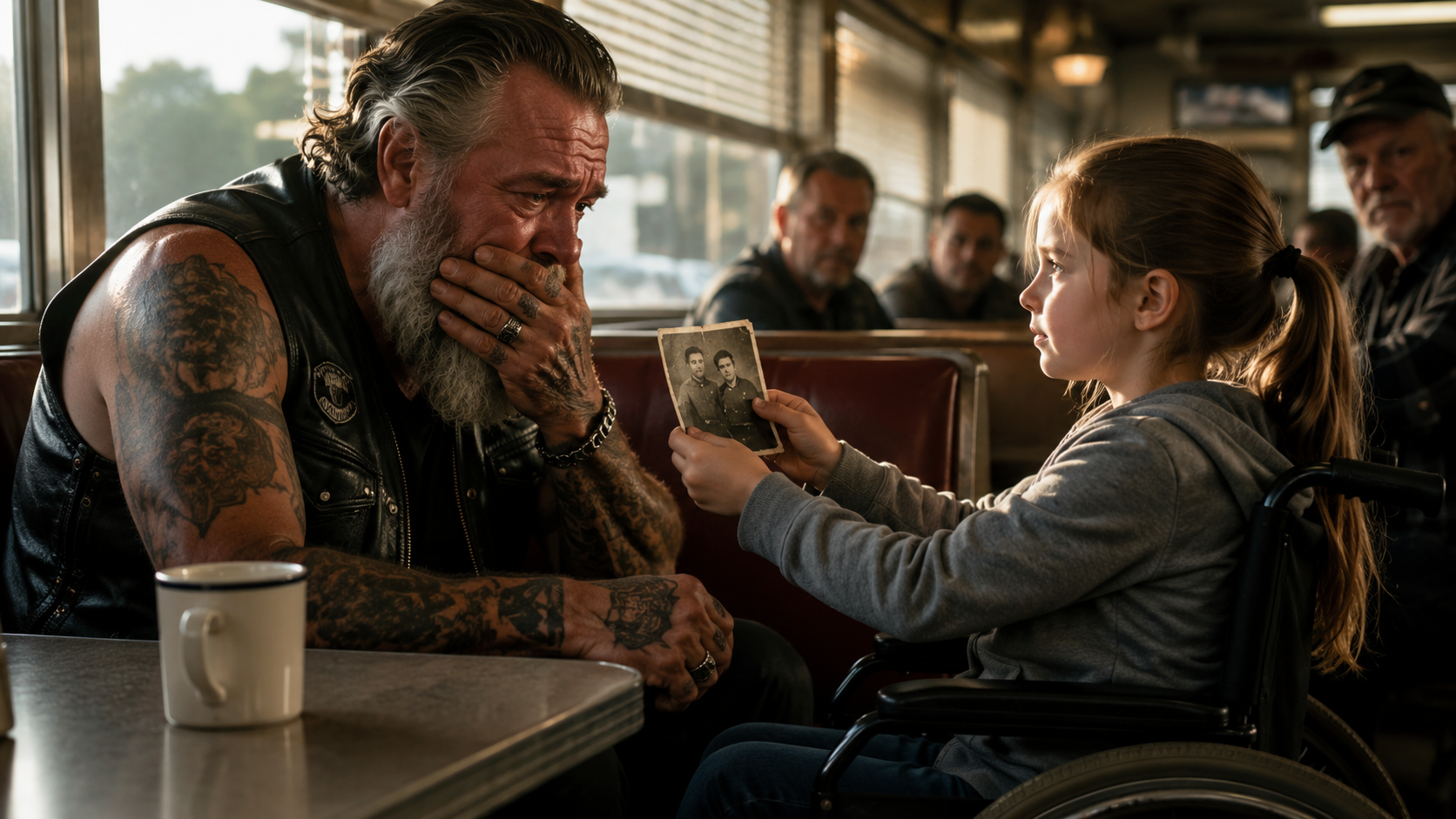
She had long brown hair, bright eyes, and a smile that looked like sunrise breaking through storm clouds. She was holding a baby wrapped in a yellow blanket. On the back of the photo, written in blue ink, were three words.
For my father.
Iron stopped breathing.
The coffee cup slipped from his hand.
It hit the table, tipped sideways, and spilled black coffee across the chrome edge. Maggie gasped. Someone stood up too fast and knocked a chair backward.
Iron did not move.
His eyes stayed locked on the photograph.
On the woman’s face.
On the baby blanket.
On the handwriting.
His dead wife’s handwriting had looked almost exactly like that.
But not quite.
This handwriting was younger.
Softer.
Alive.
Iron’s voice came out like gravel dragged across stone.
“Where did you get this?”
Noelle swallowed.
“My mother gave it to me.”
Iron’s eyes rose slowly to her face.
The diner disappeared.
The highway outside disappeared.
The years disappeared.
There was only the photograph and the child in front of him.
“What was your mother’s name?”
Noelle’s fingers curled around the edge of her blanket.
“Lily.”
A sound moved through the diner.
Not a gasp exactly.
Something worse.
The sound people make when a secret grave opens in the middle of the room.
Iron’s face changed.
Not much.
Just enough.
The hard mask cracked at the mouth first. Then around the eyes. Then somewhere deeper, in a place no one could see but everyone could feel.
“No,” he whispered.
Noelle looked down.
“She said you might say that.”
Iron’s hand moved toward the photo, then stopped an inch above it.
He looked almost afraid to touch it.
“Lily died,” he said.
The words were not spoken to Noelle.
They were spoken to the past.
To the hospital.
To the tiny coffin.
To the rain.
To twenty-eight years of pain.
“She died when she was three days old.”
Noelle shook her head.
“No, sir.”
The old woman behind her closed her eyes.
Noelle reached into her backpack again.
This time she pulled out an envelope.
It was cream-colored, soft from being held too many times. Across the front was written one name.
Harlan.
Iron stared at it.
His hands had not shaken in years.
They shook now.
Noelle held the envelope out.
“My mom told me to give you this if she couldn’t.”
Iron did not take it.
For a long second, he looked like a man standing at the edge of a bridge, unsure whether the thing below him was water or fire.
Then he reached out.
His fingers closed around the envelope.
The diner was silent enough to hear the old paper tear as he opened it.
Inside was a letter.
Iron unfolded it.
His eyes moved over the first line.
Then his shoulders dropped.
Not dramatically.
Not like in movies.
Just a small collapse, barely visible.
But everyone in that diner saw it.
And everyone understood.
Whatever was written on that paper had reached inside the most feared man in Millstone County and broken something open.
He read silently at first.
Then his mouth trembled.
Then he whispered the first words aloud.
“Daddy…”
Maggie covered her mouth.
Sheriff Mercer stood slowly.
Iron read on, his voice low and uneven.
“If you are reading this, then Noelle found you. That means I was either too sick to come myself, or I ran out of time before I could fix what was stolen from us.”
He stopped.
His eyes squeezed shut.
The letter rattled in his hands.
Noelle watched him carefully.
She had imagined this moment a hundred times during the bus ride to Millstone. Her mother had described him as tall, frightening, stubborn, and sad. She had said he might shout. He might deny everything. He might refuse to listen because grief can turn truth into an enemy.
But her mother had also said one more thing.
“If he looks at you like he already lost you,” Lily had whispered from the hospital bed, “don’t be afraid of him.”
Noelle was not afraid.
Not yet.
Iron forced himself to keep reading.
“I was told my whole life that you abandoned me. I was told you were cruel. I was told you gave me away because you didn’t want a child. I believed it because children believe what adults repeat often enough.”
His jaw tightened.
“But three months ago, I found the hospital file. Not the fake one. The real one. I found the nurse’s statement. I found the adoption papers that were never supposed to exist. I found out you were told I died.”
Iron’s fist came down on the table.
The silverware jumped.
Noelle flinched then.
Only a little.
Iron saw it immediately.
His anger vanished from his face as quickly as it had appeared.
“I’m sorry,” he said.
Those two words shocked the diner almost as much as the letter.
Iron Vale did not apologize.
Not to strangers.
Not to cops.
Not to God.
But he had just apologized to a little girl in a taped wheelchair.