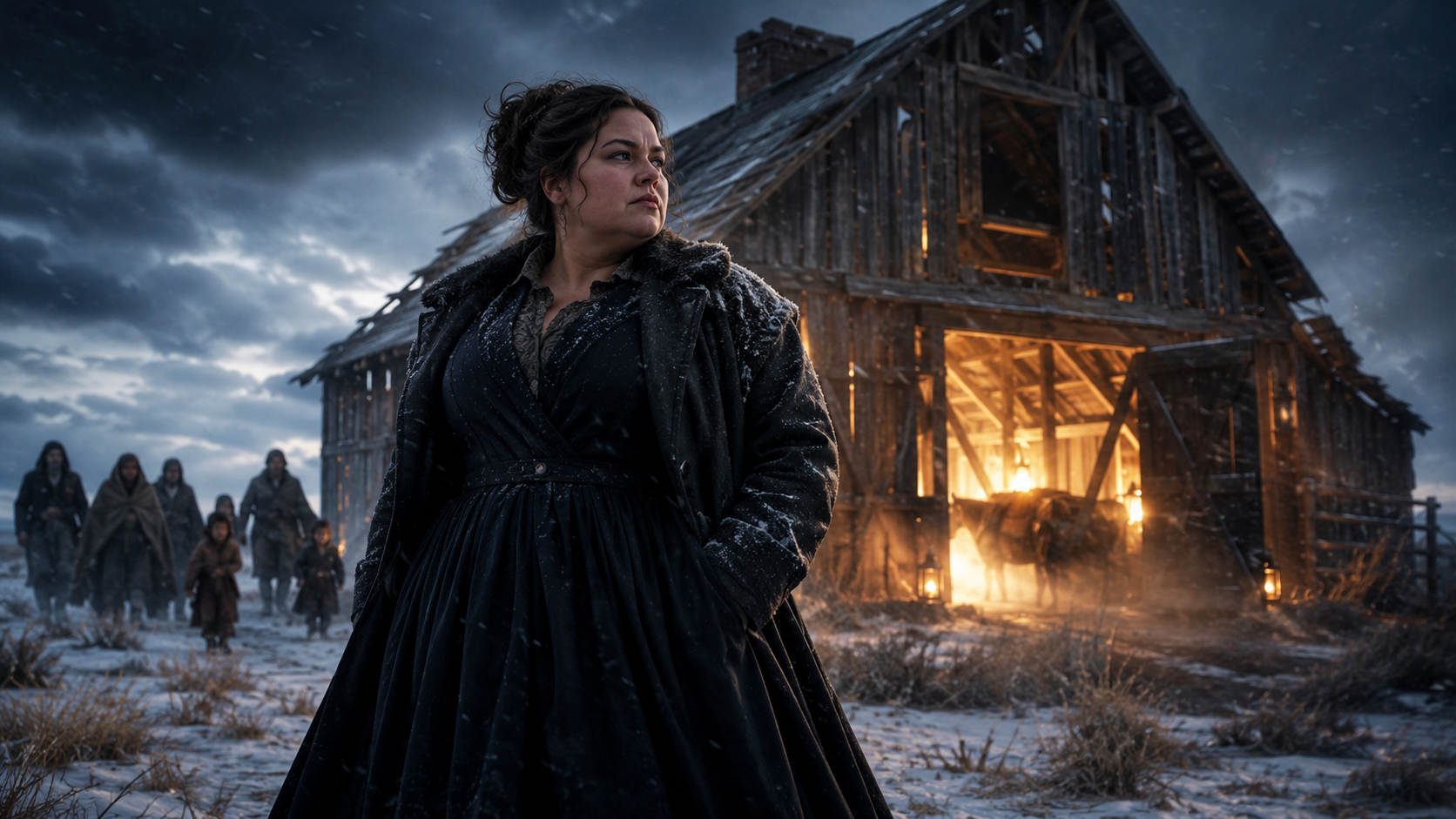
Marnie appeared from the alley, breathless, without gloves. “I told you not to come alone.”
“I am not alone,” Ada said.
Marnie glanced at Rowan and swallowed.
Rook crossed the street, moving with the leisure of a man who had never been forced to hurry for bread. Shaw followed at his shoulder.
“Miss Crowell,” Rook said. “My condolences. Your mother was a complicated woman.”
“She was a good one,” Ada said.
Rook’s smile thinned. “Goodness does not settle debt.”
“No. But fraud sometimes creates it.”
The word struck the street like a dropped pan.
Shaw stepped forward. “Grief can make the mind unstable. No one here wishes to shame you, child.”
“I am thirty-two years old,” Ada said. “Do not child me from behind a Bible you use as a ledger.”
A murmur moved through the gathered people.
Shaw’s face flushed.
Rook lifted a hand. “Let us not turn private family matters into spectacle.”
“Why not?” Ada asked. “You did.”
His eyes sharpened.
Ada reached into her coat and removed one of her mother’s notebooks. She had brought only one, and not the most dangerous. She was grieving, not foolish.
“My mother kept records,” she said.
Rook’s smile vanished for half a second.
Only half.
But Ada saw it.
Shaw saw it too.
Celestine whispered, “Ada, what is that?”
“The reason Mama died with debt,” Ada said. “The reason she left me the barn. The reason Mr. Rook wants me declared incompetent before anyone can ask what is under his paperwork.”
Rook’s voice dropped. “Careful.”
“No,” Ada said. “I have been careful all my life. It did not make cruel people kinder. It only made them comfortable.”
The first flakes began to fall.
Large ones.
Heavy.
A bell rang from the church tower, though no one had pulled the rope. The wind had caught it. Once. Twice. Then again.
From the west road, a boy came running, slipping in the snow.
“Storm took the mill bridge!” he shouted. “Mercer’s row is flooding with ice water! The poor houses are losing roofs!”
The street broke into movement.
Rook cursed under his breath.
Shaw lifted both hands. “Everyone remain calm. The church basement can take perhaps twenty—”
“No,” said a woman from the crowd. “It cannot. The stove is broken.”
“The hotel?” someone asked.
“The hotel wants payment,” another answered.
Ada looked at the sky.
Then at the people.
Then at Rook.
And she understood her mother at last.
The barn was not only proof.
It was shelter.
It was warmth.
It was the town’s salvation, hidden beneath the one place everyone had been taught to despise.
Ada climbed onto the wagon seat.
“My barn has heat,” she called. “Food. Blankets. Water. Bring the children first. Bring the old. Bring anyone who cannot survive the night.”
Rook shouted, “That structure is unsafe!”
Ada looked down at him. “Then stay out of it.”
A laugh rose from somewhere in the crowd, startled and bright.
Rowan swung up beside her. “You realize this will bring everyone to your door.”
Ada took the reins.
“Yes,” she said. “That is the point.”
By nightfall, the north barn was no longer a ruin.
It was a beating heart.
Lanterns hung from beams. Horses steamed in the stalls. Children slept in rows of blankets. Women stirred soup over iron pots. Men patched cracks in the walls while snow screamed across the fields. The trapdoor remained open, and warm air rose from below like a blessing too stubborn to die.
Ada stood at the entrance, counting heads.
Forty-three.
Then fifty-one.
Then sixty.
She stopped counting after that.
Marnie arrived with three frightened children whose mother had collapsed from cold. Celestine arrived an hour later, hair undone, carrying medicine from the main house and shame she had not yet learned how to hold.
“I was wrong,” Celestine said.
Ada looked at her sister. “Yes.”
Celestine flinched.
Ada handed her a kettle. “Boil water.”
That was all.
Forgiveness could wait. Work could not.
Near midnight, Rowan found Ada beneath the loft, reading by lantern while the storm battered the roof.
“You should rest,” he said.
“I have been told that by people who wanted me quiet.”
“I am not one of them.”
Ada looked up.
No, she thought. He was not.
Before she could answer, hoofbeats thundered outside.
The barn fell silent.
Rowan moved toward the door. Ada stopped him with one hand.
“No,” she said. “Let them see who owns it.”
She opened the barn doors herself.
Silas Rook stood outside with four armed men, Reverend Shaw, and a county clerk half frozen in a borrowed coat.
Rook held up a paper.
“By emergency petition and witness statement,” he said, “the north parcel is to be placed under temporary administrative control pending review of Ada Crowell’s competency.”
Ada stared at the paper.
Then she laughed.
It surprised everyone, including her.
Rook’s mouth tightened. “You find the law amusing?”